As the blockchain industry shifts from single assets to application ecosystems, RPC node services have become a key component of Web3 infrastructure. Whether you're querying wallet balances, calling smart contracts, reading NFT data, or broadcasting on-chain transactions, all these actions fundamentally depend on the communication between applications and blockchain nodes.
In the current Web3 infrastructure landscape, Alchemy and QuickNode are two of the most prominent RPC platforms. Both offer developers multichain node access and API services, but they differ significantly in product direction and ecosystem strategy. Alchemy emphasizes development tools, enhanced data APIs, and account abstraction ecosystem, while QuickNode focuses more on node performance, global deployment, and a plugin extension ecosystem.
Alchemy vs QuickNode: A Quick Overview
Alchemy is a blockchain infrastructure platform designed for Web3 developers, offering RPC nodes, on-chain data APIs, smart wallets, and account abstraction tools. Its product suite covers NFT API, Transfers API, Webhooks, Account Kit, and Gas Sponsorship, earning it the reputation of being the "AWS of Web3."
QuickNode, by contrast, primarily provides developers with multichain node access and high-performance RPC services.
Compared to Alchemy, QuickNode places greater emphasis on node performance, global deployment, and a modular plugin ecosystem. Its Marketplace plugin system allows developers to extend node capabilities based on their needs, such as NFT data analysis, wallet monitoring, or Solana enhancement tools.
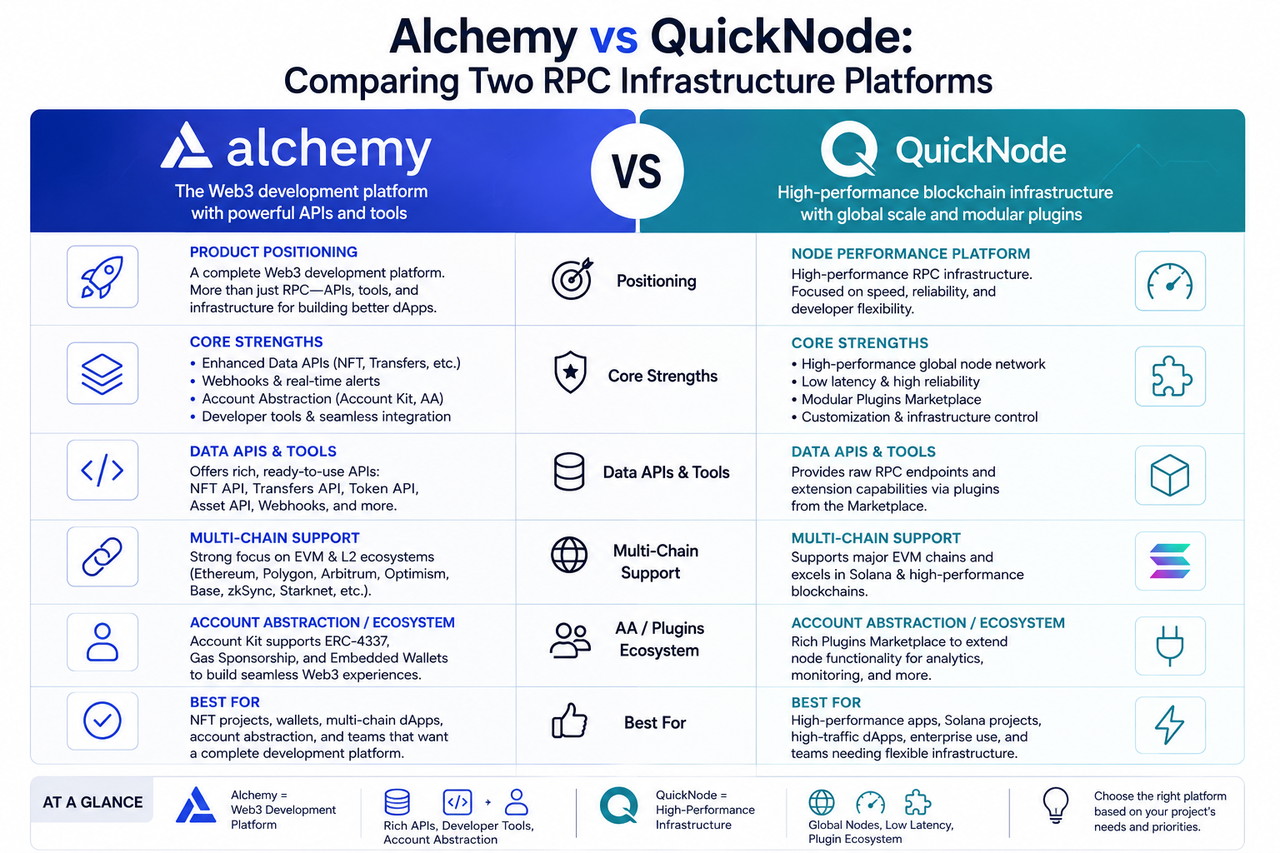
How Does the Core Positioning of Alchemy and QuickNode Differ?
Although both operate in the Web3 RPC service space, their product logic is clearly distinct.
Alchemy leans toward being a "development platform," focusing on enhanced data APIs, account abstraction, and a robust developer tool ecosystem. Beyond basic RPC services, it offers NFT data indexing, real-time Webhooks, smart wallets, and AA (account abstraction) tools, making it ideal for NFT platforms, wallets, and multichain DApps.
QuickNode, in contrast, positions itself as a "high-performance node platform." Its focus is on global node deployment, low-latency access, and plugin extensibility, making it better suited for high-frequency trading, enterprise-level node deployment, and Solana use cases.
This fundamental difference means each platform serves distinct types of Web3 applications.
What Are the Differences in Node Architecture Between Alchemy and QuickNode?
Both Alchemy and QuickNode use a distributed node architecture, but their optimization priorities diverge.
Alchemy emphasizes a data processing and API enhancement layer. Its system caches and indexes on-chain data, enabling structured features like NFT API, Transfers API, and real-time notifications. Developers can quickly retrieve available results without dealing with raw on-chain complexity.
QuickNode, on the other hand, prioritizes node performance and global deployment. It focuses on reducing request latency, improving node stability, and supporting extensive custom extensions. This approach suits applications with strict requirements for response speed and concurrency.
One of Alchemy's key advantages is its enhanced data APIs.
These APIs go beyond raw RPC requests to offer advanced features such as NFT queries, token transfer history, wallet asset aggregation, and real-time event notifications. This structure reduces the need for backend development and data indexing.
For example, NFT platforms typically need to fetch NFT images, collection metadata, and holder addresses, but traditional RPC nodes don't return such structured data. Alchemy pre-processes this information, providing data interfaces better tailored to Web3 applications.
QuickNode's strength lies in its plugin ecosystem. Developers can install plugins based on their business needs—such as on-chain analysis, wallet monitoring, or Solana extension tools. This model offers greater flexibility and suits projects requiring customized functionality.
Multichain Support: Alchemy vs QuickNode
Both Alchemy and QuickNode support major EVM networks including Ethereum, Polygon, Arbitrum, Optimism, and Base, but their focus areas differ slightly.
Alchemy is more invested in Layer2 and account abstraction ecosystems, dedicating significant resources to Base, zkSync, Starknet, and smart accounts.
QuickNode is more active in Solana and high-performance chain support, with several of its products and plugin systems built around Solana development.
As multichain ecosystems become the Web3 mainstream, competition among infrastructure platforms has expanded from basic RPC services to cross-chain development capabilities.
Account Kit vs Plugin Ecosystem: What's the Difference?
Alchemy is currently doubling down on the account abstraction (AA) ecosystem.
Its Account Kit supports ERC-4337, Gas Sponsorship, and Embedded Wallet, enabling developers to build smart wallets without the need for seed phrases or Gas fee management. This approach addresses key Web3 user experience challenges.
QuickNode, by contrast, emphasizes a modular plugin system. Developers can select different extension modules based on project requirements to enhance node capabilities.
To summarize their product logic:
- Alchemy is more of a complete Web3 development platform.
- QuickNode is more of a high-performance node and modular service platform.
Alchemy vs QuickNode: How Should Web3 Projects Choose?
Different projects have different infrastructure requirements.
If your project revolves around NFTs, smart wallets, account abstraction, or multichain DApps, Alchemy's enhanced APIs and development tools are likely the better fit.
If your focus is on node performance, Solana development, high-concurrency requests, or enterprise-level deployment, QuickNode's global node infrastructure and plugin ecosystem may better serve your needs.
Neither platform is inherently superior—they are optimized for different use cases.
A significant number of Web3 applications currently rely on third-party RPC services, raising concerns about infrastructure centralization.
If a large number of DApps depend on the same platform, a service outage could disrupt many applications. This issue has sparked industry debate, particularly during peak traffic periods on the Ethereum network.
As a result, the Web3 industry is exploring decentralized RPC networks, modular data layers, and distributed infrastructure architectures to reduce reliance on any single provider.
Summary
Both Alchemy and QuickNode are major RPC service platforms in the Web3 infrastructure landscape, but they differ markedly in product direction and development philosophy.
Alchemy emphasizes enhanced APIs, account abstraction, and a developer tool ecosystem, positioning itself as a comprehensive Web3 development platform. QuickNode focuses on high-performance nodes, multichain support, and a plugin extension ecosystem, making it ideal for performance-driven and customizable scenarios.
FAQs
What is the difference between Alchemy and QuickNode?
Alchemy focuses on development tools, data APIs, and account abstraction, while QuickNode prioritizes high-performance nodes and a plugin extension ecosystem.
What is an RPC node?
An RPC node is a data interface that allows Web3 applications to access a blockchain network for reading on-chain data and sending transactions.
Which platform is better for NFT projects?
Alchemy offers strong support for NFT APIs and on-chain data indexing, making it a common choice for NFT platform development.
Why does QuickNode emphasize its plugin ecosystem?
QuickNode lets developers extend node capabilities through plugins, enabling them to meet diverse application needs.
Do both platforms support Solana?
Yes, both Alchemy and QuickNode support Solana, but QuickNode is particularly active in high-performance Solana node solutions.