Alltoscan is a Web3 infrastructure platform built around a multi-chain block explorer. Since December 2022, it has been offering cross-chain on-chain data query services. Its technical mission is to transform block, transaction, address, and contract metadata scattered across disparate chains into searchable, analyzable, standardized data—using a unified indexing layer and API gateway—in an environment where heterogeneous public chains and Layer2/Rollup solutions are evolving in parallel.
Block explorers are often called the "public ledger interface" of blockchain: users verify transfers, developers debug contracts, and analysts track capital flows—all relying on the node connections and indexing systems behind the explorer. Maintaining a separate explorer for each chain leads to ballooning data models, interface specs, and operational costs. Multi-chain explorers abstract away chain differences and reuse the indexing pipeline, lowering the barrier to ecosystem collaboration. This is the industry backdrop that shaped Alltoscan's technical architecture.
From an infrastructure evolution standpoint, the technical value of Alltoscan lies in covering both the data layer (multi-chain indexing, Rollup compatibility, domain name resolution) and the application layer (wallet connection, unified Gas settlement). The following sections walk through its core architecture, indexing implementation, query efficiency optimizations, open data ecosystem positioning, differences from traditional explorers, security and transparency mechanisms, track challenges, and future technical directions. This helps readers understand the complete journey of a multi-chain block explorer from raw on-chain data to a user-readable interface.
Alltoscan's Core Technical Architecture
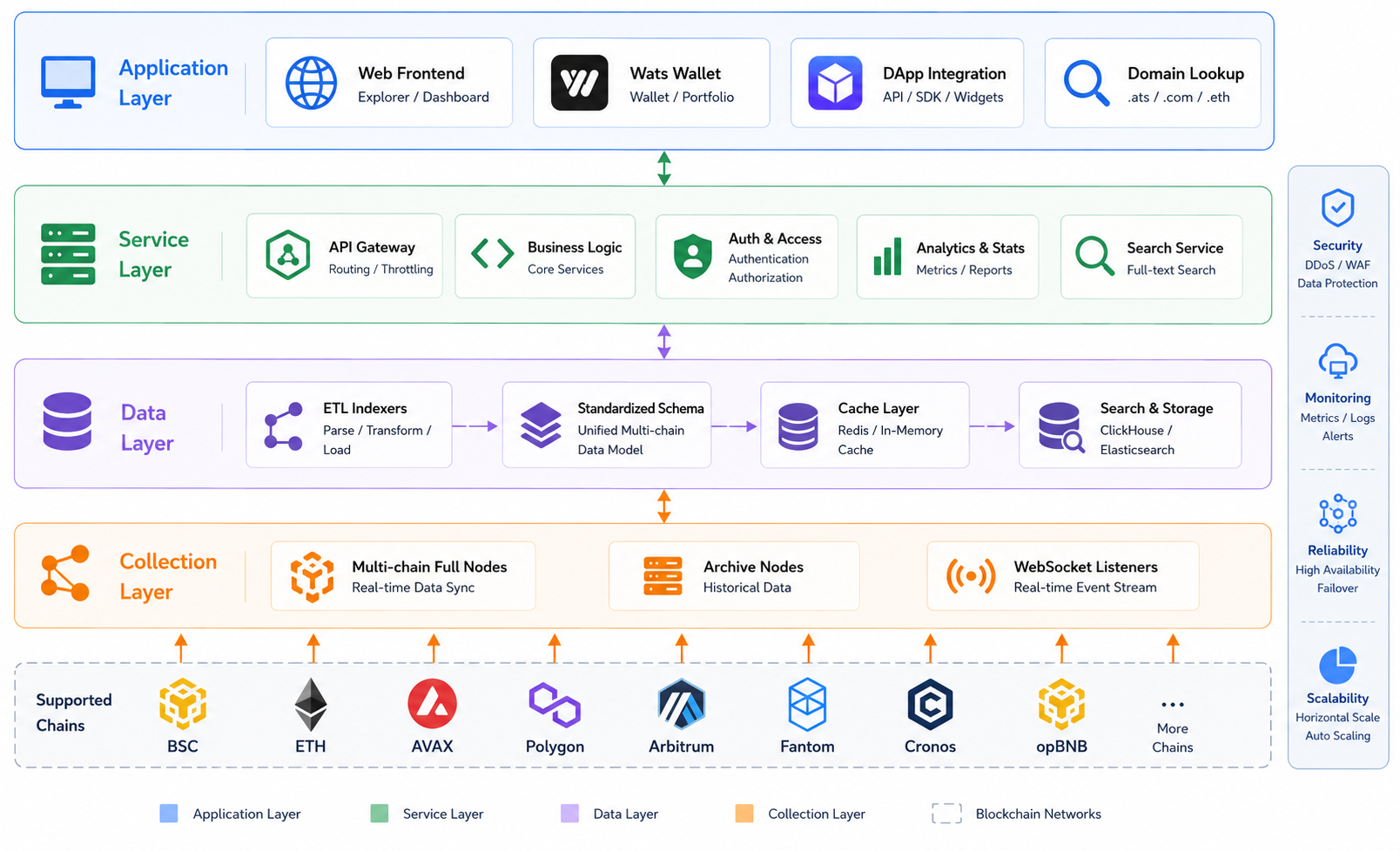
Alltoscan's technology stack can be summarized in four layers: data collection, indexing and storage, service and API, and application and interaction.
-
Data Collection Layer: Connects to full nodes or third-party node providers via JSON-RPC, WebSocket, etc., continuously pulling new blocks, transaction receipts, event logs, and contract bytecode. For EVM chains, it calls standard interfaces like eth_getBlockByNumber and eth_getTransactionReceipt; for non-EVM chains (e.g., when integrating Solana SNS), it adapts to the chain's native RPC and account model.
-
Indexing and Storage Layer: After ETL (Extract-Transform-Load) cleaning, raw on-chain data is written into relational or document databases, with index fields built for addresses, Transaction Hashes, block heights, etc. This layer handles engineering challenges such as chain reorganizations (Reorg), backfilling missing blocks, and parsing internal transactions.
-
Service and API Layer: Exposes REST/JSON-RPC interfaces. The official API endpoints return token metadata (e.g., ATS symbol, contractAddress, holdersCount, TotalSupply), demonstrating Alltoscan's ability to encapsulate on-chain state into structured API responses.
-
Application and Interaction Layer: Encompasses the multi-chain explorer frontend, the planned open-source explorer codebase, the Wats Wallet Non-Custodial Wallet, and Web3 domain name search. Users perform queries, tracking, and on-chain operations here rather than interacting directly with raw RPC.
Alltoscan also emphasizes deploying nodes in globally distributed, independent data centers to serve dApps and analysts with low latency and high throughput—a significant engineering investment compared to small single-chain explorers.
How the Multi-Chain Data Indexing System Works
The essence of multi-chain indexing is mapping heterogeneous chain data onto a unified data model. The industry-standard process closely mirrors Alltoscan's stated approach:
Phase One: Extract
- Regular Worker: Monitors the latest block height and indexes in real time.
- Catchup Worker: When the index falls behind, batch-backfills blocks retroactively.
- Rescanner / Manual Worker: Rescans failed batches or contract upgrade scenarios.
Phase Two: Transform
- Standardizes transaction structure: from / to / value / gas / status / timestamp.
- Parses ERC-20/ERC-721 transfer events to generate token holdings and transfer records.
- For rollups: additionally indexes L1 batch submissions, L2 state roots, Sequencer info, etc., allowing users to "drill through" L2 transaction details—this is the technical meaning behind Alltoscan's claim of full Rollup compatibility.
Phase Three: Load
- Hot data goes to caches like Redis (block headers, hot address balances).
- Cold data archives to PostgreSQL/MongoDB or columnar storage for historical queries.
- Optional message queues (Kafka, NATS, etc.) decouple fetching from writing to prevent data loss from node instability.
Alltoscan's Publicly Supported Chains (Partial)
| Type |
Network Examples |
| EVM Mainnet/L1 |
BNB Chain, Ethereum, Avalanche, Fantom, Cronos |
| L2 / Scaling |
Polygon, Arbitrum, opBNB |
| Ecosystem Expansion |
Solana SNS (domains), BNB Greenfield (storage testnet collaboration) |
Partnerships with nearly 40 ecosystem players give the indexer early access to new chain RPC specs, testnet data, and brand traffic, shortening the "new chain launch → queryable" cycle.
How Alltoscan Boosts On-Chain Data Query Efficiency
On-chain query efficiency hinges on four factors: node response speed, indexing depth, caching strategy, and frontend rendering. Alltoscan's optimization approaches include:
-
Distributed Nodes and Regional Acceleration: Node clusters across global data centers reduce physical distance to RPC sources, cutting query RTT (Round-Trip Time). This is critical for high-frequency interfaces like latest blocks, Gas Price, and hot contracts.
-
Precomputation and Materialized Views: Aggregates metrics such as address labels, large investor rankings, and 24h Volume on a schedule, avoiding full-table scans of on-chain history for each query. The "chain health" indicator on the homepage relies on such offline computations.
-
Multi-Level Caching:
- L1: CDN-cached static resources (JS/CSS/icons).
- L2: Redis caches hot addresses and recent blocks.
- L3: In-app pagination and lazy loading—transaction lists are fetched page by page to keep payloads small.
-
Search and Domain Name Resolution: Integrates Web3 domain solutions like Unstoppable Domains, letting users search by human-readable names. This reduces errors from copying 42-character hex hashes and increases the proportion of effective queries.
-
API Standardization: A unified multi-chain API means third-party dApps, risk control platforms, and tax tools need only one authentication and field spec to pull data across chains—lowering developer integration costs. This is also the technical pivot for Alltoscan's evolution from a "consumption tool" to "infrastructure."
Web3 Infrastructure and Open Data Ecosystem
Web3 infrastructure goes beyond public chains to include reusable off-chain services: block explorers, indexing APIs, oracles, storage networks, and wallet middleware. Alltoscan positions itself as an "open data hub":
Three Layers of Open Data
- Readable: Anyone can query transactions and contracts without permission.
- Programmable: Developers embed on-chain data into apps via APIs.
- Auditable: Open-source explorer code and verifiable indexing logic reduce "black box operator" risk.
Alltoscan's planned open-source multi-chain block explorer aims to complete the third layer: the community can review indexing rules, submit PRs to fix chain adaptation bugs, and projects can fork and deploy private instances for their own ecosystems.
Integrations with BNB Greenfield testnet, opBNB, and SNS embody an "data + storage + identity" infrastructure combo: the explorer ensures transaction transparency, the storage network hosts large files, domain services improve address usability, and the wallet (Wats Wallet) handles the last mile of user access.
The ATS token serves as unified Gas and a burn mechanism, coupling infrastructure usage frequency with the economic model—technology delivers usability, the token provides sustainable incentives, and together they support the open ecosystem's cold start and long-term maintenance.
Alltoscan vs. Traditional Block Explorers
| Dimension |
Traditional Model (Etherscan Series) |
Open-Source Deployable (Blockscout) |
Alltoscan |
| Product Form |
Independent sites per chain (BscScan, Arbiscan, etc.) |
Chains can self-host open-source instances |
Unified multi-chain entry + built-in wallet |
| Data Model |
Deeply optimized single-chain EVM |
Modular workers, 100+ EVM chains |
Multi-chain aggregation + Rollup scrutiny |
| Business Model |
Ads, API subscriptions |
Hosting/sponsorship |
ATS fees + burn |
| Open Source Level |
Core closed-source |
Emphasizes open source |
Plans open-source explorer |
| User Path |
Query-focused; needs external wallet for transactions |
Varies by deployer |
Integrated query + Wats Wallet |
| Cross-Chain Experience |
Multi-chain entries like Blockscan still emerging |
Multichain Service in development |
Native multi-chain + unified ATS Gas |
Alltoscan's Technical Differentiators:
- Emphasizes a unified cross-chain UI and API rather than a multi-domain switch under a federated model.
- Emphasizes fine-grained L2/Rollup transparency and domain-friendly interaction.
- Emphasizes a closed consumer loop (wallet, Swap planning) rather than a purely read-only index.
Relative Weaknesses: Brand legacy, contract verification toolchain maturity, and developer documentation breadth still lag behind leaders like Etherscan. It must build long-term credibility through data accuracy and API stability.
Data Security and On-Chain Transparency
On-chain transparency is guaranteed by the blockchain protocol itself: once confirmed, a transaction is publicly verifiable. The explorer's job is to faithfully present—not tamper with—data. Alltoscan's relevant mechanisms include:
-
Trustworthy Data Sources: Indexing results should be cross-verifiable with user-run nodes. The open-source plan helps the community spot indexing bias or omissions.
-
Wallet Security Architecture (Wats Wallet):
- Private Keys are generated and encrypted stored locally (AES256). The non-custodial model prevents platform asset appropriation.
- End-to-end encryption reduces the risk of "express transactions" that hand private keys to unencrypted servers.
- NFC physical cards and biometrics add device-level protection.
-
Application Layer Security:
- Key Vault and secure login reduce credential leakage risk.
- API side requires DDoS protection, anti-crawling measures, and SQL injection prevention—industry standards include rate limiting, JWT authentication, and input validation.
-
Transparent Operations: The multi-chain explorer displays block height, timestamp, and miner/verifier information, allowing independent transaction status verification. For advanced features like contract verification and internal transaction parsing, transparency depends on whether the indexer fully captures trace data.
The explorer shows an indexed copy. If indexing is delayed or erroneous, the interface may temporarily diverge from the actual on-chain state. Major capital operations should rely on direct wallet node connections or block hash receipts.
Challenges in the Multi-Chain Explorer Track
-
High Heterogeneous Chain Adaptation Cost: EVM, Solana, and Move-based chains have vastly different account models and RPCs. Each new chain demands an independent worker and test matrix, driving up labor and node expenses.
-
L2 and Rollup Complexity: Designs like fraud proofs, ZK proofs, and Sequencer centralization make "finality" and "reversibility" behave differently across L2s. The indexer must track L1 batches and L2 state synchronously—significantly harder than for L1.
-
Chain Reorganization and Data Consistency: Reorgs can roll back indexed transactions, requiring a rewind mechanism. If not handled promptly, it can trigger a user trust crisis.
-
Performance vs. Cost Trade-Off: Full historical archiving consumes massive storage. Hot/cold separation, sharding, and compression are essential; otherwise, API costs erode the business model.
-
Competition and Commercialization: Etherscan, OKLink, Blockscout, and Chainbase have already built moats in data quality, developer ecosystem, and B2B clients. New entrants need differentiated scenarios (e.g., unified Gas, vertical chain depth, open-source hosting).
-
Compliance and Privacy: Address labels, sanctions list integration, and EU data regulations impose compliance engineering demands on globally operating multi-chain explorers.
As a relatively new multi-chain solution, Alltoscan must continuously invest in data accuracy, API documentation, and open-source progress to turn its architectural advantages into market advantages.
Alltoscan's Future Technical Directions
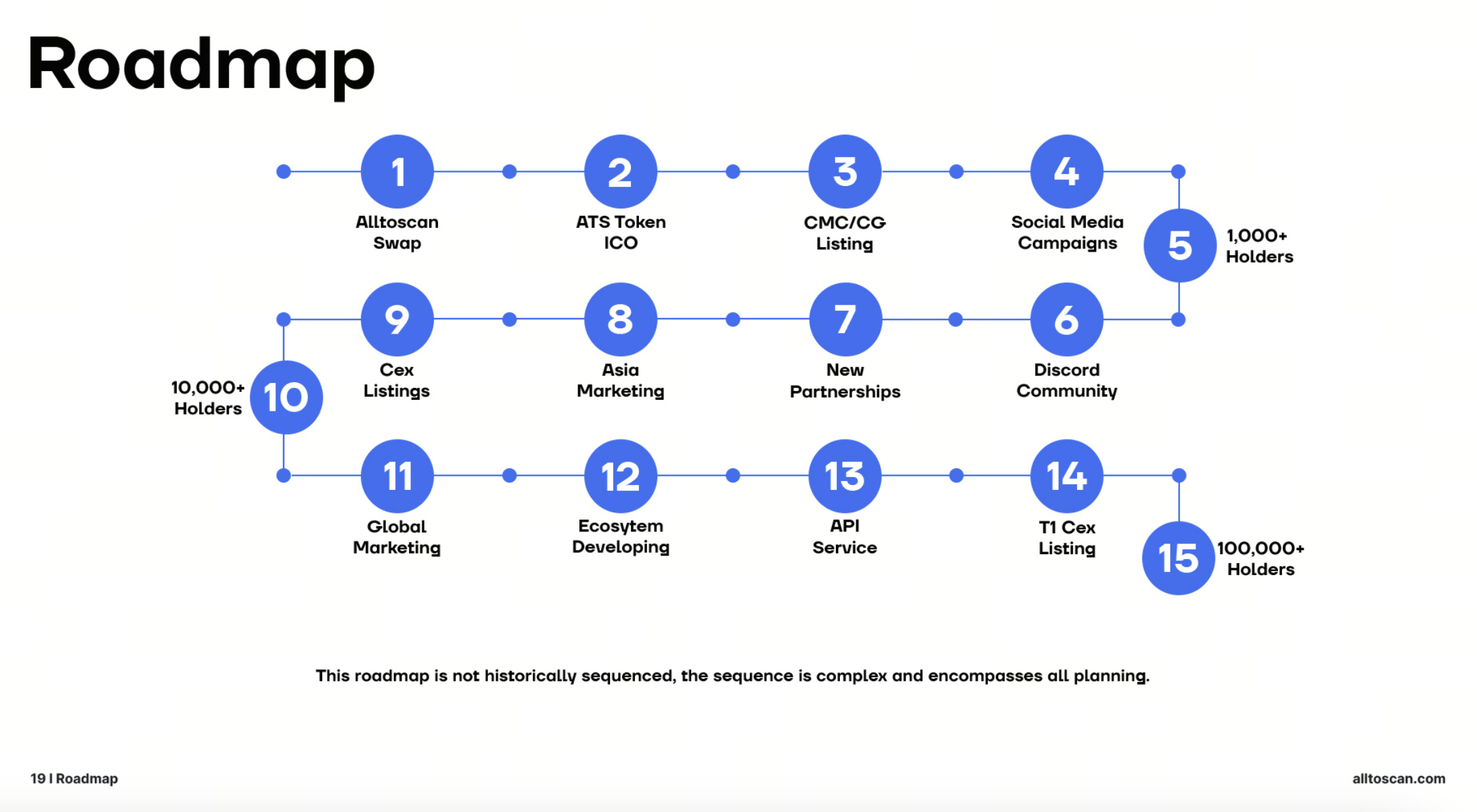
Based on its roadmap and industry trends, Alltoscan's technical evolution is likely to focus on:
-
Full Open-Source Explorer Release: Releasing core indexing and frontend code to attract developer contributions for chain adaptation modules, creating a community flywheel similar to Blockscout.
-
Node and API Productization: Offering dedicated nodes, webhooks, real-time alerts, and enterprise-grade SLAs to projects—monetizing technical capability.
-
Deep Rollup and New L2 Support: With the post-Cancun L2 explosion, strengthen batch tracking, Blob data correlation, and cross-Rollup address profiling.
-
Swap and Trading Infrastructure: Embed Swap into the explorer, linked with Wats Wallet and the ATS Gas pool, shortening the "query → trade" path and boosting indexing-layer revenue efficiency.
-
AI-Assisted On-Chain Analysis (Industry Trend): Automatically detect abnormal transfers, contract vulnerability patterns, and phishing addresses, improving analyst efficiency—subject to explainability and privacy compliance.
-
Integration with Storage Networks like BNB Greenfield: On-chain transaction indexing combined with off-chain large-file storage, serving NFT, SocialFi, and other dApps that need rich media data.
The measure of technical success will go beyond "how many chains are supported" to include latency, accuracy, developer satisfaction, and open-source community activity.
Conclusion
Alltoscan's multi-chain block explorer architecture follows the industry-standard path of ETL indexing + distributed nodes + unified API + multi-layer caching, layered with Rollup-compatible queries, Web3 domains, and Wats Wallet. This forms an "aggregation infrastructure" distinct from traditional federated explorers.
Its operational logic in a nutshell: each chain node continuously produces blocks → the indexer writes real-time/backfill data to the database → API and frontend present readable data → the wallet and ATS economic layer close the interaction loop. Advantages include a one-stop multi-chain experience and a strong L2 transparency narrative. Challenges include heterogeneous adaptation, reorg handling, and competition from established players.
For developers, key points to watch are its API specifications, open-source progress, and speed of new-chain integration. For users, remember that the explorer is a "mirror service" of on-chain data—critical operations should always rely on final on-chain confirmation. As its open-source plan and node services deepen, Alltoscan has the potential to evolve from a tool product into a Web3 data layer that the ecosystem can fork and integrate—provided its technical transparency and data quality withstand long-term market scrutiny.







