When users search for Bedrock vs Babylon, they usually want to understand why both are related to BTC Restaking, yet their product forms, yield sources, and asset usage methods are not the same. In the context of BTCFi in particular, the two represent two separate paths: “BTC yield generation” and “BTC security reuse.”
This topic usually involves several layers, including underlying architecture, BTC yield sources, incentive models, asset control methods, and ecosystem application directions.
What Is Bedrock?
Bedrock can be understood as a yield protocol built around BTCFi, Restaking, and multi-chain liquidity. Its core purpose is to convert assets such as BTC into liquid assets that can participate in on-chain yield and DeFi applications.
First, users connect BTC or related assets to Bedrock. The system then maps BTC into on-chain yield scenarios through assets such as uniBTC and brBTC. Next, users can use these assets in supported DeFi, Restaking, or liquidity applications. Finally, through multi-chain deployment and governance incentives, Bedrock connects BTC assets with yield networks.
Structurally, Bedrock focuses more on BTC capital efficiency. It does not simply lock BTC. Instead, it uses liquid assets to allow BTC to continue entering on-chain trading, lending, yield aggregation, and ecosystem incentive scenarios.
What Is Babylon?
Babylon’s core positioning is BTC Staking and shared security. Through cryptographic mechanisms, it allows BTC to provide security for external proof-of-stake networks without requiring BTC to be transferred into custody on another chain.
In other words, Babylon focuses more on BTC’s security properties than on directly building liquid yield assets. First, users participate in BTC Staking according to protocol rules. The system then connects external chains through Bitcoin timestamping, finality mechanisms, and validation networks. Next, BTC’s economic security can be used to support other blockchain systems. Finally, participants may receive incentives from the relevant networks.
Structurally, Babylon is not a typical DeFi yield aggregation protocol. It is closer to BTC security-layer infrastructure, with a focus on making BTC a source of security for other chains and applications.
How Do Their Underlying Architectures Differ?
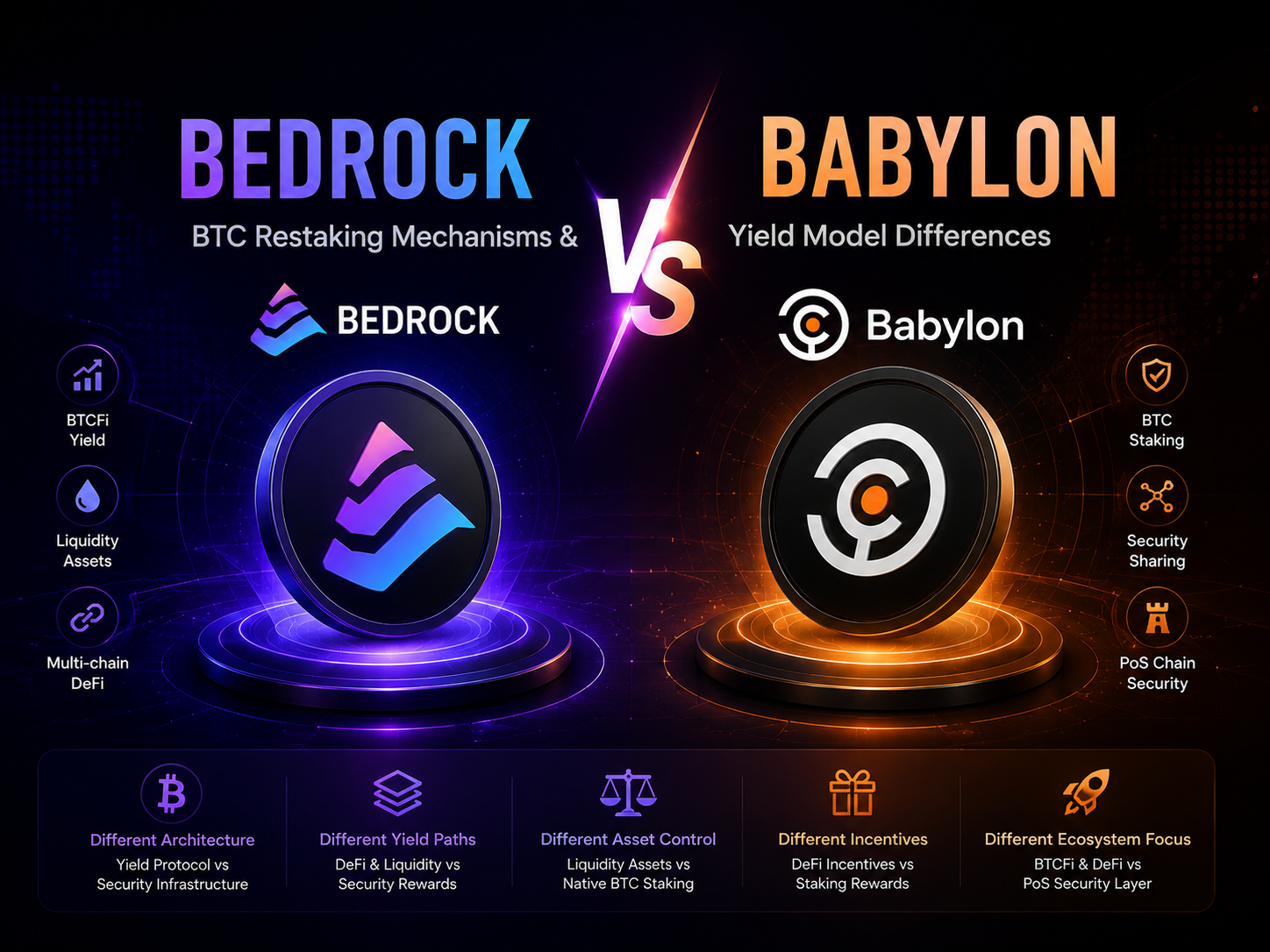
The architectural difference between Bedrock and Babylon comes down to one being oriented toward liquid yield, while the other is oriented toward security reuse. Bedrock connects yield scenarios through asset issuance and multi-chain applications, while Babylon connects BTC with the security needs of external networks through protocol-layer mechanisms.
First, Bedrock allows users to convert BTC into uniBTC or related assets. The system then connects these assets to multi-chain DeFi and Restaking scenarios. Next, users can continue using these assets for yield activities. Finally, Bedrock forms a liquid asset network.
Babylon follows a different process. First, users participate in BTC Staking. The system then records and verifies BTC security commitments through protocol mechanisms. Next, external networks use this security to strengthen their own consensus or finality. Finally, Babylon forms a BTC shared security network.
| Comparison Dimension |
Bedrock |
Babylon |
| Core positioning |
BTCFi yield protocol |
BTC security infrastructure |
| Asset form |
Liquid assets such as uniBTC and brBTC |
BTC Staking rights |
| Main mechanism |
Liquid yield and Restaking |
BTC security reuse |
| Use cases |
DeFi, yield aggregation, multi-chain applications |
External network security and finality |
| User focus |
Asset liquidity and yield |
BTC security participation and protocol incentives |
This difference means the two are not direct competitors in every sense. Bedrock sits closer to the DeFi application layer, while Babylon sits closer to the protocol security layer.
How Do Bedrock and Babylon Differ in BTC Yield Paths?
Bedrock’s BTC yield path mainly comes from liquid assets entering DeFi, Restaking, and yield aggregation scenarios. Babylon’s yield path comes more from protocol incentives earned after BTC provides security to external networks.
First, in Bedrock, users submit BTC-related assets. The system then mints uniBTC or related credentials. Next, these assets enter liquidity pools, Restaking applications, or other DeFi scenarios. Finally, yield may come from liquidity incentives, protocol rewards, and external yield networks.
Babylon’s path is more focused on security participation. First, users participate in BTC Staking. The system then connects BTC security with external networks. Next, external networks provide incentives based on security services or validation participation. Finally, yield sources are related to network adoption, protocol rules, and security demand.
The key point is that Bedrock’s yield depends more on asset utilization efficiency, while Babylon’s yield depends more on demand for BTC security services. Both revolve around BTC, but their yield logic is different.
How Do the Two Protocols’ Incentive Models Work?
Bedrock’s incentive model revolves around BR, veBR, liquid assets, and ecosystem rewards. Babylon’s incentive model is formed around BTC Staking, validation participation, and external network rewards.
In Bedrock’s structure, users first hold or use assets such as uniBTC. The protocol then forms incentive distribution through DeFi scenarios, liquidity markets, and governance mechanisms. Next, BR and veBR participate in governance weight and resource allocation. Finally, incentives are more closely tied to protocol liquidity, asset usage, and long-term governance.
Babylon’s incentive logic is more oriented toward security services. First, users participate in the protocol through BTC Staking. The system then establishes incentive relationships based on security commitments and external network demand. Next, participants may receive rewards from the relevant ecosystems. Finally, the incentive model depends on how many networks adopt BTC security.
This difference shows that Bedrock places more emphasis on liquidity growth and DeFi usage, while Babylon places more emphasis on the supply of security services and network collaboration.
How Do Bedrock and Babylon Differ in Asset Control?
Asset control is one of the key differences between Bedrock and Babylon. Bedrock usually brings BTC into multi-chain applications through liquid assets, while Babylon emphasizes participating in security mechanisms without transferring BTC custody.
First, in the Bedrock model, after users submit BTC-related assets, they receive corresponding liquid assets. The system then supports the use of assets such as uniBTC through asset mapping, cross-chain structures, or protocol connections. Next, users can use these assets in DeFi scenarios. Finally, the asset control experience is closer to receiving a tradable credential.
Babylon’s asset control method is closer to native BTC Staking. First, users participate in locking or commitment according to protocol rules. The system then records participation status using cryptographic and Bitcoin network mechanisms. Next, external networks recognize this security commitment. Finally, BTC does not need to migrate to another chain through a traditional bridge.
This mechanism difference affects the risk structure. Bedrock requires users to pay attention to cross-chain, liquid asset, and DeFi protocol risks. Babylon places more emphasis on Staking rules, validation mechanisms, and external network integration risks.
How Do Their Ecosystem Expansion Directions Differ?
Bedrock’s ecosystem expansion direction leans more toward multi-chain DeFi, BTCFi yield assets, and liquidity scenarios. Babylon’s ecosystem expansion direction leans more toward providing BTC security for proof-of-stake networks, appchains, and modular blockchains.
First, Bedrock enters different on-chain scenarios through assets such as uniBTC and brBTC. The protocol then connects lending, liquidity pools, Restaking, and yield aggregation applications. Next, users use these assets to participate in multi-chain DeFi. Finally, Bedrock’s ecosystem growth depends on asset use cases and liquidity depth.
Babylon’s expansion logic is different. First, it establishes BTC Staking and shared security mechanisms. External networks then connect to Babylon to obtain BTC security. Next, more chains or applications can be built around this security layer. Finally, Babylon’s ecosystem value depends on how many networks are willing to adopt BTC as a security source.
From an application perspective, Bedrock is more like a BTCFi asset layer, while Babylon is more like a BTC security infrastructure layer.
Which Scenarios Are More Suitable for Bedrock or Babylon?
If users care about BTC’s on-chain liquidity, yield aggregation, and DeFi usage, Bedrock is more aligned with those scenarios. If users care about how BTC participates in external network security and Staking incentives, Babylon’s mechanism is a better fit.
First, users need to identify their core needs. If the goal is to bring BTC into DeFi, Restaking, or multi-chain yield scenarios, assets such as Bedrock’s uniBTC create a clearer usage path. If the goal is to participate in shared security through BTC, Babylon’s BTC Staking structure is more direct. Ultimately, the better fit depends on a user’s preferences around liquidity, yield sources, and asset control methods.
Structurally, Bedrock is better suited for understanding the BTCFi application layer, while Babylon is better suited for understanding the BTC security layer. Together, they show that BTC’s on-chain usage has expanded beyond simple holding into multiple directions, including yield, liquidity, and security services.
Summary
Bedrock and Babylon both revolve around on-chain BTC usage, but their mechanisms are clearly different. Bedrock connects DeFi, Restaking, and yield aggregation through liquid assets such as uniBTC and brBTC, with a focus on improving BTC capital efficiency. Babylon uses BTC Staking and shared security mechanisms to let BTC provide security support for external networks.
Looking at the full process, Bedrock’s path is that users submit BTC, the system generates liquid assets, and those assets then enter yield scenarios. Babylon’s path is that users participate in BTC Staking, the system records security commitments, and external networks then use BTC security. The two represent the asset yield direction and the security infrastructure direction within the BTCFi ecosystem.
FAQs
What is the biggest difference between Bedrock and Babylon?
Bedrock leans more toward a BTCFi liquid yield protocol, while Babylon leans more toward BTC Staking and shared security infrastructure. Both use BTC, but their core mechanisms and application scenarios are different.
Is Bedrock a competitor to Babylon?
The two overlap partly in the BTC Restaking narrative, but they are not the same type of protocol. Bedrock focuses more on liquid assets and DeFi yield, while Babylon focuses more on BTC security reuse.
Will Babylon issue an asset similar to uniBTC?
Babylon’s core mechanism is not to issue liquid BTC assets. Instead, it allows BTC to participate in external network security. This makes it clearly different from asset models such as uniBTC.
Does Bedrock’s yield come from Babylon?
Bedrock’s yield sources depend on the DeFi, Restaking, and external protocol structures it connects to. Babylon can serve as one type of infrastructure in the BTC security ecosystem, but the two have different yield paths.
Should BTCFi users pay more attention to Bedrock or Babylon?
If the focus is BTC liquidity, yield aggregation, and DeFi usage, Bedrock is more worth studying. If the focus is how BTC provides security for external networks, Babylon is a better comparison point.