As the blockchain industry gradually evolves from a single payment network into long term digital infrastructure, energy efficiency, hardware barriers, and network sustainability have become major issues.
Bitcoin has long been regarded as one of the most secure cryptocurrency networks, but its high energy consumption and ASIC centralization have also sparked extensive debate. Chia attempts to preserve the core idea of Bitcoin’s security model while replacing continuous computing power competition with storage resources. For this reason, it has gained broad attention in discussions around “green blockchains” and low energy consensus mechanisms.
A Brief Look at Chia and Bitcoin
Chia is a Layer 1 blockchain network created by BitTorrent founder Bram Cohen. Its core mechanism is Proof of Space and Time (PoST). Unlike traditional PoW networks, Chia does not rely on GPUs or ASICs for continuous computation. Instead, it allows users to participate in network validation with idle hard drive space. Users generate Plot files in advance and submit the corresponding Proof when the network issues a challenge.
Bitcoin is a decentralized digital currency network launched by Satoshi Nakamoto in 2009. It was also the first blockchain system to successfully achieve decentralized consensus. Bitcoin’s core mechanism is Proof of Work (PoW). Miners compete to produce new blocks through large amounts of computation and receive BTC block rewards. Thanks to its long and stable operation, Bitcoin is still widely seen as one of the most secure networks in the blockchain industry.
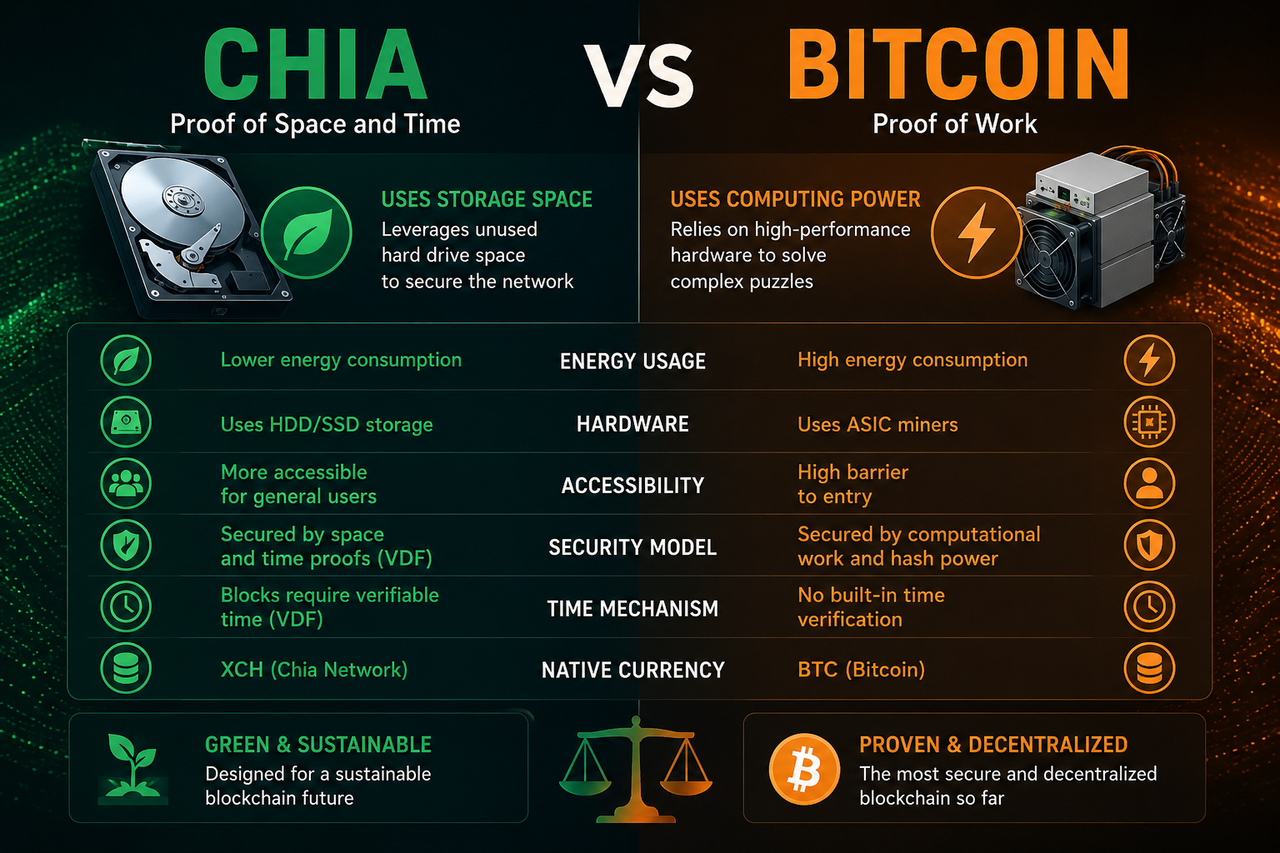
Core Differences Between Proof of Space and Proof of Work
The biggest difference between Proof of Space and Proof of Work is the resource each mechanism relies on for network security.
Bitcoin’s PoW depends on continuous competition in computing power. Miners must keep performing hash calculations to compete for the right to produce the next block.
$SHA256(SHA256(Block\ Header)) < Target$
Chia’s Proof of Space, by contrast, depends on Plot data that has already been stored. Nodes participate in challenges through hard drive space rather than continuous high frequency computation.
$P(\text{win}) \propto \frac{\text{Farmer Space}}{\text{Total Network Space}}$
In simple terms:
As a result, the two differ clearly in hardware structure, energy model, and cost composition.
Why Is There Such a Large Difference in Energy Consumption Between Chia and Bitcoin?
Bitcoin mining machines need to run at high power for long periods, so PoW networks usually consume large amounts of electricity.
ASIC miners not only need continuous computation, but also additional cooling systems and professional mining facility environments. This is one of the main reasons Bitcoin’s energy use is so often debated.
By comparison, Chia’s Farming stage mainly relies on hard drive reads, so its long term operating power consumption is usually lower.
That said, Chia is not free from resource consumption.
During the Plotting stage, the system writes a large amount of data. In the early Chia boom, many users used high performance SSDs to generate Plot files, causing heavy wear on some SSDs.
Therefore:
How Do Chia and Bitcoin Differ in Security Model?
Bitcoin’s security comes from competition in computing power.
To launch a 51% attack, an attacker would need to control more than half of the network’s total hash power and bear extremely high energy and hardware costs.
Chia’s security comes from storage space and time proofs.
In addition to Proof of Space, Chia also introduces Proof of Time and Verifiable Delay Functions (VDFs), ensuring that blocks must be produced in real chronological order.
This means that even if an attacker has a large amount of storage resources, they cannot quickly reconstruct block history through parallel acceleration.
Although the two security models are different, both follow the Nakamoto Consensus approach, meaning they maintain network consistency through the longest chain rule.
How Do Chia and Bitcoin Differ in Tokenomics?
Bitcoin’s token model is relatively simple.
The total supply of BTC is fixed at 21 million, and block rewards are halved according to a fixed schedule.
Although Chia’s XCH also uses a gradually decreasing reward structure, one of its biggest controversies is the Strategic Reserve.
At the initial mainnet launch, Chia’s official team pre generated a large amount of XCH for enterprise partnerships, ecosystem development, and long term financing.
Supporters believe this helps ecosystem development, while critics argue that it may affect the fairness of token distribution.
As a result, the two differ clearly in their approach to “fair issuance.”
Conclusion
Chia and Bitcoin are both blockchain networks based on Nakamoto Consensus, but they differ fundamentally in consensus mechanism and resource structure.
Bitcoin uses Proof of Work to maintain network security through continuous competition in computing power. Chia uses Proof of Space and Time to reduce energy consumption through storage space and time proofs.
PoW has proven its security over a long period of time, but it also comes with high energy consumption and ASIC centralization. PoST, by contrast, attempts to use low power storage resources to create more sustainable blockchain infrastructure.
FAQs
What Is the Biggest Difference Between Chia and Bitcoin?
Bitcoin uses Proof of Work (PoW), while Chia uses Proof of Space and Time (PoST).
Why Does Bitcoin Need ASIC Miners?
Because ASICs are far more efficient than ordinary GPUs or CPUs at SHA-256 hash computation.
Does Chia Need Mining Machines?
Chia does not rely on ASIC mining machines. It usually uses HDDs or SSDs for Farming.
Is Chia Less Secure Than Bitcoin?
Bitcoin’s security model has been tested for a much longer time, while Chia uses a different structure based on space and time proofs. The two are difficult to compare in a simple, direct way.







