In recent years, more and more crypto companies have sought to integrate blockchain technology into everyday scenarios. One of the most prominent developments is Bitcoin Cashback. Unlike traditional credit card rewards that offer cashback, bonus points, or airline miles, Bitcoin Cashback turns rewards into Bitcoin, allowing consumers to accumulate digital assets as they shop.
Lolli is one of the leading examples on the market. By collaborating with merchants and payment networks, Lolli has established an automated system for tracking purchases and distributing BTC rewards. For users, the experience is nearly identical to typical credit card shopping, yet the process involves payment networks, merchant alliances, reward distribution, and crypto distribution behind the scenes.
How Does Bitcoin Cashback Differ from Traditional Cashback?
At first glance, Bitcoin Cashback operates much like conventional cashback programs: after a purchase at a partner merchant, users receive a percentage-based reward. The key difference lies in the nature of the reward. Traditional programs issue rewards in fiat currency, which can offset future purchases or be withdrawn as cash. In contrast, Bitcoin Cashback converts these rewards into Bitcoin, giving users not just a discount but a freely transferable, tradable, and storable digital asset. As a result, Bitcoin Cashback combines both consumer reward and asset accumulation, making it a major focus for many crypto payment platforms in recent years.
How Does Lolli’s Reward Process Work?
 (Source: TheBlockCo)
From the user’s perspective, Lolli is straightforward to use, though the system itself involves multiple parties. After registering, a user links their Visa or Mastercard credit card to the platform. Whenever they make a qualifying purchase at a participating merchant, the system automatically recognizes the transaction and calculates the reward.
Once the transaction is complete, the merchant pays a promotional commission to the reward network. Lolli then allocates part of this commission as BTC rewards, which are distributed to users. For merchants, this reward operates as a marketing expense; for consumers, it’s an added Bitcoin bonus. This model is fundamentally a reward system built on affiliate marketing and payment infrastructure.
What Role Does Kard Play in the Overall Structure?
 (Source: BlocksterCom)
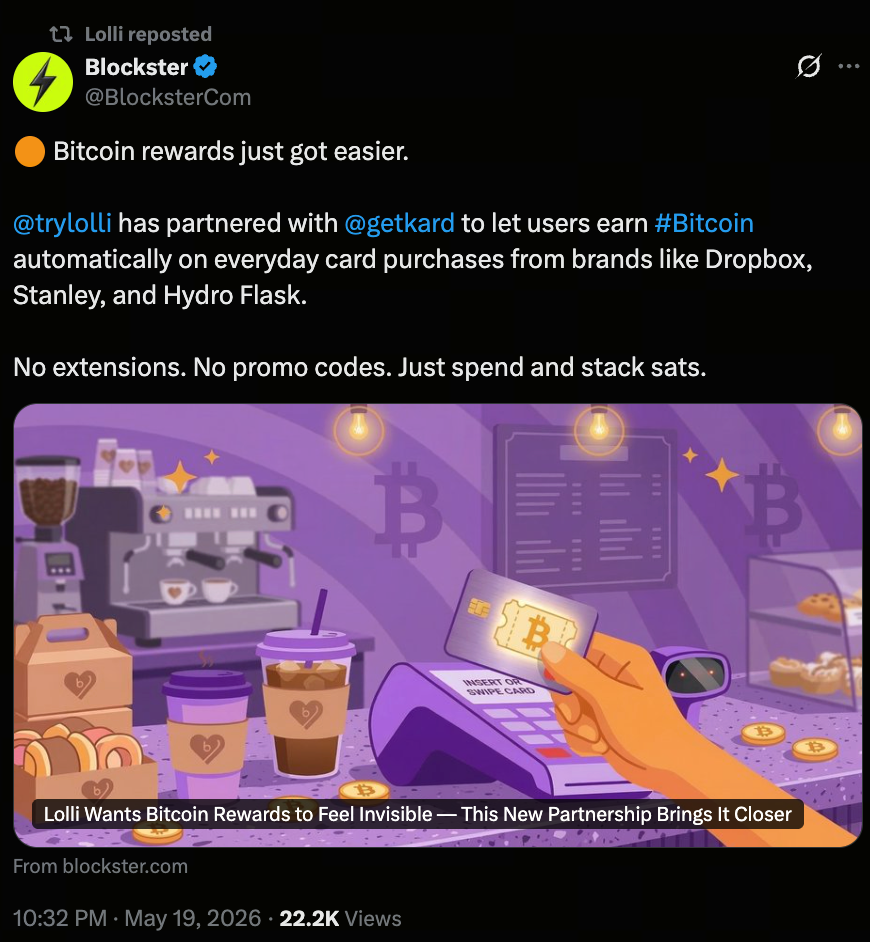
Lolli’s recent collaboration with Kard is an important step in expanding its payment network. Kard specializes in card reward infrastructure, helping brands, merchants, and payment platforms implement consumer reward systems. Traditionally, Lolli would need to invest significant time and resources to partner with hundreds or thousands of merchants. Through Kard’s merchant network, however, Lolli can quickly connect with more brands and retailers. This partnership enables rapid expansion and allows users to earn Bitcoin rewards in a wider range of scenarios. In essence, Kard delivers the underlying capabilities for payment and merchant integration, while Lolli focuses on converting rewards into BTC and offering the crypto experience.
Where Do Bitcoin Cashback Funds Come From?
A common question among new users encountering Bitcoin Cashback is: Where does the Bitcoin distributed by the platform originate? In most cases, the rewards are not subsidized by the platform itself but come from promotional fees paid by merchants. When merchants want to attract more consumers, they are usually willing to allocate a certain percentage of their marketing budget to partner platforms. Lolli then converts a portion of this income into Bitcoin and distributes it to eligible users. Thus, the platform does not create rewards out of thin air, but rather redistributes value through merchants’ marketing budgets. This model is essentially similar to traditional credit card rewards or airline mileage programs, except that the reward is given in Bitcoin instead of fiat currency.
For most people, acquiring Bitcoin still involves a learning curve—registering an Exchange account, managing a wallet, and understanding crypto markets. Bitcoin Cashback provides an alternative entry. Users do not need to invest proactively or commit large sums at once; instead, they gradually accumulate BTC through their regular spending. This turns Bitcoin from a speculative investment into an everyday reward, lowering the barrier for mainstream adoption. For many first-time crypto users, the rewards from Lolli may represent their first Bitcoin holdings.
What Is the Future Outlook for Bitcoin Cashback?
As payment infrastructure continues to advance, Bitcoin Cashback could see even broader adoption. Beyond e-commerce, sectors like dining, travel, transportation, and digital subscriptions could be integrated into the Bitcoin Cashback ecosystem. Users’ BTC rewards may not necessarily be only stored in platform accounts, but could also be sent directly to the Lightning Network, on-chain payment tools, or other Web3 financial services. Additionally, advances in AI could reshape rewards, enabling platforms to automatically recommend optimal reward plans or dynamically adjust rates based on user behavior, boosting engagement and user experience—which means Bitcoin Cashback may not just serve as a short-term marketing tool, but could gradually become an important component of the crypto payment ecosystem.
Summary
The Bitcoin Cashback model exemplified by Lolli shows how crypto can enter mainstream markets through familiar shopping experiences. By partnering with merchants, payment networks, and reward platforms, users can steadily accumulate Bitcoin without changing their payment habits. On a broader industry level, this model is more than a simple rewards program—it serves as a vital bridge between traditional finance and the crypto world. As payment technology, the Lightning Network, and Web3 infrastructure mature, platforms like Lolli are poised to further accelerate the adoption and everyday use of Bitcoin.







