As the Ethereum restaking market enters a new phase, the focus of industry competition is moving beyond simple TVL growth toward yield quality, value capture, and long-term incentive structures. For any yield protocol, the ability to translate ecosystem growth into token value—while balancing short-term incentives with sustainable development—has become a key benchmark for market competitiveness. PUFFER's economic model has taken shape precisely within this context.
Looking at the evolution of DeFi yield infrastructure, PUFFER represents more than a governance token; it embodies a value system driven by real yield generation. Through its native restaking architecture, AVS yield expansion, lock-up governance, and long-term incentives, Puffer aims to build a more sustainable yield ecosystem and chart a new growth trajectory for the Ethereum restaking track.
Core Functions and Use Cases of the PUFFER Token
PUFFER serves as the governance core of the Puffer ecosystem and a critical value medium for the entire yield system. Unlike many DeFi projects that rely on high-inflation rewards to fuel growth, PUFFER is designed to emphasize the synergy between governance rights, long-term participation, and protocol-generated yield.
Governance is PUFFER's most fundamental function. Holders can vote on protocol parameter adjustments, including reward distribution ratios, ecosystem incentive plans, and future product upgrades. As Puffer scales from a single liquid restaking protocol into a full-fledged yield infrastructure platform, the importance of governance continues to grow.
PUFFER also plays a central role in the long-term incentive system. By locking tokens to obtain vlPUFFER, users gain higher governance weight and access to more ecosystem rewards. This mechanism encourages sustainable participation in protocol development rather than short-term yield chasing.
Moreover, PUFFER functions as a vehicle for protocol value capture. As Puffer's yield sources expand, the economic value generated by the protocol flows back into the PUFFER ecosystem, creating a virtuous cycle among governance, yield, and long-term growth.
PUFFER Token Distribution and Release Mechanism
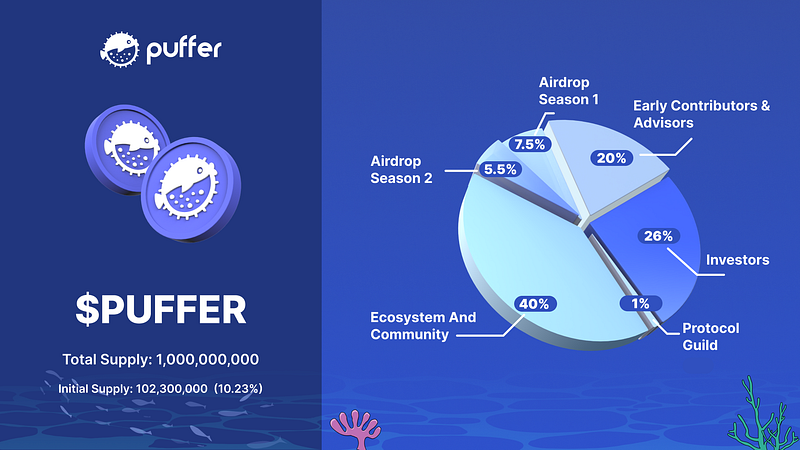
A well-designed tokenomics model must balance ecosystem growth, community incentives, and market stability. From the outset, PUFFER's design prioritized long-term development. With a fixed total supply, tokens are primarily allocated to the community ecosystem, team members, investors, the DAO treasury, and early contributors. The ecosystem incentive portion is the largest, aimed at supporting protocol expansion and community growth rather than relying on short-term subsidies.
Tokens allocated to the team and investors follow extended lock-up periods with linear vesting schedules. This structure helps mitigate the risk of early concentrated sell-offs while aligning the core team's interests with the protocol's long-term success.
For market participants, the release rate, circulating supply dynamics, and upcoming unlock schedules are key indicators for assessing PUFFER's market performance. As the ecosystem grows, balancing incentive distribution with market supply and demand will remain a critical factor influencing the token's long-term value.
PUFFER's Role in Governance
Governance capability is one of the key differentiators between PUFFER and typical incentive tokens.
As Puffer's product lineup expands, governance extends beyond simple parameter adjustments to encompass the entire yield ecosystem's long-term development. Decisions on AVS yield distribution ratios, protocol fee structures, ecosystem partner integration, DAO treasury spending, and future product upgrades all require community input.
PUFFER holders obtain governance rights by locking their tokens, enabling them to vote on these critical matters. Unlike the standard one-token-one-vote model, Puffer places greater weight on long-term commitment, with longer lock-up periods resulting in higher governance influence.
This design effectively reduces the impact of short-term speculation on governance decisions, giving a stronger voice to participants who are genuinely committed to the protocol's long-term growth. For a restaking protocol built on sustainable yield generation, a stable and engaged governance system is essential for healthy ecosystem development.
How vlPUFFER and the Long-Term Lock-Up Mechanism Work
vlPUFFER is a cornerstone of Puffer's long-term incentive system, modeled on the Vote Escrow mechanism now widely adopted across DeFi.
When users lock PUFFER for a set period, they receive a corresponding amount of vlPUFFER. The longer the lock-up term, the more vlPUFFER they receive, and the greater their governance weight.
Unlike ordinary tokens, vlPUFFER cannot be freely traded—it represents a long-term equity stake. Holders can not only participate in governance but may also qualify for additional yield incentives and ecosystem rewards.
The logic behind this mechanism is straightforward. On one hand, locking reduces market circulating supply, enhancing token price stability. On the other hand, it incentivizes users to stay engaged with the ecosystem rather than trading on short-term price movements.
In the current DeFi landscape, more protocols are adopting similar designs because lock-up mechanisms are healthier than high-inflation subsidies and help build a stable, committed community base.
How PUFFER Captures Protocol Value
Value capture is a key measure of a governance token's long-term potential. Puffer's value capture model is built on real yield, starting with Ethereum native staking rewards. When users deposit ETH, they earn base yields through validators—this forms the foundation of the entire system.
On top of this, Puffer expands yield sources through its native restaking mechanism. Users' ETH not only earns basic staking rewards but can also participate in multiple actively validated services (AVS) for additional incentives. This diversifies the protocol's yield structure beyond a single stream.
As the restaking ecosystem matures, more infrastructure projects are connecting to the AVS network. Puffer can generate ongoing revenue from validation services, data availability, and other on-chain services. Additionally, the protocol's own products and ecosystem services will produce fee income.
Over the long term, as protocol revenue grows, the ecosystem scales, and more users lock PUFFER for governance, the token's value becomes increasingly tied to the protocol's success. This is a key reason why the market focuses on PUFFER's long-term potential.
What Is the Relationship Between PUFFER and pufETH?
For new users, understanding the distinction between PUFFER and pufETH is essential to grasping the Puffer ecosystem.
pufETH is fundamentally a yield-bearing asset. When users deposit ETH into the protocol, they receive an equivalent amount of pufETH.
Holding pufETH provides continuous access to:
- Ethereum staking rewards
- Restaking rewards
- AVS incentive rewards
It functions like a yield receipt.
PUFFER, in contrast, is a governance asset.
Its responsibilities include:
- Governance voting
- Yield incentives
- Long-term lock-up
- Value capture
- Ecosystem development
pufETH represents yield rights; PUFFER represents governance rights and ecosystem value. Together, they form Puffer's dual-token system.
This model preserves liquidity for yield-bearing assets while allowing governance assets to focus on long-term value creation.
Key Factors Influencing PUFFER Token Value
PUFFER's long-term value depends on multiple factors, most notably the growth rate of the restaking market.
If the Ethereum restaking market continues to expand, attracting more participants, Puffer's user base, protocol revenue, and ecosystem activity all stand to benefit. Conversely, if the industry enters a slowdown, market expectations may suffer.
Protocol TVL is another important metric. TVL reflects not only the volume of assets deposited but also market confidence in the protocol's security and yield generation. As TVL grows, the protocol can manage more assets and create more yield opportunities.
The development of the AVS ecosystem is also critical. If more infrastructure projects integrate with the restaking network, Puffer's yield sources will diversify further, strengthening its value capture ability.
Changes in the lock-up ratio can influence token performance. When more users convert PUFFER to vlPUFFER, circulating supply decreases while governance demand rises. This supply-demand shift could support the token's long-term value.
Additionally, because Puffer is built on Ethereum, ETH price trends, staking adoption, and the overall direction of the restaking industry will have a significant impact on PUFFER.
Risks to Consider When Investing in PUFFER
While PUFFER has a well-designed economic model, investors should remain aware of potential risks.
-
Market Volatility Risk
The cryptocurrency market is highly volatile. Even if the protocol's fundamentals are strong, token prices can be affected by market sentiment.
-
Competition in the Restaking Sector
Competition in the restaking space has intensified. Protocols compete on yield rates, liquidity, and ecosystem partnerships. Shifts in the competitive landscape could impact Puffer's market share.
-
Smart Contract Risk
Although Puffer has undergone multiple security audits, smart contracts and restaking mechanisms carry inherent technical risks. No protocol can completely eliminate the possibility of security incidents.
-
Token Unlock Risk
Future unlocks for the team, investors, and ecosystem rewards may affect market supply. Investors should monitor the unlocking schedule and changes in circulating supply.
-
Ethereum Ecosystem Risk
Given Puffer's deep integration with Ethereum, changes to Ethereum's network policies, declining staking yields, or adjustments to restaking rules could negatively affect PUFFER's long-term performance.
Summary
PUFFER is the core governance token of Puffer's yield ecosystem. Its value derives not solely from market trading but from the underlying fundamentals of native liquid restaking, long-term governance incentives, and protocol-driven yield growth. Through the coordinated design of PUFFER, vlPUFFER, and pufETH, Puffer is building a restaking ecosystem that balances yield generation, governance, and long-term value accumulation.
As the Ethereum restaking market shifts from a focus on scale to one centered on yield efficiency and real value capture, tokenomics are becoming increasingly important. For investors following DeFi yield infrastructure and the restaking track, PUFFER's long-term performance hinges not just on the token itself, but on Puffer's ability to continue expanding its ecosystem, growing protocol revenue, and establishing a durable competitive advantage in the highly competitive restaking market.







