When users search for Space vs Polymarket, they're typically seeking to understand why both are classified as prediction markets but diverge in trading experience, market structure, and ecosystem direction. The core function of a prediction market isn't simply wagering—it’s about converting collective judgment into price signals through trading activity.
This comparison usually touches on platform positioning, technical architecture, order logic, incentives, settlement processes, and application scenarios.
What is Space?
Space is a decentralized prediction market platform built on Solana. Users can trade on the outcomes of real-world events, expressing their probability assessments via price. Space’s official documentation defines it as a prediction market on Solana, spanning crypto, politics, sports, tech, and culture.
Structurally, Space prioritizes trading experience and market depth. Users trade outcome shares with each other—not against the platform—with prices adjusting to buying and selling activity. According to Space’s documentation, prediction markets aggregate market views into probability signals through trading.
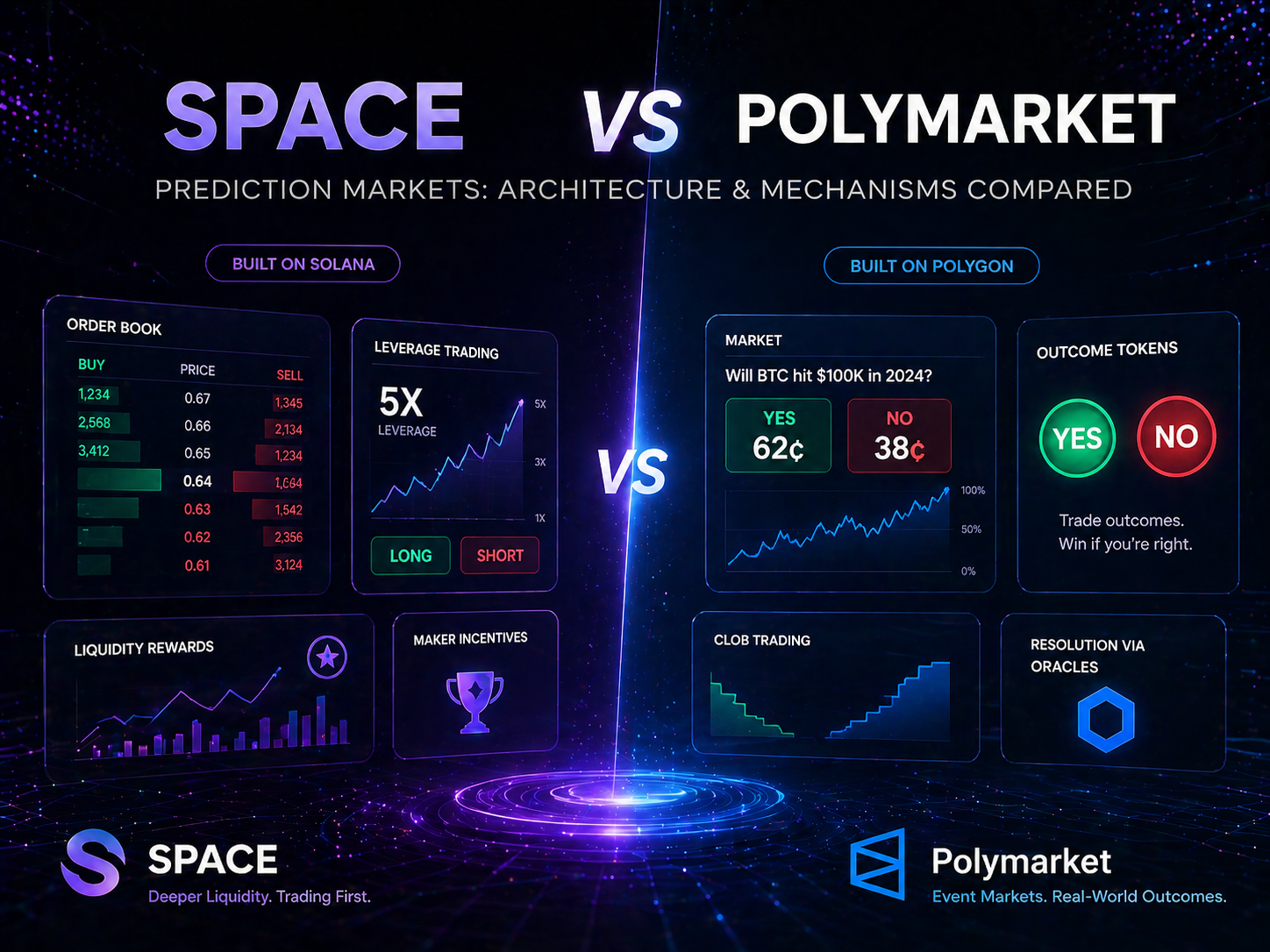
Space utilizes an order book system, letting users set prices, manage orders, and enter or exit positions as markets fluctuate. Features like leverage trading, maker rewards, and multi-outcome markets cater to active traders.
Space is not just an event prediction tool—it’s a market protocol built for information pricing and on-chain trading.
What is Polymarket?
Polymarket is a decentralized prediction market platform where users express their views on future events by buying or selling outcome shares.
Polymarket’s official documentation states the platform uses a peer-to-peer order book (CLOB), so users trade directly with each other—not with the platform. Prices are driven by market supply and demand; YES and NO share prices reflect the market’s probability estimates for particular outcomes.
Polymarket is structured around events, markets, outcome tokens, and an order system. Users buy shares for a specific outcome; if the event resolves in their favor, winning shares can be redeemed by rule.
Polymarket stands out for its broad market coverage, high user awareness, and mature developer tools. Its documentation offers APIs, SDKs, and CLOB clients, streamlining access to market data, order creation, and trading integrations.
Architectural Differences: Space vs Polymarket
Space and Polymarket differ most in their underlying networks and product focus.
Space is built on Solana, emphasizing low-latency trading, deep order books, and trader experience. Developer docs highlight transparent order books and 0% maker fees, supporting algorithmic trading, arbitrage, and automation.
Polymarket, built on Polygon, features a mature prediction market architecture—CLOB, outcome tokens, and external settlement mechanisms. Polymarket documentation highlights APIs, SDKs, and real-time market data for easy developer integration.
| Comparison Dimension |
Space |
Polymarket |
| Underlying Network |
Solana |
Polygon |
| Core Positioning |
Trader-focused prediction market |
Mature event prediction market |
| Trading Structure |
Order book with leverage |
Peer-to-peer CLOB |
| Product Focus |
Market depth & trading incentives |
Market coverage & data interfaces |
| User Focus |
Active traders |
Event predictors & developers |
Space leans toward trading efficiency and incentive design; Polymarket emphasizes market breadth, developer ecosystem, and robust infrastructure.
Trading Mechanism Differences
Both Space and Polymarket use order book logic, but their trading priorities differ.
Space’s documentation identifies makers and takers as key CLOB participants. Makers provide liquidity via limit orders; takers remove liquidity with market orders. This setup mirrors exchanges, ideal for users who want active pricing, order management, and depth tracking.
Space offers leverage, allowing users to amplify their exposure with partial margin. Documentation notes that leverage can boost potential gains—along with risk.
Polymarket also uses CLOB, letting users buy or sell outcome shares and exit before event resolution. However, Polymarket focuses on a streamlined YES/NO share trading experience, with prices representing market probabilities.
Space is more of a trading tool; Polymarket is a mainstream event prediction platform.
Incentive Mechanism Comparison
Both platforms drive liquidity, but their incentive models differ.
Space explicitly rewards liquidity providers (makers) who deepen the order book. Official docs explain that Space incentivizes makers through limit order rewards, since a deep order book enhances price reliability and reduces manipulation.
Space also boosts engagement via SPC-related incentives, trading competitions, and referral programs—connecting tokens, trading activity, and platform growth.
Polymarket’s incentives are centered on market scale, event coverage, and trading opportunities. Users profit by trading outcome shares; developers build with APIs and market data. Polymarket documentation emphasizes APIs, SDKs, and real-time data, signaling ecosystem incentives focus on trading data and developer integration.
Overall, Space prioritizes explicit trading and liquidity incentives; Polymarket relies on market depth, event popularity, and network effects.
Data & Settlement Differences
Prediction market settlement hinges on event outcome confirmation and share redemption.
Space documentation emphasizes trading real-world outcomes, with prices reflecting collective expectations. Users trade outcome shares, and after market closure, settlement is based on event results. Data and settlement logic focus on on-chain records, order management, and outcome confirmation.
Polymarket settles markets using conditional tokens and oracles. Legacy docs explain that Polymarket uses the Gnosis conditional token framework and resolves outcomes via UMA Optimistic Oracle. UMA describes its Oracle as a mechanism for recording verifiable facts or data on-chain.
Space highlights the trading system and execution layer; Polymarket emphasizes the settlement framework built from conditional tokens and external oracles.
This impacts user expectations for outcome visibility, dispute resolution, and settlement transparency.
Application Scenarios & Ecosystem Direction
Both platforms serve real-world event prediction, but their ecosystem directions differ.
Space covers crypto, politics, sports, tech, and culture—emphasizing trading real outcomes, leverage, and reward mechanisms. It targets highly active traders and on-chain trading strategies.
Polymarket is well-known in mass event markets—covering politics, macro, sports, and crypto. Third-party sources describe Polymarket as a decentralized prediction market on Polygon, where users trade outcome shares with USDC.
Space emphasizes trading capabilities and token incentives; Polymarket highlights market scale, event coverage, and data accessibility.
Neither platform fully replaces the other—they serve different prediction market user needs: Space is for trading efficiency; Polymarket is for market coverage and user scale.
Summary
Both Space and Polymarket are on-chain prediction markets, but their product trajectories differ. Space, built on Solana, emphasizes order book depth, leverage, maker rewards, and SPC incentives. Polymarket, on Polygon, offers a comprehensive infrastructure—CLOB, conditional tokens, UMA oracles, and mature APIs. Understanding their differences hinges on distinguishing “trader-oriented prediction market protocol” from “mature event prediction market platform.”
FAQ
What is the main difference between Space and Polymarket?
Space emphasizes trading experience, leverage, and liquidity incentives on Solana. Polymarket focuses on mature event markets, CLOB trading, conditional tokens, and external oracle settlement.
Are Space and Polymarket both prediction markets?
Yes. Both allow users to trade shares on real-world event outcomes, with prices reflecting the market’s probability assessments.
What trading mechanism does Space use?
Space uses an order book trading mechanism with maker and taker roles. Makers provide liquidity; takers remove liquidity and enable instant execution.
How does Polymarket settle outcomes?
Polymarket uses a conditional token framework, integrating UMA Optimistic Oracle and related mechanisms to confirm outcomes and complete settlement.
Which platform is best for high-frequency traders?
From a product design standpoint, Space is best suited to active traders and strategy users, emphasizing order book depth, 0% maker fees, leverage, and liquidity rewards.







