As the on-chain commodity narrative increasingly converges with the Meme market, more projects are drawing market attention through concepts like energy, gold, and reserve assets. Compared to traditional Meme Coins, these commodity-style Narrative Tokens more readily establish market associations tied to "real-world assets," making it easier to generate short-term liquidity concentration during hot cycles.
In today’s crypto market, GDOR stands out as a typical high-volatility Narrative Token. Its price is not solely determined by real-world commodity value, but is largely influenced by market sentiment, on-chain liquidity, and social media dissemination. Since such assets typically lack mature asset audit systems and long-term value anchoring mechanisms, their risk profile differs significantly from traditional financial commodities and stable RWA Tokens.
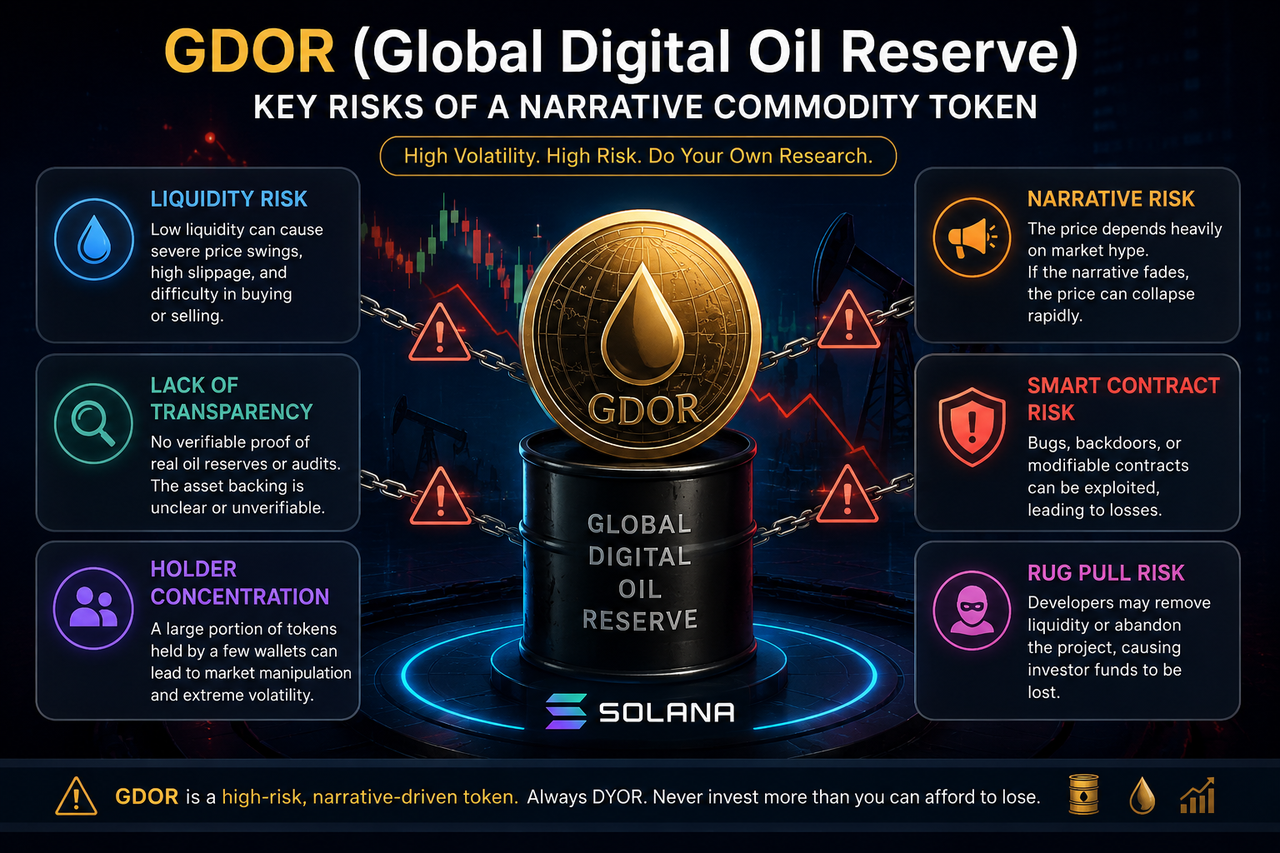
What Is the Liquidity Risk of GDOR?
Liquidity risk is one of the most fundamental issues for on-chain Narrative Tokens.
GDOR is primarily traded on DEXs (decentralized exchanges) on Solana, with its price typically determined by AMM (Automated Market Maker) liquidity pools. When the pool size is small, large transactions can cause severe price swings.
For instance, when many users buy simultaneously, the shifting token ratio in the pool can rapidly drive prices upward; conversely, concentrated selling may lead to significant slippage.
Compared to large mainstream assets, Narrative Tokens usually lack deep liquidity, making the market prone to:
-
Sharp short-term surges and crashes
-
High-slippage trades
-
Sudden liquidity evaporation
-
Rapidly widening bid-ask spreads
When market sentiment wanes, insufficient liquidity often amplifies downside risk.
Why Is Reserve Transparency Important for GDOR?
GDOR adopts the name "Global Digital Oil Reserve," which naturally leads the market to associate it with real-world oil reserves or energy asset backing.
However, for Real World Asset (RWA) projects, one of the most critical questions is whether the assets actually exist and can be verified.
Typical RWA Tokens usually disclose:
| Core Information |
Typical RWA Project |
| Reserve asset quantity |
Publicly verifiable |
| Custodian |
Clearly disclosed |
| Third-party audit |
Provided periodically |
| Legal structure |
Relatively clear |
| On-chain mapping mechanism |
Traceable |
Based on currently available public information, GDOR has not yet established a complete real-world oil reserve verification system. Therefore, whether a genuine mapping exists between its narrative and physical assets remains a key market concern.
Without a transparent reserve mechanism, the market price becomes entirely sentiment-driven.
What Does Holder Concentration Risk Mean?
Many on-chain high-volatility assets face Holder concentration, meaning a large portion of tokens is held by a small number of wallets.
When token distribution is highly concentrated, large wallets (Whales) can significantly influence market prices. For example:
-
Concentrated buying can rapidly inflate prices
-
Concentrated selling can trigger instant crashes
-
Some wallets may simultaneously control both liquidity and token supply
This structure amplifies market instability.
For narrative-based commodity Tokens, if liquidity is already thin, combined with Holder concentration, the market price becomes more vulnerable to manipulation.
Thus, Holder distribution, the percentage held by the top ten wallets, and liquidity lock-up status are key risk indicators.
Why Does Narrative Collapse Affect Price?
The market value of a Narrative Token largely hinges on whether the market continues to believe in the story.
When a concept is in a hot cycle, the market continuously reinforces the associated narrative. For example:
-
"Digital oil reserve"
-
"On-chain energy asset"
-
"New RWA hotspot"
-
"Next hot Solana asset"
These labels quickly spread across social media.
However, crypto market hotspots shift rapidly. Once narrative heat declines, market attention and trading volume often shrink in tandem.
For tokens lacking long-term cash flow and real-world asset support, narrative decay typically spells reduced liquidity and falling prices.
This explains why many hot assets experience violent swings in short cycles.
Why Are On-Chain Commodity Narrative Prone to High Volatility?
Commodity narratives have a natural communication advantage.
Compared to ordinary Meme Tokens, concepts like "oil reserve," "gold reserve," and "energy asset" make it easier for users to associate with real-world value, so the narrative builds credibility more quickly.
At the same time, highly active on-chain ecosystems like Solana offer:
-
Extremely low transaction costs
-
Rapid capital rotation
-
High-frequency Meme market
-
Social media-driven liquidity
These structural features further amplify narrative propagation speed.
When a narrative intersects with a high-frequency speculative market, price volatility typically intensifies.
How to Identify High-Risk Narrative Tokens?
When assessing the risk of on-chain Narrative Tokens, the market usually examines the following dimensions:
| Risk Dimension |
Key Observation |
| Liquidity |
Whether LP depth is sufficient |
| Holder distribution |
Whether it is overly concentrated |
| Narrative |
Whether it relies entirely on hot topics |
| Reserve transparency |
Whether real verification exists |
| Contract security |
Whether it has been audited |
| Team structure |
Whether it is open and transparent |
| Market cycle |
Whether it is at the tail end of a trend |
Narrative-based assets typically lack a fixed valuation model, so changes in market sentiment directly drive price volatility.
Summary
GDOR (Global Digital Oil Reserve) is a classic narrative-driven on-chain commodity Token. Its market hype stems from the "digital oil reserve" and RWA concepts, rather than a traditional real-world commodity anchoring structure.
Compared to mature RWA projects, GDOR is currently more exposed to risks from insufficient liquidity, Holder concentration, narrative switching, and market sentiment swings. Furthermore, weak reserve transparency and the high-volatility on-chain trading structure amplify its risk profile.
FAQs
What is the biggest risk of GDOR?
GDOR's primary risk comes from its narrative-driven structure, including insufficient liquidity, market sentiment volatility, and the absence of a real-world asset verification mechanism.
Is GDOR a real RWA asset?
GDOR uses narratives tied to RWA and energy assets, but publicly available information currently does not provide a complete, verifiable proof of real-world oil reserves.
What does rug pull risk mean?
Rug Pull typically refers to developers withdrawing liquidity or abusing contract permissions to cause a project's rapid collapse—a key risk type for high-risk on-chain assets.
Why are high-volatility narrative tokens prone to appear on Solana?
Solana's low fees, high transaction speed, and active Meme market ecosystem create a favorable environment for short-cycle, high-volatility narrative asset trading.