As the DeFi derivatives market continues to expand, trading models that solely depend on Automated Market Makers (AMMs) are encountering performance and liquidity efficiency bottlenecks. In particular, scenarios involving High Frequency trading, deep Order Book management, and large, High Leverage trades are driving more protocols to explore order book architectures and hybrid trading models.
The Perpetual Futures market demands low latency, real-time settlement, and robust risk control. Consequently, the order matching and settlement mechanism often defines the platform's overall performance. Pacifica's architectural design not only affects trading speed but also directly influences liquidity depth, capital efficiency, and the user risk management experience.
What Is Off-Chain Matching and On-Chain Settlement
Off-chain matching refers to a process where user orders are not matched directly on the blockchain. Instead, an off-chain matching engine handles the order logic, including price matching, order sorting, and trade confirmation.
On-chain settlement is responsible for the final asset transfer, position updates, and margin status synchronization. Trade results are submitted to the blockchain network, where the on-chain system performs the final confirmation.
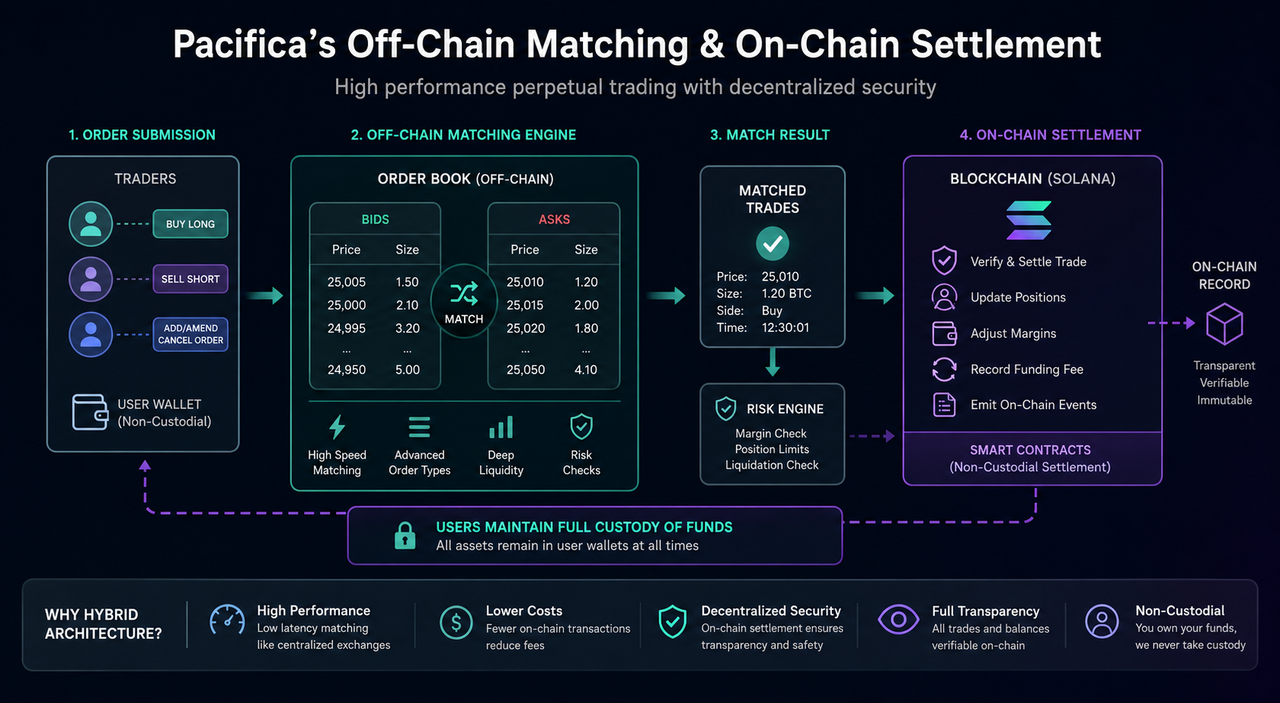
This architecture essentially follows the Hybrid DEX (Hybrid Decentralized Exchange) model. Its core objective is to improve trading efficiency without fully sacrificing decentralization.
Compared to fully on-chain order book systems, off-chain matching reduces the computational burden on the blockchain and alleviates network congestion. Compared to centralized exchanges, on-chain settlement maintains fund transparency and user asset self-custody.
How Does Pacifica's Order Matching Process Work
In Pacifica, users first connect to the platform via a Wallet and submit buy or sell orders.
After orders enter the off-chain matching engine, the system sorts them based on price priority and time priority. The matching engine scans the order book in real time to find counterparties that meet the conditions.
When a buy and a sell order match at the same price, the system generates a trade result and sends the relevant data to the on-chain settlement module.
The entire matching process is primarily completed off-chain, enabling faster order update frequency and lower latency. This is especially critical for the Perpetual Futures market, as High Leverage trading is typically more sensitive to price fluctuations and execution speed.
At the same time, off-chain matching reduces Gas costs. Users do not need to pay on-chain transaction fees for every order modification or cancellation, thereby improving the overall trading experience.

What Role Does On-Chain Settlement Play in Pacifica
Although order matching occurs off-chain, actual asset changes still require on-chain confirmation.
Pacifica's on-chain settlement system is primarily responsible for the following core functions:
- Updating user position status
- Adjusting Margin balances
- Recording executed orders
- Executing Funding Rate settlements
- Triggering liquidation and Risk Control logic
This design ensures that all final transaction states are publicly verifiable. Users can view position changes and asset flows through a blockchain explorer, thereby increasing system transparency.
On-chain settlement is also a key component of the non-custodial trading model. User assets are not entirely controlled by a centralized server but are managed through Smart Contracts and on-chain accounts.
What Are the Differences Between Pacifica and AMM Perpetual DEXs
Traditional AMM perpetual DEXs typically rely on liquidity pool pricing. When users trade, they are essentially exchanging assets with the liquidity pool.
While this model simplifies market structure, it also comes with limitations:
- Large trades are prone to Slippage
- Liquidity utilization is relatively low
- Prices may deviate from external markets
- High Frequency trading experience is limited
Pacifica is closer to an order book trading system. Its price formation relies primarily on market order matching rather than a single liquidity pool algorithm.
The order book architecture is generally more suitable for professional trading markets, as it provides finer price levels and higher liquidity management efficiency.
However, Hybrid DEXs also face new challenges, such as matching engine reliability, system synchronization speed, and data consistency between off-chain and on-chain components.
On-chain trading systems have long faced a core issue: there is often a trade-off between performance and decentralization.
Fully on-chain execution offers higher transparency but is often constrained by blockchain throughput. Fully centralized systems provide higher performance but compromise user asset security and transparency.
The hybrid architecture adopted by Pacifica essentially seeks a balance between these two extremes.
By processing high-frequency order handling off-chain, the platform can improve trading performance. By keeping asset settlement and position status records on-chain, it maintains a certain level of verifiability and non-custodial security.
Pacifica's Future Trading Infrastructure Direction
Beyond the current Hybrid DEX architecture, Pacifica also plans to expand unified margin systems, multi-asset collateral, and on-chain lending capabilities in the future.
Unified Margin will allow users to share funds across multiple markets, improving overall capital efficiency.
The platform is also focusing on the real-world asset (RWA) derivatives market, with the goal of supporting more on-chain financial products in the future.
Conclusion
Pacifica's off-chain matching and on-chain settlement mechanism represents one of the key technical approaches for high-performance DeFi derivative platforms.
By completing order matching off-chain while retaining on-chain asset settlement and risk control logic, Pacifica can achieve a balance between trading performance, fund transparency, and non-custodial security.
FAQs
What is off-chain matching?
Off-chain matching is a process where order matching is not executed directly on the blockchain but is handled by an off-chain matching engine for price matching and order processing.
Why does Pacifica use off-chain matching?
Off-chain matching reduces trading latency, improves order processing speed, and lowers on-chain Gas costs, making it more suitable for high-frequency perpetual futures trading.
Are Pacifica's trades ultimately recorded on-chain?
Yes. After a trade is executed, the final asset settlement, position updates, and margin status are synchronized to the on-chain system.
Is Pacifica a fully decentralized exchange?
Pacifica is a Hybrid DEX, i.e., a hybrid decentralized trading platform that combines off-chain matching with on-chain settlement mechanisms.
What is the difference between Pacifica and an AMM DEX?
AMM DEXs primarily rely on liquidity pool pricing, while Pacifica is closer to an order book trading model, forming market prices through order matching.