À mesure que les RWA et les marchés multi-chaînes évoluent rapidement, la gouvernance traditionnelle des DAO montre ses limites en matière de gestion des permissions, de coordination inter-chaînes et d’exécution automatique. Quack AI propose une couche de gouvernance IA qui permet aux agents IA de participer à l’analyse de la gouvernance, à l’identification des risques et à l’exécution on-chain selon des règles prédéfinies, réduisant ainsi considérablement les coûts de coordination manuelle dans la gouvernance multi-chaînes.
Avec l’expansion continue de l’économie des agents IA, l’architecture de gouvernance de Quack AI est parfaitement adaptée non seulement à la gestion des DAO, mais aussi à la coordination des trésoreries, à la gouvernance des RWA et aux opérations automatisées on-chain.
Qu’est-ce que la gouvernance des RWA ?
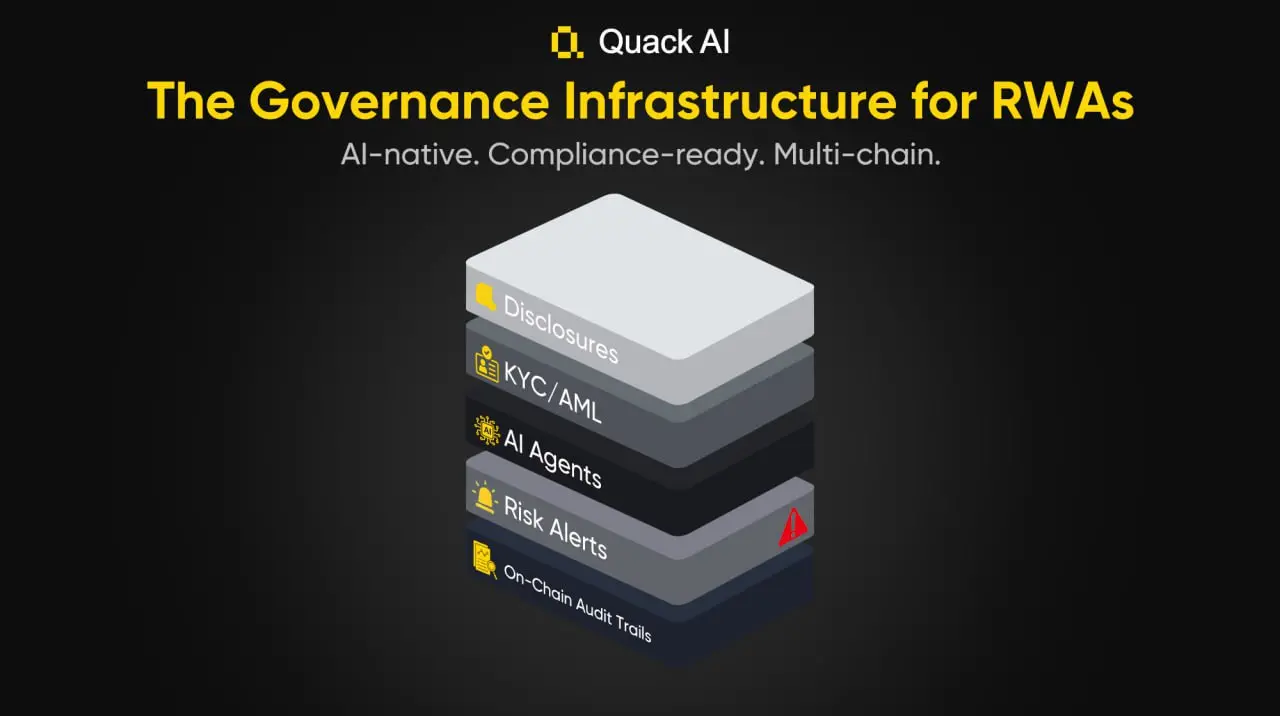
La gouvernance des RWA désigne l’ensemble des processus de gouvernance et de gestion on-chain centrés sur les actifs du monde réel.
Les RWA regroupent généralement des représentations on-chain d’obligations, de biens immobiliers, de billets, de parts de fonds ou d’autres actifs tangibles. Leur gestion on-chain exige des règles de gouvernance plus complexes, comme la garde des actifs, les approbations de permissions, la distribution des rendements et les contrôles de conformité.
Comparée aux protocoles DeFi standards, la gouvernance des RWA met davantage l’accent sur la transparence, l’application des règles et la prise de décision collaborative. Par conséquent, les DAO qui gèrent des RWA nécessitent une infrastructure de gouvernance plus robuste et des capacités d’automatisation avancées.
L’un des principaux atouts de Quack AI est sa capacité à soutenir la gouvernance inter-chaînes et l’exécution multi-chaînes.
Dans un marché multi-chaînes, les DAO gèrent souvent des actifs et des protocoles sur différents réseaux comme Ethereum, BNB Chain, Arbitrum et Polygon. Alors que les outils de gouvernance traditionnels sont généralement limités à des environnements mono-chaîne, Quack AI est conçu pour une collaboration inter-chaînes fluide.
Grâce à la couche de gouvernance IA, les agents IA peuvent synchroniser les processus de gouvernance sur plusieurs blockchains. Par exemple, lorsqu’un DAO finalise le vote d’une proposition sur sa chaîne principale, l’agent d’exécution peut automatiquement mettre à jour les paramètres ou coordonner les fonds sur d’autres chaînes.
Cette approche réduit la complexité des opérations manuelles inter-chaînes et améliore la cohérence de l’exécution de la gouvernance.
Quel est le rôle du Policy Engine dans la gouvernance des RWA ?
Le Policy Engine est un élément fondamental du cadre de gouvernance de Quack AI. Il définit le périmètre des permissions et les règles d’exécution des agents IA.
Dans les contextes RWA, la gestion des actifs exige généralement une application rigoureuse des règles. Par exemple, un DAO peut imposer des restrictions sur les transferts d’actifs, définir des flux d’approbation ou préciser les conditions de distribution des rendements, afin de garantir que la gouvernance automatisée respecte les exigences établies.
Le Policy Engine garantit que les agents IA opèrent strictement dans les limites définies, sans aucune activité on-chain non encadrée.
Cette structure réduit les risques potentiels liés à l’automatisation et renforce la transparence et la vérifiabilité de la gouvernance des RWA.
Dans le système de gouvernance Quack AI, les agents IA interviennent à plusieurs étapes de la gouvernance.
L’agent de proposition génère des résumés de gouvernance et analyse les propositions, permettant aux membres de la communauté d’accéder rapidement aux informations essentielles.
L’agent de risque surveille les risques de gouvernance : anomalies dans les permissions de fonds, problèmes de gestion d’actifs ou conflits d’exécution on-chain.
Lors de la phase d’exécution, l’agent d’exécution effectue de manière autonome des opérations inter-chaînes selon les règles définies par le DAO. Par exemple, lorsqu’une proposition de trésorerie est approuvée, l’agent IA peut coordonner les actifs et mettre à jour les paramètres sur plusieurs chaînes automatiquement.
Ce modèle améliore l’efficacité de la gouvernance et réduit les coûts d’intervention manuelle dans les environnements multi-chaînes.
La coordination des trésoreries est un aspect essentiel de la gestion des DAO et des RWA.
À mesure que les actifs sous gestion (AUM) des DAO augmentent, les trésoreries sont souvent réparties sur plusieurs chaînes et protocoles. La gestion conventionnelle nécessite généralement une allocation manuelle des actifs et une distribution des rendements, ce qui alourdit la gouvernance.
Quack AI, grâce à sa couche de gouvernance IA et à son système d’exécution automatisée, permet une automatisation partielle des processus de gestion des trésoreries.
Par exemple, un DAO peut configurer des règles de gestion via le Policy Engine, et les agents IA exécutent l’allocation des fonds ou la distribution des rendements en fonction de conditions prédéfinies.
Ce cadre de gouvernance automatisée réduit les coûts de coordination et augmente l’efficacité de la gestion des trésoreries.
En quoi Quack AI diffère-t-il des outils de gouvernance multi-chaînes traditionnels ?
Les outils de gouvernance multi-chaînes traditionnels se concentrent généralement sur la synchronisation des votes et les actions inter-chaînes de base, tandis que Quack AI privilégie l’intégration des agents IA et la logique de gouvernance automatisée.
Dans les systèmes conventionnels, l’analyse et l’exécution de la gouvernance dépendent largement de processus manuels. Quack AI exploite l’intelligence de gouvernance et le Policy Engine pour permettre aux agents IA de gérer l’analyse des propositions, la détection des risques et l’exécution automatisée.
La principale différence réside dans le niveau d’automatisation de la gouvernance et les capacités de collaboration de l’IA.
| Dimension |
Outils de gouvernance multi-chaînes traditionnels |
Quack AI |
| Analyse des propositions |
Manuelle |
Agent IA |
| Identification des risques |
Examen manuel |
Agent de risque IA |
| Méthode d’exécution |
Coordination manuelle |
Exécution automatique |
| Contrôle des permissions |
Basé sur multisig |
Policy Engine |
| Collaboration inter-chaînes |
Synchronisation de base |
Gouvernance collaborative IA |
Quelle est la signification de Quack AI dans l’économie des agents ?
Avec l’évolution de l’économie des agents IA, de plus en plus d’agents participent à l’analyse, au trading et à la gouvernance on-chain.
Cependant, sans application structurée des règles ni infrastructure de gouvernance, la collaboration à grande échelle des agents IA peut poser des défis en matière de gestion des permissions et de sécurité d’exécution.
Quack AI vise à fournir une infrastructure de gouvernance fondamentale pour l’économie des agents, permettant aux agents IA de collaborer on-chain dans un cadre de règles vérifiables.
Ce modèle est applicable non seulement à la gestion des DAO et des RWA, mais pourrait également façonner l’avenir de la synergie entre l’IA et la blockchain.
Résumé
Quack AI est une plateforme d’infrastructure de gouvernance IA qui intègre les agents IA, le Policy Engine et des mécanismes d’exécution automatisée. Elle sert la gouvernance des RWA, la collaboration multi-chaînes et les cas d’usage de coordination des trésoreries.
À mesure que les marchés multi-chaînes et les actifs du monde réel entrent dans le Web3, les modèles de gouvernance traditionnels sont confrontés à des défis croissants en matière d’efficacité d’exécution, de gestion des permissions et de coordination inter-chaînes. Grâce à sa couche de gouvernance IA, Quack AI permet une automatisation partielle des processus, garantissant transparence et conformité aux règles établies.
À l’avenir, la gouvernance IA est appelée à devenir un pilier des marchés multi-chaînes et de l’économie des agents, l’architecture automatisée de Quack AI jouant un rôle clé dans l’infrastructure Web3.
FAQ
Comment Quack AI prend-il en charge la gouvernance des RWA ?
Quack AI utilise sa couche de gouvernance IA, son Policy Engine et son cadre d’exécution automatisée pour aider les DAO à gérer les processus de gouvernance on-chain liés aux actifs du monde réel.
Qu’est-ce que la gouvernance multi-chaînes ?
La gouvernance multi-chaînes désigne les mécanismes qui permettent aux DAO ou protocoles de coordonner la gouvernance, la gestion des actifs et les processus d’exécution sur plusieurs blockchains.
Quel rôle le Policy Engine joue-t-il dans la gestion des RWA ?
Le Policy Engine impose des restrictions sur les permissions d’exécution des agents IA et garantit que la gouvernance automatisée respecte les règles prédéfinies.
Les agents IA peuvent-ils exécuter automatiquement des opérations inter-chaînes ?
Lorsque les permissions et les règles le permettent, les agents IA peuvent effectuer de manière autonome certaines tâches de gouvernance inter-chaînes et de coordination on-chain.
Comment Quack AI améliore-t-il la coordination des trésoreries ?
Quack AI simplifie la gestion des trésoreries en automatisant les processus grâce à des workflows basés sur des règles et à la collaboration des agents IA, ce qui améliore l’efficacité de la gestion des actifs multi-chaînes.
Qu’est-ce qui distingue Quack AI des outils DAO traditionnels ?
Quack AI met l’accent sur la gouvernance IA, l’exécution automatique et la collaboration des agents IA, tandis que les outils DAO traditionnels reposent largement sur des processus de gouvernance manuels.
Avertissement sur les risques :
Les actifs en cryptomonnaie sont très volatils. Les projets liés aux RWA et à l’IA peuvent être impactés par les conditions de marché, les avancées technologiques, les politiques réglementaires et l’adoption par l’écosystème. Ce contenu est fourni à titre informatif uniquement et ne constitue pas un conseil en investissement.