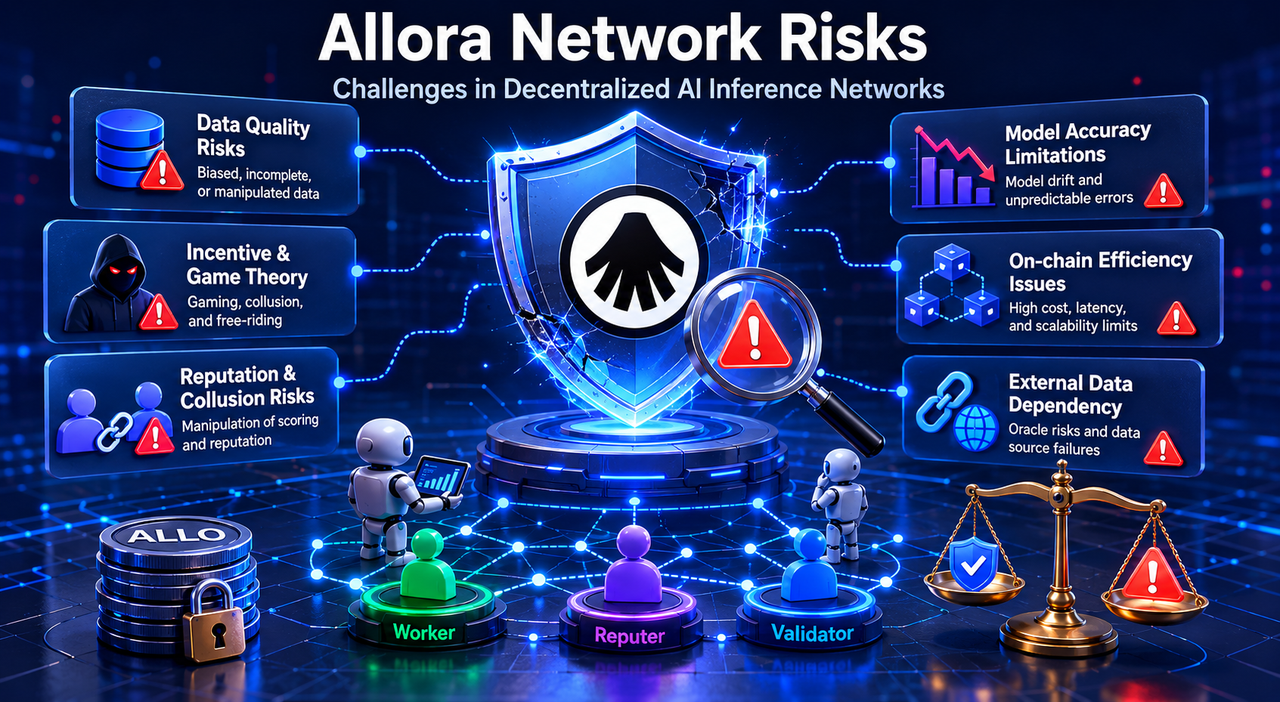
Allora Network coordinates multiple AI models for prediction and inference tasks through a decentralized architecture, aiming to boost information efficiency and forecast accuracy using collective intelligence. However, like any open network, decentralization does not mean risk-free. Data quality, participant behavior, and incentive mechanisms all impact the reliability of final results.
In the field of decentralized AI infrastructure, the Allora Network represents the future trajectory of AI inference markets. Compared to traditional centralized AI services, Allora offers more transparent model evaluation and reward mechanisms, but also introduces new layers of complexity such as on-chain governance, reputation systems, and economic incentives.
Why Does Data Quality Determine Prediction Results?
Allora Network's prediction capability rests on its data foundation. No matter how advanced the model, if input data is biased, the output results will likely contain errors.
Data issues fall into three categories: missing data, delayed data, and distorted data. On-chain data may include noise, while off-chain data can be affected by collection methods and source quality.
Since multiple models in the network may rely on similar data sources, erroneous data can be collectively amplified rather than automatically canceled out.
Can Model Accuracy Be Manipulated?
One of Allora's core mechanisms rewards based on prediction accuracy, but accuracy evaluation itself can become a target for gaming.
If some participants gain advance access to privileged information or exploit loopholes in scoring rules to adjust prediction strategies, the network may develop unfair advantages.
For example, certain models may optimize specifically for the scoring mechanism rather than genuinely improving prediction ability. In machine learning, this is known as "objective gaming."
Thus, aligning rewards with true prediction quality is a challenge faced by all prediction markets.
What Are the Potential Risks of the Reputer System?
Reputers assess the prediction performance of Workers and determine reputation weights.
If a Reputer itself is manipulated, the entire scoring system could lose credibility. In theory, multiple Reputer nodes could form collusive alliances to artificially inflate the reputation scores of specific models.
While Validators verify the scoring process, collusion attacks in complex networks remain a long-term concern.
Therefore, the Reputer's reputation management mechanism and anti-collusion design are critical to network security.
Why Can Incentive Mechanisms Lead to Gaming Behavior?
Any token-based reward network faces incentive gaming issues.
Allora aims to reward the most accurate predictors, but participants pursue economic gains. When the reward structure misaligns with prediction goals, nodes may prioritize profit maximization over prediction quality.
For instance, some participants may choose to mimic high-reputation models instead of investing resources in developing new prediction methods. This reduces the network's overall innovation capacity.
If a "free-rider effect" persists over time, the advantages of collective intelligence may gradually diminish.
Does the Reputation System Pose Centralization Risks?
Allora uses reputation mechanisms to amplify the influence of high-quality models, but over-reliance on historical performance can create new problems.
When a small set of models maintains high reputations for extended periods, their predictions may dominate the network. Over time, it becomes harder for new models to enter the market.
This phenomenon is called "reputation centralization."
If reputation concentration becomes too high, the network may drift away from open competition, undermining the diversity expected from a decentralized network.
What Efficiency Issues Does On-Chain Verification Bring?
Allora emphasizes verifiability of prediction results, so some processes must be recorded and validated on-chain.
Compared to centralized AI services, on-chain verification typically requires extra time and resource costs.
When the volume of inference requests surges, the network may face the following challenges:
- Increased data processing delays
- Rising costs
- Degraded user experience
- Limited network throughput
Therefore, balancing transparency and efficiency is a key challenge for Allora's future development.
What Risks Arise from External Data Dependencies?
Many prediction tasks require real-world data.
For example, financial market prices, macroeconomic indicators, or social media sentiment analysis—most of this information comes from off-chain sources.
If external data sources are attacked, tampered with, or cease updating, the quality of prediction models is directly impacted.
These issues are similar to those faced by oracles—unavoidable risks in the connection between blockchain and the real world.
Do AI Models Themselves Have Limitations?
Allora can optimize model performance, but it cannot eliminate AI's inherent limitations.
Machine learning models are trained on historical data, while the real world is constantly changing.
When market structures shift, historically effective models can quickly become obsolete.
In finance, this is often called "model drift."
Even if the network continuously updates reputation scores, it cannot guarantee future prediction accuracy.
How Does Allora Mitigate These Risks?
One of Allora's design goals is to reduce single points of failure through collective intelligence.
With multiple models participating simultaneously, the impact of any single model's failure is mitigated. The two-tier verification structure of Reputers and Validators also reduces the risk of scoring manipulation.
Additionally, the network uses a dynamic reputation system, allowing model influence to adjust as performance changes.
While these mechanisms cannot eliminate risks entirely, they improve the network's overall resilience and long-term stability.
Summary
Allora Network builds an open AI inference market through collective intelligence and on-chain incentives. But openness also brings risks around data quality, scoring credibility, incentive gaming, and network efficiency. As a key explorer in decentralized AI infrastructure, Allora does not aim to eliminate all risks—rather, it reduces their impact on prediction outcomes through protocol design and economic incentives.
As AI and blockchain integration deepens, finding the right balance between openness, accuracy, and security will remain a core challenge for the Allora Network and the entire decentralized AI industry.
FAQs
What is the biggest risk of the Allora Network?
The main risks include data quality issues, model scoring manipulation, incentive misalignment, and efficiency limitations from on-chain verification.
Why does data quality affect Allora's prediction results?
Allora's AI models rely on input data for inference. If data is biased, delayed, or erroneous, predictions may be off even if the models themselves are sound.
Can Reputers be manipulated?
In theory, yes. If multiple participants collude to influence scoring, the reputation system could be compromised. That's why Reputers require continuous oversight from Validators.
What is the incentive gaming problem?
This occurs when participants adjust their behavior to maximize rewards, causing a misalignment between goals and reward mechanisms that hurts overall network efficiency.
Can Allora completely avoid incorrect predictions?
No. Allora can improve prediction quality through collective intelligence, but it cannot eliminate uncertainties from data errors, market shifts, or model limitations.
How do Allora's risks differ from those of traditional AI platforms?
Traditional AI platforms face mainly technical risks. Allora, besides technical risks, must also address on-chain governance, token economics, and participant gaming in an open network.