MyDiscover

vip
Age 0.1 Year
Peak Tier 0
No content yet
#SpaceXOfficiallyFilesforIPO
🔥 $SPCX Pre-market contract trading competition officially begins!
Trade $SPCX/ $USDT, share a prize pool of 200,000 $USDT ! Both new and existing users can participate, the more you trade, the more rewards you get!
🔥 Event Highlights
🎁 Exclusive gift for newcomers: Trade ≥ 1,000 $USDT to receive 20 $USDT
🎁 Participation gift: Trade ≥ 30,000 $USDT to randomly get 50–100 $USDT
🎁 Trading prize pool: Trade ≥ 100,000 $USDT to share 100,000 $USDT
👉 Join now: https://gate.onelink.me/7pdk/e124cfea3928b7ac
#Gate #Futures #SPCX
Gate广场_Official
🔥 $SPCX Pre-market contract trading competition officially begins!
Trade $SPCX/ $USDT, share a prize pool of 200,000 $USDT ! Both new and existing users can participate, the more you trade, the more rewards you get!
🔥 Event Highlights
🎁 Exclusive gift for newcomers: Trade ≥ 1,000 $USDT to receive 20 $USDT
🎁 Participation gift: Trade ≥ 30,000 $USDT to randomly get 50–100 $USDT
🎁 Trading prize pool: Trade ≥ 100,000 $USDT to share 100,000 $USDT
👉 Join now: https://gate.onelink.me/7pdk/e124cfea3928b7ac
#Gate #Futures #SPCX
repost-content-media
  • Reward
  • 7
  • Repost
  • Share
discovery:
To The Moon 🌕
View More
🍕 Pizza Day Thoughts: Those 10,000 BTC and that disappeared Cullinan
As May 22 approaches, people are starting to hype up again at Gate Square.
Honestly, just seeing these words makes my chest tighten. You newcomers think this is a celebration, but in our old folks’ eyes, this is a “day of suffering.”
On May 22, 2010, Laszlo traded 10,000 BTC for two pizzas, which was only about $25 at the time. Now, at its peak, that meal is worth 60k to 1 billion dollars.
Satoshi Nakamoto wanted to create “digital cash,” but BTC’s volatility was too high, so no one dared to spend it, and it turned into “dig
BTC-2.78%
LTC-3.13%
ETH-3.3%
MasterChuTheOldDemonMasterChu
🍕 Pizza Day Thoughts: Those 10,000 BTC and that disappeared Cullinan
As May 22 approaches, people are starting to hype up again at Gate Square.
Honestly, just seeing these words makes my chest tighten. You newcomers think this is a celebration, but in our old folks’ eyes, this is a “day of suffering.”
On May 22, 2010, Laszlo traded 10,000 BTC for two pizzas, which was only about $25 at the time. Now, at its peak, that meal is worth 60k to 1 billion dollars.
Satoshi Nakamoto wanted to create “digital cash,” but BTC’s volatility was too high, so no one dared to spend it, and it turned into “digital gold.” Everyone became HODLers, which ironically gave USDT an opportunity.
Talking about this, I feel even more upset. Remember 2014, right after the 2013 bull market turned bearish, and a lady was stuck at the $1,000 top. I was making a good living shorting, and my proudest move was shorting LTC.
Back then, everything was coin-backed, and exchanges were still in China. One weekend, LTC dropped from ¥20 to ¥17. I went all-in with a 20x short at ¥17-18, and in two days, it crashed to ¥8. I reversed and went all-in long at ¥9.5, and the next day, it rebounded straight to ¥16.
That move earned me about 60k LTC, which felt like an astronomical number at the time, so I used my profits to buy a E260 car, still not paying it off, afraid the coin would drop.
After settlement, I had less than 1 million cash in hand, thinking I was the top-timing king. But then came the 2017 bull run, and LTC soared to over ¥2,400.
Calculate for yourselves how much I missed out on selling? Don’t even mention the E260—by that rise, I should have parked a Cullinan in my garage.
Every time Pizza Day comes around and I think of Laszlo, I used to think he was a fool, now I see him as my half-brother. He missed out on becoming the richest, and I missed out on billions.
BTC won; it became a store of value. I didn’t lose either—I earned a car. But the biggest enemy is truly oneself. Asking if ETH can be bottom-fished? I don’t know. All I want to say is: if you’re just gambling for short-term thrills, you’ll never earn beyond your understanding.
Family, does this hurt? Do you have worse “missed out” stories than mine? Drop your stories in the comments to help me find some balance. 🚬#Gate广场披萨节 #卖飞一个亿 #合约玩家的自我修养 #错失库里南 #HODLorDie
repost-content-media
  • Reward
  • 4
  • Repost
  • Share
discovery:
2026 GOGOGO 👊
View More
#BTCPizzaDay 🍕 is proof that the world always misunderstands revolutionary ideas before finally accepting them.
Fourteen years ago, Bitcoin was treated like a joke.
People mocked it.
Banks dismissed it.
Economists attacked it.
The media called it useless internet money created by dreamers who didn’t understand “real finance.”
Then one transaction changed history forever.
10,000 BTC for two pizzas.
At the time, nobody cared.
There were no headlines calling it historic.
No experts analyzing its long-term significance.
No institutions discussing Bitcoin adoption.
It was just a simple trade betwe
BTC-2.78%
SoominStar
#BTCPizzaDay 🍕 is proof that the world always misunderstands revolutionary ideas before finally accepting them.
Fourteen years ago, Bitcoin was treated like a joke.
People mocked it.
Banks dismissed it.
Economists attacked it.
The media called it useless internet money created by dreamers who didn’t understand “real finance.”
Then one transaction changed history forever.
10,000 BTC for two pizzas.
At the time, nobody cared.
There were no headlines calling it historic.
No experts analyzing its long-term significance.
No institutions discussing Bitcoin adoption.
It was just a simple trade between two people.
But that moment quietly triggered one of the biggest financial revolutions of the modern era.
Because for the first time, Bitcoin proved it could function outside theory.
That mattered.
━━━━━━━━━━━━━━━
The world today looks completely different because of what followed.
Now governments discuss crypto regulation constantly.
Major corporations hold Bitcoin exposure.
Institutional money flows aggressively into digital assets.
Entire industries emerged around blockchain technology.
The same asset once exchanged casually for pizza now influences global financial conversations daily.
That transformation is unbelievable.
━━━━━━━━━━━━━━━
But the deeper story behind Pizza Day is not about regret.
It is about conviction.
Someone believed Bitcoin had value before the world agreed.
That is how every major technological revolution begins.
The internet looked unnecessary before adoption exploded.
Social media looked ridiculous before it dominated communication.
Streaming looked impossible before it destroyed traditional television.
AI looked experimental before it reshaped industries worldwide.
Bitcoin followed the same path.
People laughed first.
Then they watched it grow.
Then they wished they had paid attention earlier.
━━━━━━━━━━━━━━━
That pattern repeats constantly because human psychology never changes.
Most people reject uncertainty.
They wait for proof before believing in anything new.
But by the time proof becomes obvious, the biggest opportunities are usually already gone.
Early adopters always look crazy before they look intelligent.
Bitcoin holders experienced that reality for years.
━━━━━━━━━━━━━━━
When BTC traded at a few dollars, critics called it worthless.
When BTC crossed $100, people called it a bubble.
When BTC crossed $1,000, panic spread across traditional finance.
Now Bitcoin sits among the most recognized financial assets on Earth and the same institutions that mocked it compete for exposure aggressively.
That level of reversal is historic.
━━━━━━━━━━━━━━━
The market still underestimates what Bitcoin actually represents.
Most people focus only on price action.
They obsess over volatility, charts, corrections, and short-term trading narratives.
But Bitcoin’s real power comes from something much bigger:
Scarcity.
For decades the financial world operated under systems where supply could expand endlessly.
Governments print money.
Central banks manipulate monetary policy.
Inflation slowly destroys purchasing power over time.
Bitcoin disrupted that structure completely.
Only 21 million BTC will ever exist.
No politician can change that.
No institution can increase supply.
No central authority controls issuance.
That idea fundamentally changed how millions of people think about money itself.
━━━━━━━━━━━━━━━
Pizza Day accidentally introduced the world to digital scarcity before society fully understood what it meant.
Back then, 10,000 BTC felt almost meaningless.
Today, no rational person would make that trade.
Why?
Because adoption changed perception.
The asset did not suddenly become powerful overnight.
Belief expanded gradually until global demand exploded.
That is how revolutions happen.
Slowly at first.
Then suddenly everywhere.
━━━━━━━━━━━━━━━
Bitcoin’s journey also exposed the weakness of modern market psychology.
Every cycle follows the same emotional script.
When prices rise, confidence becomes limitless.
When markets crash, fear destroys conviction instantly.
Weak hands disappear.
The media celebrates Bitcoin’s “death.”
Critics return aggressively.
Then Bitcoin survives again.
Every single time.
That resilience is why long-term holders think differently from average traders.
They understand volatility is temporary.
Adoption is permanent.
━━━━━━━━━━━━━━━
Most people entering crypto today see Bitcoin as a massive financial asset already accepted globally.
What they fail to understand is how difficult the early years actually were.
There was no certainty.
No institutional validation.
No mainstream acceptance.
No political support.
Only belief.
The people who stayed committed during those years carried enormous risk while the world mocked them constantly.
Now history treats many of those same people like visionaries.
━━━━━━━━━━━━━━━
And honestly, the market may still be underestimating Bitcoin’s future impact.
Global debt continues rising.
Inflation continues damaging currencies.
Trust in traditional financial systems continues weakening.
In that environment, decentralized assets naturally become more attractive.
Bitcoin entered the world offering something radically different from traditional finance:
A system without centralized control.
That concept alone changed economic discussions permanently.
━━━━━━━━━━━━━━━
Pizza Day represents the exact moment the future quietly entered reality.
Not through governments.
Not through banks.
Not through billion-dollar corporations.
Through pizza.
That irony makes the story even more powerful.
One of the greatest financial transformations in history began with a simple food purchase while the world ignored what was happening.
━━━━━━━━━━━━━━━
The real lesson of Bitcoin Pizza Day is brutal:
Massive opportunities rarely look important when they first appear.
Most revolutionary ideas arrive disguised as uncertainty.
People reject them because they feel unfamiliar.
Then years later society pretends the outcome was obvious all along.
Bitcoin proved how dangerous that mindset can become.
━━━━━━━━━━━━━━━
Today millions of people track BTC daily.
Entire careers were built around crypto.
Massive industries emerged from blockchain innovation.
Governments race to build digital asset frameworks.
Institutional capital continues entering the market.
All because someone once believed digital money had value before consensus existed.
━━━━━━━━━━━━━━━
That is why Pizza Day matters.
Not because of the money.
Because it symbolizes belief before validation.
And history consistently rewards the people capable of seeing change before the crowd finally understands what is happening.
repost-content-media
  • Reward
  • 4
  • Repost
  • Share
discovery:
To The Moon 🌕
View More
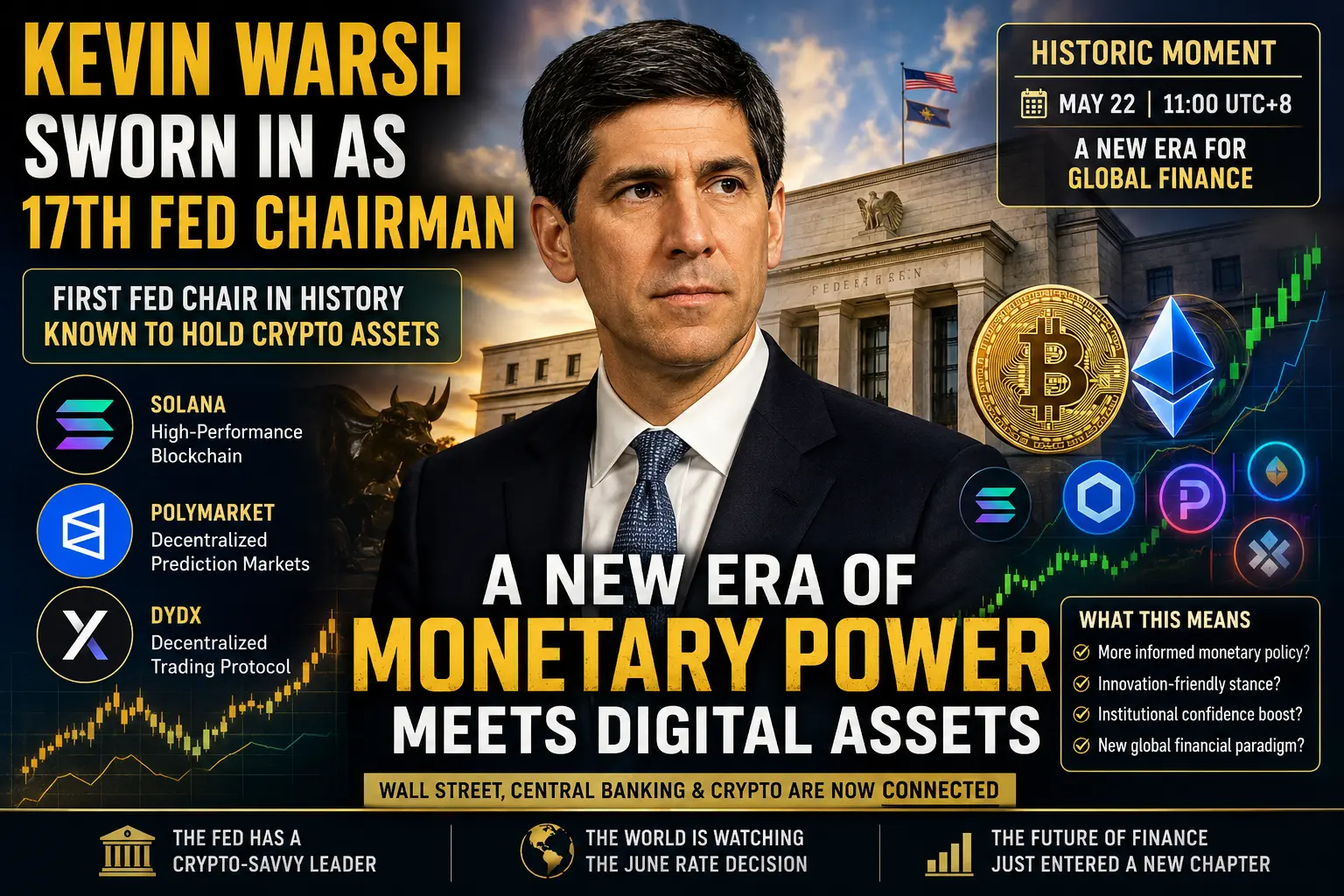
#WarshSwornInAsFedChair The global financial system has just crossed a line it can never uncross.
On May 22 at 11:00 UTC+8, Kevin Warsh was officially sworn in as the 17th Chairman of the Federal Reserve — not as a routine leadership transition, but as the beginning of a structural shock to global monetary governance and digital asset markets.
This is not just a change of chair. It is a regime shift in how money, power, liquidity, and decentralized technology will now interact at the highest level of global finance.
For the first time in history, the head of the Federal Reserve is not a dist
SOL-3.22%
DYDX-5.82%
BTC-2.78%
SoominStar
#WarshSwornInAsFedChair The global financial system has just crossed a line it can never uncross.
On May 22 at 11:00 UTC+8, Kevin Warsh was officially sworn in as the 17th Chairman of the Federal Reserve — not as a routine leadership transition, but as the beginning of a structural shock to global monetary governance and digital asset markets.
This is not just a change of chair. It is a regime shift in how money, power, liquidity, and decentralized technology will now interact at the highest level of global finance.
For the first time in history, the head of the Federal Reserve is not a distant observer of crypto markets — but reportedly an active participant within them.
That single fact is already rewriting market psychology.
A Fed Chair Who Understands the System He Regulates
For over a decade, central banking institutions have treated crypto as an external anomaly — sometimes a threat, sometimes a curiosity, almost never a legitimate financial layer.
Previous Fed leadership cycles were defined by distance:
Distance from blockchain infrastructure
Distance from decentralized markets
Distance from tokenized financial systems
Distance from Web3 liquidity dynamics
That distance shaped policy. And that policy shaped volatility.
But Kevin Warsh enters with a fundamentally different profile. Reports suggest exposure across more than 20 blockchain-based assets and ecosystems, including infrastructure-driven networks and decentralized financial protocols such as Solana, Polymarket, and dYdX.
This is not passive awareness. This is embedded familiarity with how decentralized systems behave under real liquidity conditions.
And that changes everything.
Because for the first time, monetary policy is being led by someone who does not merely regulate liquidity — but also understands how liquidity flows inside permissionless markets.
The End of the Old Crypto-Fed Equation
Historically, crypto markets operated under a brutally simple macro equation:
Fed hawkish → crypto collapse
Fed dovish → crypto expansion
Liquidity tightening → risk-off crash
Liquidity injection → speculative surge
Bitcoin, Ethereum, and altcoins were not driven only by adoption or technology — but by the Federal Reserve’s balance sheet behavior and interest rate trajectory.
In that environment, crypto was not independent. It was reactive.
But now markets are confronting a new and uncomfortable possibility:
What happens when the Fed chair is no longer structurally disconnected from the asset class he influences?
This does not automatically mean bias. It does not guarantee bullish policy. But it does introduce something far more important: informational symmetry between monetary authority and decentralized markets.
And that alone is enough to destabilize old assumptions.
Markets Are No Longer Pricing Ignorance — They Are Pricing Awareness
The immediate reaction across trading desks, hedge funds, and macro funds is not simple optimism. It is recalibration.
Because under Warsh, the Fed is no longer expected to behave as a purely traditional institution blind to digital transformation. Instead, markets are now pricing in a central bank leadership that:
Understands tokenized liquidity cycles
Recognizes blockchain settlement efficiency
Observes decentralized derivatives behavior in real time
Is aware of prediction markets as sentiment engines
Tracks on-chain leverage and liquidity stress patterns
This introduces a new macro variable:
Policy informed by participation.
And that shifts how every major asset class is being evaluated.
Crypto is no longer being treated as a fringe speculative overlay. It is now being treated as an integrated component of the financial system that sits directly inside the cognitive framework of the Fed’s top decision-maker.
Institutional Fear Is Being Replaced by Institutional Uncertainty
For years, institutional capital avoided crypto because of one dominant factor: regulatory unpredictability combined with ideological resistance from policymakers.
Now, that resistance narrative is breaking down — but it is not being replaced by clarity.
It is being replaced by uncertainty of a different kind.
Because investors are now asking:
Does familiarity lead to leniency or stricter control?
Does understanding lead to adoption or containment?
Will crypto be integrated into monetary frameworks or regulated more aggressively because it is better understood?
This is no longer a simple bullish or bearish environment.
It is a transition phase where traditional financial models no longer fully apply.
The Conflict Question That Cannot Be Ignored
Despite market excitement, a serious structural issue is already emerging: conflict of interest risk.
A Federal Reserve chair with exposure to volatile digital assets introduces immediate questions:
How are disclosures handled?
Can monetary decisions be fully neutral under personal exposure?
What safeguards exist to prevent perceived market influence?
Will policy be scrutinized more aggressively than in previous administrations?
These questions will not disappear.
In fact, they will intensify during every major policy move — especially during rate decisions, liquidity shifts, or inflation-linked interventions.
And in highly reactive markets like crypto, perception alone can move billions in capital flows.
The June Rate Decision: First Real Stress Test
All attention is now shifting toward the upcoming Federal Reserve rate-setting meeting in mid-June.
This is no longer a routine macro event.
It is the first real stress test of the Warsh era.
Markets will be dissecting:
Every phrase in the FOMC statement
Every tone shift in inflation language
Every hint toward liquidity easing or tightening
Every mention of financial innovation or systemic modernization
Because for crypto traders, this will not just signal monetary direction.
It will signal whether the Fed is evolving into a system that recognizes digital assets as permanent infrastructure — or still treats them as peripheral speculation.
A Structural Collision: Traditional Finance vs Decentralized Systems
The deeper transformation underway is not personality-based.
It is structural.
The financial world is entering a phase where:
Central banking systems
Tokenized economies
Decentralized liquidity networks
On-chain derivatives markets
Algorithmic prediction ecosystems
are no longer separate layers.
They are converging into a single interconnected liquidity architecture.
Kevin Warsh’s appointment does not create this convergence — it exposes it.
And exposure always accelerates transformation.
The New Market Reality
Under this new regime, crypto markets are no longer reacting only to:
Halving cycles
Retail sentiment
Exchange flows
ETF inflows
They are now reacting to a more complex macro layer:
Monetary leadership cognition
Policy-maker familiarity with decentralized systems
Institutional integration of blockchain intelligence
Real-time overlap between on-chain liquidity and off-chain policy
This is an entirely different market structure.
And most participants are not yet fully positioned for it.
Final Reality Check
Kevin Warsh’s arrival at the Federal Reserve does not guarantee a bullish crypto cycle.
It guarantees something more important:
A new level of integration between traditional monetary authority and decentralized financial systems.
That integration can produce expansion, regulation, acceleration, or correction — depending on execution, macro conditions, and political pressure.
But one outcome is already locked in:
The separation between Wall Street, central banking, and crypto is officially over.
The system is now interconnected.
And interconnected systems do not move slowly.
They reprice violently.
@Gate_Square
repost-content-media
  • Reward
  • 5
  • Repost
  • Share
discovery:
To The Moon 🌕
View More
#HYPE再度领涨Markets don’t care about opinions. They care about positioning.
And right now, in the HYPE battlefield, there are only two types of participants left standing:
Those who are positioned with structure… and those who are emotionally reacting to price.
Everything else is noise.
Because once a market moves like HYPE has moved—+134% YTD, explosive 15% daily expansion, and a $30.6M liquidation wipeout—the game is no longer simple buying and selling.
It becomes a positioning war.
And the only question Gate Plaza is throwing into the arena is brutally simple:
Are you LONG or SHORT? And what i
HYPE-5.33%
SoominStar
#HYPE再度领涨Markets don’t care about opinions. They care about positioning.
And right now, in the HYPE battlefield, there are only two types of participants left standing:
Those who are positioned with structure… and those who are emotionally reacting to price.
Everything else is noise.
Because once a market moves like HYPE has moved—+134% YTD, explosive 15% daily expansion, and a $30.6M liquidation wipeout—the game is no longer simple buying and selling.
It becomes a positioning war.
And the only question Gate Plaza is throwing into the arena is brutally simple:
Are you LONG or SHORT? And what is your opening strategy?
Most people will answer this emotionally.
Professionals will answer it structurally.
And that difference is exactly where money is made or destroyed.
---
THE CURRENT STATE OF THE MARKET: DISLOCATION PHASE
HYPE is not in discovery anymore.
It is not in early accumulation.
It is not even in “clean trend continuation.”
It is in what smart money calls:
Dislocation + Liquidity Redistribution Phase
This is where price has already escaped fair value zones, forced shorts into liquidation, and now starts testing whether demand is real… or just momentum exhaustion disguised as strength.
That $30.6M liquidation event was not just a number.
It was a signal.
A signal that leverage is already stretched.
A signal that weak shorts have been removed.
And more importantly:
A signal that the market is now transitioning from liquidity hunting → liquidity balancing
This is where most traders get trapped.
They assume:
“If it’s going up, I should buy.”
But markets don’t reward simplicity at this stage.
They punish late conviction.
---
THE LONG SIDE: AGGRESSIVE BUT STRUCTURED
Let’s talk LONG first.
Being long here is not wrong.
But being blindly long is dangerous.
A proper long strategy in this environment is not about chasing candles.
It is about waiting for acceptance zones after expansion.
Because after a vertical move like HYPE’s, price usually does three things:
1. Expansion (already happened)
2. Exhaustion (currently forming)
3. Retest / Re-accumulation (next phase)
So a professional long position is not:
“Buy because it is strong”
It is:
Wait for pullback into value zones
Confirm support holding
Enter on structural continuation
Risk defined below liquidity sweep levels
In other words:
You don’t chase strength.
You wait for strength to prove it is real.
Because the biggest trap in bullish continuation phases is this illusion:
“It cannot go down because it went up too fast.”
That belief destroys accounts.
Fast moves do not guarantee continuation.
They increase probability of correction.
So long bias here only works if:
Market holds above key breakout zones
Pullbacks are shallow, not structural breakdowns
Volume supports continuation instead of exhaustion
Otherwise longs become liquidity.
And liquidity is always consumed.
---
THE SHORT SIDE: DANGEROUS BUT NOT DEAD
Now let’s talk about the side everyone loves to overconfidently take:
SHORT.
After a +134% rally, shorting feels “logical” to many traders.
But logic does not pay in momentum regimes.
Timing does.
Shorting here is not about “market is high so it must fall.”
That is retail thinking.
Professional shorting only happens when:
Momentum starts fading
Lower highs begin forming
Failed breakouts appear
Buyers lose aggression
Liquidity starts stacking above resistance instead of below support
Right now, HYPE has not confirmed full reversal structure.
It has shown volatility expansion, not breakdown confirmation.
Which means:
Shorts are not in control.
They are waiting for confirmation like everyone else.
But here is the harsh truth:
In strong expansion cycles, early shorts don’t predict the top.
They become fuel for the next leg up.
That’s exactly what happened in the $30.6M liquidation event.
So shorting here is not forbidden.
It is just extremely timing-sensitive.
Without confirmation, short positions become:
Counter-trend exposure
Liquidity providers for breakout continuation
Emotional revenge trades disguised as “top calling”
And markets are extremely efficient at punishing that mindset.
---
THE REAL EDGE: STRUCTURAL NEUTRALITY
Now here is where professionals separate themselves from gamblers:
They are not married to LONG or SHORT.
They are married to STRUCTURE.
In this phase, the only real edge is:
Understanding when trend is expanding
Understanding when trend is exhausting
Understanding when liquidity is shifting
Because HYPE is currently in a phase where:
Bulls are aggressive
Shorts are forced to be cautious
Volatility is increasing
And direction is becoming less clean
This is not a trending market anymore.
It is a decision zone market
Meaning:
The next move will not be small.
It will be expansion OR rejection.
Not continuation of randomness.
But resolution of imbalance.
---
THE MOST IMPORTANT TRUTH
Every trader wants certainty.
But markets don’t offer certainty.
They offer probability.
And in this exact phase:
Longs have probability IF structure holds
Shorts have probability IF momentum fails
But both require patience
The worst position right now is not long or short.
It is impatience.
Impatience creates:
late entries
revenge trades
overleveraged bets
emotional exits
and liquidation traps
And liquidation is exactly what already happened at scale.
---
FINAL MARKET OUTLOOK (NO HYPE, PURE STRUCTURE)
HYPE is now sitting in a zone where:
Trend is strong but stretched
Volatility is increasing
Liquidity is already partially flushed
And next direction depends on reaction, not prediction
So what happens next?
Three realistic scenarios:
1. Controlled continuation
Pullbacks get bought
Market builds higher base
New highs follow
2. Sideways consolidation
Price stabilizes
Volatility compresses
Market resets leverage
3. Sharp correction
Profit taking accelerates
Late longs trapped
Liquidity sweep downward
Which one plays out?
The market will decide.
Not you.
Not sentiment.
Not social hype.
Price will confirm everything.
FINAL QUESTION FROM GATE PLAZA
So again:
Are you LONG or SHORT?
Because the truth is:
The market is not asking for your opinion.
It is asking:
Do you have a plan… or do you have emotions?
And only one of those survives the next move.
repost-content-media
  • Reward
  • 5
  • Repost
  • Share
discovery:
To The Moon 🌕
View More
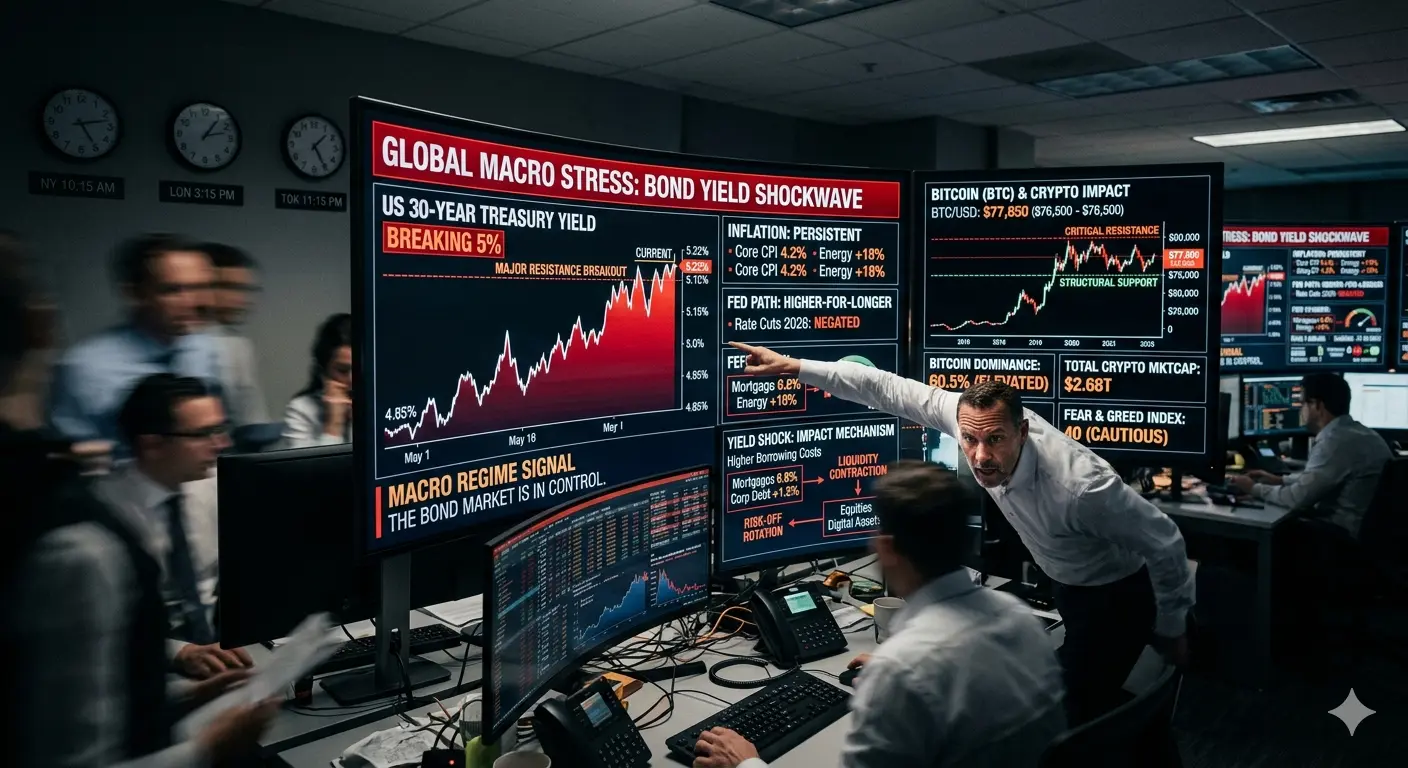
#30YearTreasuryYieldBreaks5% The global financial system is currently undergoing one of its most critical macroeconomic stress phases in recent years as the U.S. 30-Year Treasury Yield decisively breaks above the psychologically and structurally important 5% threshold, recently fluctuating in the 5.15%–5.22% range.
This is not a routine bond market adjustment. It is a signal of deep repricing across global capital markets — one that reflects shifting inflation expectations, tightening liquidity conditions, rising sovereign debt concerns, and a fundamental reassessment of long-term economic s
SoominStar
#30YearTreasuryYieldBreaks5% The global financial system is currently undergoing one of its most critical macroeconomic stress phases in recent years as the U.S. 30-Year Treasury Yield decisively breaks above the psychologically and structurally important 5% threshold, recently fluctuating in the 5.15%–5.22% range.
This is not a routine bond market adjustment. It is a signal of deep repricing across global capital markets — one that reflects shifting inflation expectations, tightening liquidity conditions, rising sovereign debt concerns, and a fundamental reassessment of long-term economic stability.
Long-duration Treasury yields are not just numbers on a chart. They represent the cost of trusting governments with capital over decades. When those yields remain in the 2%–3% range, markets are effectively pricing in stability, controlled inflation, and predictable monetary policy. But when yields push above 5%, the message becomes far more severe: capital is demanding a premium for uncertainty, risk, and the erosion of purchasing power over time.
At this level, the bond market is no longer signaling confidence — it is signaling resistance.
The U.S. 30-Year Treasury Yield is effectively the global benchmark for long-term risk-free return. When it rises aggressively, it forces a complete recalibration of valuation models across every major asset class. Equity markets, real estate, commodities, and digital assets all reprice under the pressure of higher discount rates and tighter financial conditions.
The current breakout above 5% is being driven by multiple overlapping macro forces. First, inflation is proving far more persistent than previously expected. Energy prices remain structurally elevated due to geopolitical instability, particularly in key oil-producing regions, which continues to feed into global transportation costs, production expenses, and food inflation.
Second, fiscal dynamics in the United States are becoming increasingly unsustainable in market perception. The rapid expansion of government debt issuance, combined with rising interest expenses on existing debt, is creating a feedback loop where more borrowing is required simply to service prior obligations. This dynamic forces continuous Treasury supply into the market, putting upward pressure on yields.
Third, Federal Reserve policy expectations have shifted dramatically. Where markets once anticipated aggressive rate cuts during 2026, the data has forced a reversal of that narrative. Inflation resilience and economic strength have replaced easing expectations with a “higher-for-longer” reality, in which interest rates remain elevated for an extended period.
This is not just a policy shift — it is a structural repricing of the global cost of capital.
The consequences of rising long-term yields are immediate and far-reaching. Higher yields translate directly into higher borrowing costs across the economy. Mortgage rates in the United States are now hovering in the 6.5%–7% range, significantly reducing housing affordability and freezing portions of the real estate market. Corporate debt refinancing is becoming more expensive, forcing companies to delay expansion, reduce leverage, and reassess capital expenditure strategies.
Equity markets, particularly high-growth and technology sectors, are under pressure because higher discount rates reduce the present value of future earnings. In simple terms, future profits are worth less today when risk-free yields rise, forcing investors to rotate capital away from speculative growth assets toward fixed-income instruments that now offer competitive returns without equity volatility.
Simultaneously, the U.S. dollar is strengthening as global capital flows move into dollar-denominated assets to capture higher yields. This dollar strength creates additional stress for emerging markets and risk-sensitive economies, tightening global liquidity even further.
Within this macro environment, cryptocurrencies are among the most exposed asset classes.
Bitcoin and the broader digital asset ecosystem are highly sensitive to liquidity conditions, interest rates, and risk appetite. Unlike bonds or equities, Bitcoin does not generate yield, dividends, or cash flow. Its valuation is primarily driven by liquidity expansion, speculative demand, and long-term scarcity narratives.
When the 30-Year Treasury Yield rises above 5%, it introduces a powerful alternative for capital allocation: risk-free returns with attractive yield. This increases the opportunity cost of holding non-yielding assets like Bitcoin, especially for institutional investors managing large portfolios under strict risk frameworks.
As a result, capital rotation naturally favors fixed income over high-volatility digital assets in the short term.
Liquidity tightening is another critical pressure point. Higher yields reduce access to cheap leverage, which historically fuels aggressive upside cycles in crypto markets. When leverage contracts, speculative momentum weakens, volatility increases, and downside moves become sharper due to forced liquidations and reduced marginal buying power.
As of May 2026, Bitcoin is trading in the $76,500–$78,500 range, reflecting ongoing macro-driven volatility and sensitivity to bond market movements. The total crypto market capitalization remains in the $2.6 trillion–$2.75 trillion zone, while trading activity fluctuates as investors react to inflation data, monetary policy expectations, and geopolitical risk developments.
Bitcoin dominance remains elevated near 60%–61%, indicating a clear defensive rotation toward large-cap digital assets. In uncertain macro environments, capital consolidates into perceived safer crypto assets while riskier altcoins experience relative underperformance.
Market sentiment remains cautious, with the Fear & Greed Index hovering in the 38–42 range, reflecting hesitation, reduced risk appetite, and lack of strong speculative conviction.
From a technical macro perspective, Bitcoin faces a critical structural battleground. The $80,000 level acts as a key resistance zone. A sustained breakout above this threshold would signal renewed bullish momentum and could open pathways toward $85,000–$92,000 if liquidity conditions stabilize and bond yields pause their ascent.
On the downside, the $75,000 level serves as immediate structural support. A breakdown below this zone would expose the market to deeper correction risk, with potential downside extensions toward $72,000 and even $68,000–$65,000 if macro tightening accelerates further.
However, the most important variable in this entire equation is not technical structure — it is the bond market itself. Sustained movement of the 30-Year Yield above 5.2%–5.3% would likely intensify pressure across equities and crypto simultaneously, as global liquidity continues to contract.
Historically, sustained yields above 5% have only appeared during periods of significant macro stress, including the pre-2008 financial crisis environment. While historical patterns are not perfect predictors, they highlight the psychological weight such yield levels carry in global markets.
The last major aggressive tightening cycle in 2022 demonstrated how sensitive crypto markets are to rising interest rates. During that period, Bitcoin collapsed from near $69,000 to approximately $15,500, while altcoins suffered drawdowns exceeding 80%–95% as liquidity evaporated and risk appetite vanished.
Today’s environment is structurally different due to institutional participation and ETF-driven demand. However, the core mechanism remains unchanged: liquidity dictates direction.
Even with stronger long-term adoption narratives, Bitcoin is still fundamentally tied to global monetary conditions in the short and medium term.
At the same time, a longer-term counter-narrative is also developing. Persistent inflation concerns, expanding sovereign debt, and ongoing financial system fragility continue to strengthen Bitcoin’s positioning as a non-sovereign store of value. In this framework, macro fear does not eliminate Bitcoin — it compresses it before potentially accelerating long-term accumulation cycles.
This duality defines the current market structure: short-term macro pressure versus long-term structural adoption.
In this environment, risk management becomes non-negotiable. Leverage exposure must be controlled, liquidity buffers must be maintained, and capital allocation strategies must adapt dynamically to macro conditions. Monitoring bond yields, inflation data, Federal Reserve communication, oil prices, and dollar strength is now as important as technical chart analysis.
The breakout of the U.S. 30-Year Treasury Yield above 5% is not just another data point — it is a macro regime signal. It reflects tightening global financial conditions, persistent inflation risk, rising sovereign funding stress, and a fundamental shift in how capital is priced across the world.
For Bitcoin and crypto markets, this environment creates immediate headwinds through liquidity contraction and rising opportunity costs. But at the same time, it reinforces the long-term narrative of digital scarcity in a system increasingly burdened by debt and monetary instability.
One conclusion is unavoidable:
Crypto markets are no longer operating in isolation.
They are fully embedded within the global macroeconomic system — and in 2026, the bond market is in control.
repost-content-media
  • Reward
  • 5
  • Repost
  • Share
discovery:
To The Moon 🌕
View More
#TradfiTradingChallenge
Dogecoin: The Most Misunderstood Liquidity Signal in Crypto Markets
Dogecoin is still widely mischaracterized by market participants as a “meme coin,” as if that label is enough to explain away its recurring relevance across multiple market cycles.
But when you step back and analyze liquidity flow, retail participation waves, and speculative capital rotation, a different interpretation becomes unavoidable.
Dogecoin is no longer just a narrative-driven asset.
It functions as a high-beta retail liquidity indicator — one of the earliest instruments to reflect shifts in
DOGE-3.87%
SoominStar
#TradfiTradingChallenge
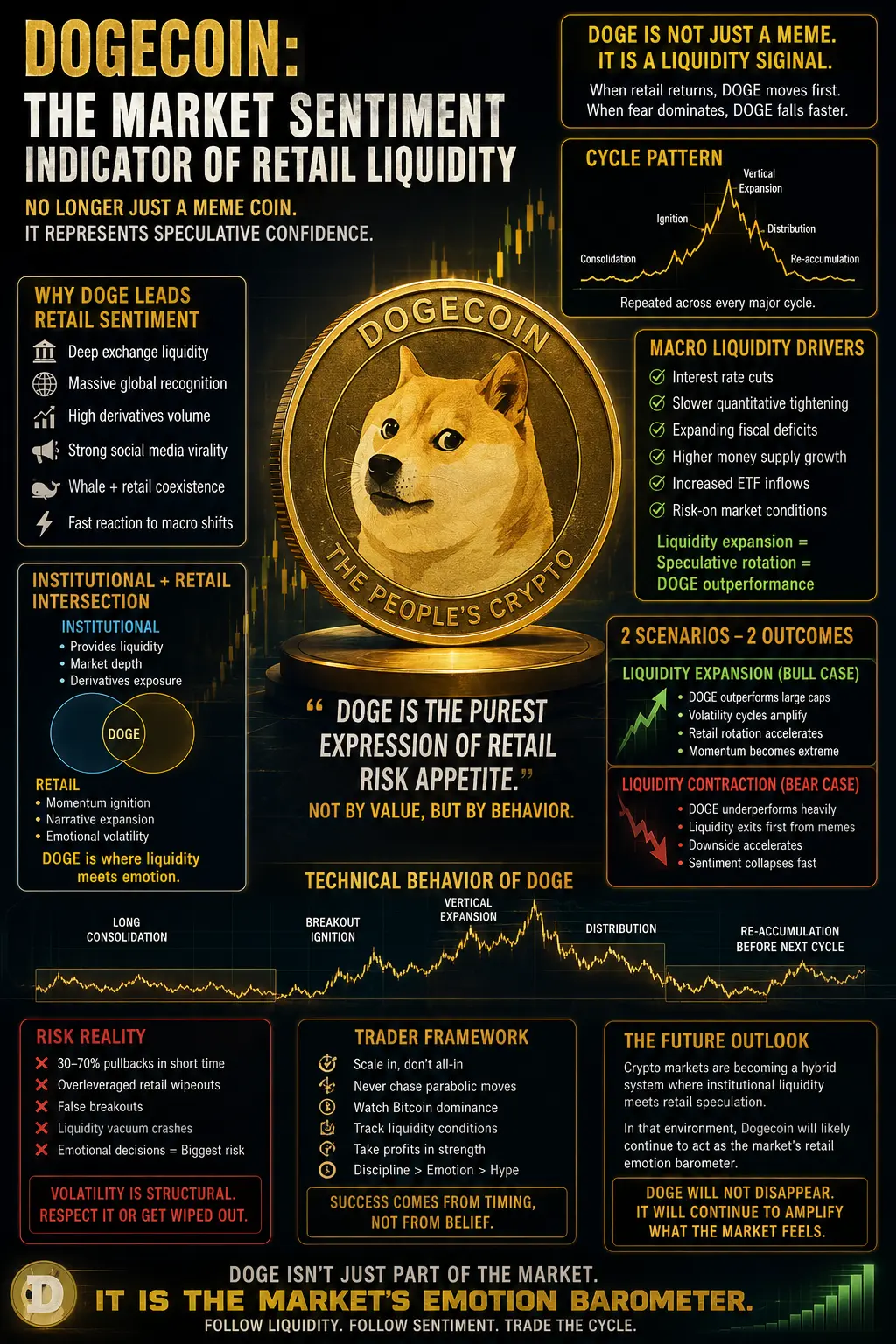
Dogecoin: The Most Misunderstood Liquidity Signal in Crypto Markets
Dogecoin is still widely mischaracterized by market participants as a “meme coin,” as if that label is enough to explain away its recurring relevance across multiple market cycles.
But when you step back and analyze liquidity flow, retail participation waves, and speculative capital rotation, a different interpretation becomes unavoidable.
Dogecoin is no longer just a narrative-driven asset.
It functions as a high-beta retail liquidity indicator — one of the earliest instruments to reflect shifts in speculative risk appetite.
And in the current global macro environment, that role is becoming structurally more important.
DOGE as a Real-Time Sentiment Mechanism
Across multiple crypto cycles, one consistent pattern has emerged:
When retail liquidity returns aggressively to the market, Dogecoin is typically among the first assets to react.
This is not coincidence. It is structure.
DOGE sits at the extreme end of risk preference:
Emotion-driven positioning
Narrative-sensitive price discovery
Liquidity-amplified volatility
Socially accelerated momentum
High participation from leveraged retail flows
Because of this, DOGE behaves less like a traditional asset and more like a live feed of crowd psychology.
When confidence returns, DOGE expands faster than most assets.
When fear dominates, it contracts harder than most assets.
This duality is not inefficiency — it is its design.
The Structural Shift in Global Liquidity
The broader financial system is undergoing a major transformation where crypto and traditional finance are increasingly interconnected.
Key developments include:
Expansion of spot crypto ETFs
Institutional custody frameworks
Tokenization of real-world assets
Stablecoin-based settlement layers
AI-driven execution systems
Cross-market liquidity integration between TradFi and crypto
This evolving structure means liquidity is no longer isolated. It moves faster, reacts faster, and rotates more aggressively across asset classes.
Historically, whenever liquidity expands in this manner, capital does not distribute evenly.
It concentrates into high-volatility sectors first.
That is where Dogecoin becomes relevant again.
Why DOGE Remains a Core Retail Liquidity Asset
Dogecoin continues to maintain unique structural advantages:
Deep global exchange liquidity
High recognition beyond crypto-native audiences
Strong derivatives participation and leverage cycles
Persistent social media amplification capability
Whale participation combined with retail crowd behavior
This creates a rare condition where DOGE becomes one of the few assets that consistently reflects mass speculative behavior in real time.
It is not just traded.
It is emotionally synchronized with market participants.
Price Behavior Structure
Dogecoin does not follow conventional valuation logic.
Its market structure typically evolves in cycles:
Extended consolidation phases with declining volatility
Sudden narrative ignition events
Rapid vertical expansions driven by momentum accumulation
Sharp distribution phases during late retail entry
Long re-accumulation periods before the next cycle begins
This structure is driven primarily by liquidity timing and behavioral reflexes rather than fundamentals.
As a result, DOGE is less about prediction and more about cycle positioning.
Liquidity Is the Real Driver
A major misconception is that Dogecoin’s movement is purely driven by social media hype.
In reality, hype is only the surface layer.
The deeper driver is macro liquidity conditions:
Interest rate cycles
Money supply expansion or contraction
Fiscal deficit trends
ETF inflow dynamics
Institutional risk exposure adjustments
If 2026 develops into a liquidity expansion phase driven by rate cuts, reduced tightening pressure, and stronger capital inflows into digital assets, then speculative capital rotation into high-volatility assets becomes highly probable.
In that scenario, Dogecoin historically becomes one of the primary beneficiaries.
Volatility Risk Structure
Dogecoin is not a stable or long-term fundamental asset.
It is a volatility instrument.
That introduces structural risks:
Rapid drawdowns during liquidity contraction
Emotion-driven liquidation cascades
False breakout traps during low-volume periods
Severe overextension during euphoric phases
Sharp reversals following speculative peaks
Most traders do not fail because of direction.
They fail because they misjudge volatility magnitude.
DOGE does not move gradually.
It moves in shocks.
Institutional and Retail Interaction Dynamic
A defining feature of the current cycle is the growing interaction between institutional liquidity and retail speculation.
Dogecoin sits directly in this intersection.
Institutions provide:
Market depth
Liquidity stability
Structural participation through derivatives exposure
Retail provides:
Momentum acceleration
Narrative expansion
Emotional volatility injection
DOGE becomes the interaction layer between both forces.
That makes it one of the clearest sentiment-driven assets in the entire crypto ecosystem.
Forward Market Outlook
Under a liquidity expansion scenario:
Dogecoin tends to outperform large-cap assets in percentage terms
Volatility cycles become sharper and faster
Retail rotation accelerates into speculative sectors
Momentum phases become increasingly extreme
Under liquidity contraction:
DOGE underperforms aggressively
Liquidity exits meme sectors first
Downside accelerates faster than most major assets
Sentiment collapses rapidly
In both environments, DOGE remains highly directional.
It does not sit in equilibrium.
It amplifies conditions.
Trading Reality
Dogecoin requires a different framework than traditional investing.
It behaves as:
A sentiment tracking instrument
A liquidity momentum proxy
A cycle timing indicator
Effective participation requires:
Controlled position scaling instead of emotional entry sizing
Awareness of Bitcoin dominance shifts
Monitoring macro liquidity conditions
Strict profit-taking discipline during euphoric phases
Avoiding late-cycle emotional exposure
Because in meme-driven environments, emotional conviction is not an advantage.
It is a liability.
Final Perspective
Dogecoin is often dismissed because it lacks traditional valuation metrics.
But that dismissal misses its actual function.
It is not trying to represent value.
It represents behavior.
In a modern financial system increasingly defined by:
Institutional liquidity frameworks
Algorithmic execution systems
Macro-driven capital flows
Retail sentiment cycles
Dogecoin remains one of the clearest real-time reflections of speculative risk appetite.
It is not becoming more serious.
It is becoming more structurally relevant to market psychology.
And in that sense, its role is unlikely to disappear in the next cycle.
Because markets will always need a pressure gauge for crowd emotion.
And right now, Dogecoin fills that role more clearly than almost any other asset.
repost-content-media
  • Reward
  • 2
  • Repost
  • Share
SoominStar:
DYOR 🤓
View More
#GateSquareDaily
The crypto market has been moving inside a tight price range in recent days. Bitcoin has found balance near the 78 thousand dollar area. The daily pullback stays small, yet a clear calm shows up on the volume side.
Market players now look for new data flow for a big move. U.S. rate policy, ETF inflows, and global capital moves keep guiding price. Large funds shifted to a hold mode instead of firm buying, which made a short-term lull in the market.
On the chart side, the 77 thousand dollar zone stands out as firm support. On the top side, 80 thousand dollars has turned into a
BTC-2.78%
discovery
#GateSquareDaily
The crypto market has been moving inside a tight price range in recent days. Bitcoin has found balance near the 78 thousand dollar area. The daily pullback stays small, yet a clear calm shows up on the volume side.
Market players now look for new data flow for a big move. U.S. rate policy, ETF inflows, and global capital moves keep guiding price. Large funds shifted to a hold mode instead of firm buying, which made a short-term lull in the market.
On the chart side, the 77 thousand dollar zone stands out as firm support. On the top side, 80 thousand dollars has turned into a mental mark. The squeeze between these two levels makes the odds of a sharp break stronger in the coming days.
The altcoin market does not look as firm as Bitcoin. Most capital flow still circles around BTC. This shows buyer focus stays on the lead asset with a safe-haven view.
While firm-side focus goes on, market mood moves with care. Large players look more at long-term value hold than short swings. For that reason, the current calm view means energy build-up before a strong move, to some pros.
#Bitcoin
repost-content-media
  • Reward
  • 7
  • Repost
  • Share
discovery:
To The Moon 🌕
View More
#GateSquareDaily
One more eye-catching step about crypto assets came up in the U.S. policy circle. A new draft bill called the “American Reserve Modernization Act” puts forward adding Bitcoin to a strategic reserve setup for at least 20 years.
This move shows that digital assets are no longer seen only as tech goods, but as a long-term economic power factor. Groups backing the bill argue that, due to its capped supply, Bitcoin can give cover against dollar-based price growth pressure.
After central banks raised gold holdings in recent years, the idea of a digital reserve began to be talked ab
BTC-2.78%
discovery
#GateSquareDaily
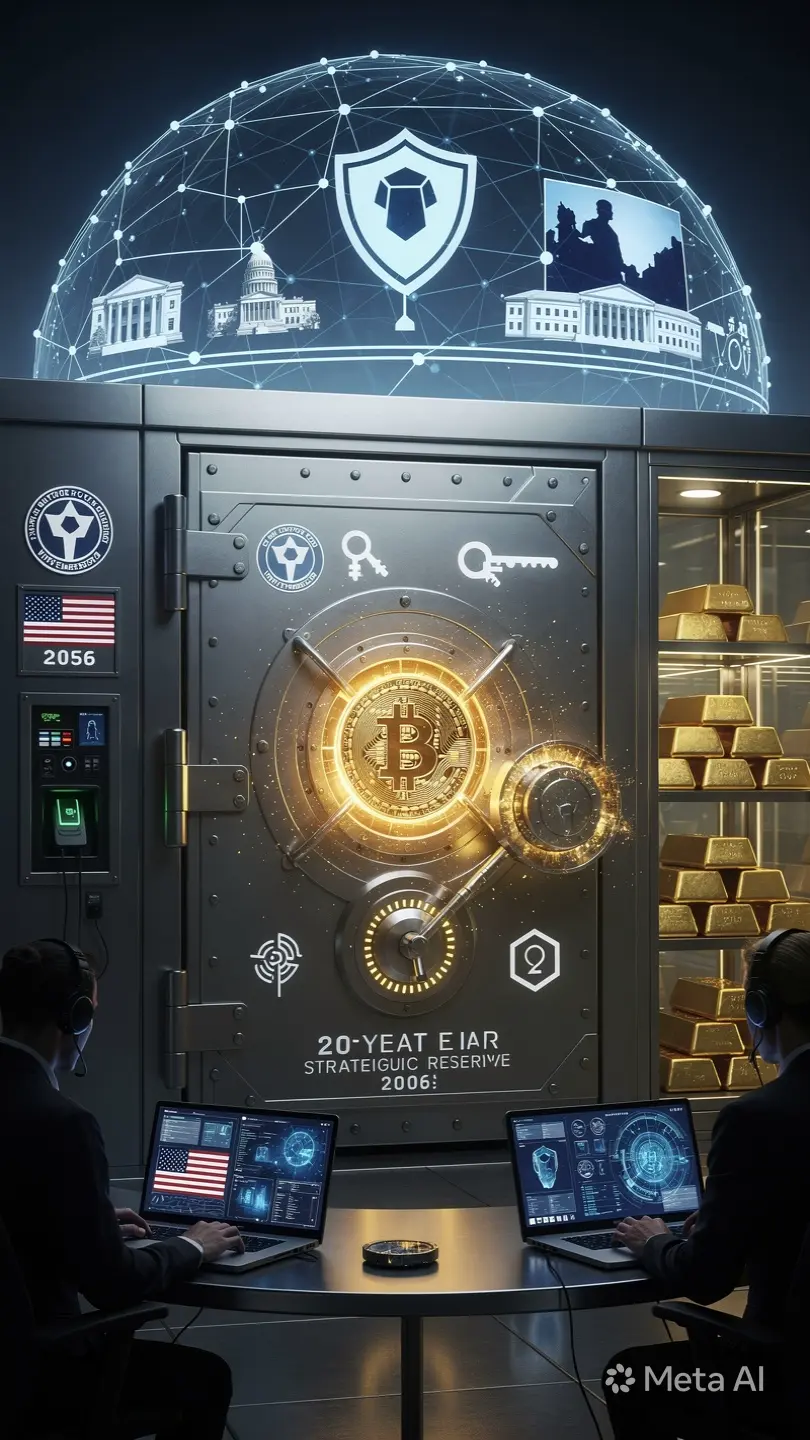
One more eye-catching step about crypto assets came up in the U.S. policy circle. A new draft bill called the “American Reserve Modernization Act” puts forward adding Bitcoin to a strategic reserve setup for at least 20 years.
This move shows that digital assets are no longer seen only as tech goods, but as a long-term economic power factor. Groups backing the bill argue that, due to its capped supply, Bitcoin can give cover against dollar-based price growth pressure.
After central banks raised gold holdings in recent years, the idea of a digital reserve began to be talked about in a big way. The “digital gold” tag for Bitcoin has been used for a long time; this bill now lifts that view to the policy level.
Two views stand out in finance circles. The side in favor thinks the U.S. must keep its lead in the digital economy race. The side against it says such a step holds risk due to high price swings.
Even so, moves like this hold huge mental value for the crypto market. Because every good step at the state level builds a stronger feel of trust for large firms.
Bitcoin is no longer just a tool to buy and hold; it is turning into a strategic asset named in the global economic power math.
#DigitalReserve
repost-content-media
  • Reward
  • 6
  • Repost
  • Share
discovery:
To The Moon 🌕
View More
#Web3SecurityGuide The Web3 ecosystem is expanding at a rapid pace, but with this growth comes a parallel rise in security threats that are becoming more sophisticated, more automated, and far more damaging than earlier crypto cycles. In a decentralized environment where users directly control their assets, there is no central authority to reverse transactions, recover funds, or resolve disputes, which means every action carries final and irreversible consequences. This makes security not just a technical requirement but the foundation of survival in Web3.
Unlike traditional finance, where ba
  • Reward
  • 5
  • 1
  • Share
discovery:
To The Moon 🌕
View More
#30YearTreasuryYieldBreaks5% The breakout of the U.S. 30-Year Treasury Yield above the critical 5% threshold is not just another macro headline—it represents a structural repricing of global capital costs that is now forcing every major asset class, from equities to cryptocurrencies, into a new financial reality.
With long-duration yields recently trading in the 5.15%–5.22% range, global markets are signaling a clear message: investors are demanding significantly higher compensation to lock money into long-term U.S. government debt due to persistent inflation concerns, fiscal expansion risks,
BTC-2.78%
  • Reward
  • 6
  • Repost
  • Share
discovery:
To The Moon 🌕
View More
#HYPEOutperformsAgain #GatePlaza | HYPE再度领涨
May 22 Market Insight — Structural Liquidity Breakdown
As of May 22, Hyperliquid (HYPE) has extended its aggressive upward trajectory with another +15% single-day surge, pushing price to $58.97 and marking a +134% year-to-date performance. This is not a simple bullish continuation phase anymore. The market is now operating in a high-volatility liquidity expansion regime where leverage, forced liquidations, and momentum flows are dominating price discovery.
The most critical event in the latest move is the liquidation wave exceeding $30.6 million wit
HYPE-5.33%
  • Reward
  • 3
  • Repost
  • Share
SoominStar:
Diamond Hands 💎
View More
#WarshSwornInAsFedChair The swearing-in of Kevin Warsh as Chairman of the U.S. Federal Reserve is not just a leadership change—it represents a global monetary reset signal that will directly influence liquidity flows, risk appetite, and capital allocation across every major asset class on Earth.
In today’s macro environment, the Federal Reserve is not simply a domestic institution. It is the central pricing engine of global liquidity, and any shift in its leadership instantly forces revaluation across equities, bonds, forex, commodities, and increasingly the crypto market.
This transition ar
BTC-2.78%
  • Reward
  • 6
  • 1
  • Share
ellesmul:
To The Moon 🌕
View More
#SpaceXOfficiallyFilesforIPO The financial world may be standing at the edge of a structural shift that most investors are still underestimating. The latest IPO filing from SpaceX has revealed something that instantly changed the tone of both traditional finance and crypto markets: a reported holding of 18,712 BTC worth approximately $1.45 billion.
This is not just another corporate treasury update. This is a signal. A loud, deliberate, and highly strategic signal from one of the most influential technology companies in the world that Bitcoin is no longer being treated as an experimental ass
  • Reward
  • 5
  • Repost
  • Share
SoominStar:
1000x VIbes 🤑
View More
GATE SQUARE PIZZA FESTIVAL — MEME MARKET REFLECTION
In every crypto cycle, there is always one story that breaks the seriousness of finance and exposes the raw psychology of early adoption. The 10,000 BTC pizza trade is that story.
At the time, it was not irrational. It was utility testing. A developer proving Bitcoin could function as money in the real world. Two pizzas became proof of concept.
But markets don’t evaluate intention. They evaluate outcome.
Today, that same trade is used as a meme, but behind the humor lies a structural truth: value in emerging assets is invisible until adoption
MEME-4.7%
BTC-2.78%
  • Reward
  • 4
  • Repost
  • Share
SoominStar:
1000x VIbes 🤑
View More
🍕 Gate Square Pizza Festival — BTC Pizza Day: The Trade That Became the Most Expensive Meal in History
There are moments in financial history that don’t just define a market… they redefine perception of value itself.
BTC Pizza Day is one of those rare moments.
Fourteen years ago, a simple transaction took place — 10,000 BTC exchanged for two pizzas. At that time, it was a casual experiment in digital money utility.
Today, it stands as a permanent reminder that markets don’t reward immediate logic.
They reward conviction over time.
━━━━━━━━━━━━━━━━━━━━━━ 📊 THE REAL LESSON BEHIND THE PIZZA TRA
BTC-2.78%
  • Reward
  • 2
  • Repost
  • Share
SoominStar:
DYOR 🤓
View More
#Polymarket每日热点 — Bitcoin Trading Idea: Will Momentum Exhaust After Relief Bounce or Extend Into Short Squeeze Expansion?
MARKET UPDATE: Bitcoin is currently stabilizing around the $77K region after a short-term rebound attempt triggered by improving macro sentiment and temporary risk-on positioning. Price briefly pushed toward $78K but failed to establish strong continuation structure, leaving the market inside a fragile consolidation zone.
The key issue right now is not direction alone.
It is whether this rebound has real structural demand behind it — or if it is simply a liquidity-driven mo
BTC-2.78%
  • Reward
  • 3
  • 1
  • Share
SoominStar:
1000x VIbes 🤑
View More
#Polymarket每日热点 — Bitcoin Intraday Prediction: Is BTC Preparing for a Breakout Reversal or Just a Macro Relief Trap?
📢 MARKET STRUCTURE UPDATE: Bitcoin is currently hovering around the $77K zone after a brief rebound attempt toward $78K, following renewed macro optimism tied to geopolitical developments and risk sentiment improvement.
But beneath the surface, the real question is not about the rebound itself.
It is about whether this move has structural strength — or is just liquidity-driven relief inside a broader distribution range.
The market is now sitting at a critical decision point.
━━
BTC-2.8%
  • Reward
  • 2
  • Repost
  • Share
SoominStar:
1000x VIbes 🤑
View More
#PlatinumCardCreatorExclusive — Gate Square Platinum Tier: The Hidden Power Layer Behind Institutional-Level Crypto Content Influence
PLATINUM CARD CREATOR status inside Gate Square is not a cosmetic label or engagement badge.
It is a structural positioning layer inside the ecosystem — where content stops being “posts” and starts becoming market influence signals.
What is forming here is not just a creator hierarchy.
It is a content-driven influence economy emerging inside crypto trading communities.
And Platinum sits at the top of that structure.
━━━━━━━━━━━━━━━━━━━━━━ 📊 PLATINUM TIER: WHAT
  • Reward
  • 3
  • Repost
  • Share
SoominStar:
To The Moon 🌕
View More
#TradfiTradingChallenge XAUT Under Pressure: Is Tokenized Gold Entering a Hidden Institutional Liquidity Repricing Phase?
🚨 BREAKING STRUCTURAL READ: XAUT is no longer just moving as a passive gold proxy — it is now behaving like a macro-sensitive liquidity instrument inside the evolving tokenized commodity stack.
What looks like a simple pullback is actually forming a deeper structural question:
Is tokenized gold absorbing institutional capital quietly… or is it preparing for a forced liquidity expansion phase?
The market is not trending.
It is compressing under macro tension.
And historical
XAUT-0.73%
XAUUSD-0.74%
  • Reward
  • 3
  • Repost
  • Share
SoominStar:
Diamond Hands 💎
View More
  • Pinned