juttmunda

vip
Age 0.7 Year
Peak Tier 0
No content yet
#Web3SecurityGuide
Web3 has transformed the financial world by giving users direct ownership of digital assets without relying on traditional banks or centralized institutions. Blockchain technology allows people to control their own wealth, interact with decentralized applications, trade globally, and participate in the digital economy with full financial freedom.
However, this freedom comes with major responsibility.
In traditional finance, banks manage security systems, fraud protection, and account recovery processes. In Web3, users are fully responsible for protecting their wallets, priv
HighAmbition
#Web3SecurityGuide
Web3 has transformed the financial world by giving users direct ownership of digital assets without relying on traditional banks or centralized institutions. Blockchain technology allows people to control their own wealth, interact with decentralized applications, trade globally, and participate in the digital economy with full financial freedom.
However, this freedom comes with major responsibility.
In traditional finance, banks manage security systems, fraud protection, and account recovery processes. In Web3, users are fully responsible for protecting their wallets, private keys, and assets. If a wallet is compromised or a seed phrase is exposed, transactions cannot usually be reversed.
As cryptocurrency adoption continues expanding in 2026, cyber threats inside the blockchain ecosystem are also increasing rapidly. Phishing attacks, wallet drainers, fake applications, malicious smart contracts, social engineering campaigns, and exchange impersonation scams are now more advanced than ever before.
Understanding Web3 security is now one of the most important skills for every crypto user.
The Foundation of Crypto Ownership
The most important principle in blockchain security is:
“Not Your Keys, Not Your Coins.”
This means ownership of crypto assets depends entirely on who controls the private keys.
Important components of every wallet include:
🔑 Private Key — The secret code controlling access to funds
🔑 Public Address — The wallet address used to receive assets
🔑 Seed Phrase — Backup recovery phrase used to restore wallets
🔑 Smart Contract Permissions — Approvals allowing applications to access tokens
Anyone with access to the seed phrase or private key can fully control the wallet.
This is why crypto security begins with protecting recovery information properly.
Modern Web3 Threat Landscape
The Web3 ecosystem now faces multiple categories of cyber threats, including:
• Phishing websites
• Fake exchange login pages
• Wallet drainers
• Malicious browser extensions
• Address poisoning attacks
• Fake customer support accounts
• AI-generated scam campaigns
• Fake airdrops and giveaways
• Social engineering attacks
• Smart contract exploits
• SIM swap attacks
• Malware targeting wallet files
Many attacks no longer rely on technical hacking alone. Instead, attackers often manipulate users emotionally through urgency, fear, excitement, or fake investment opportunities.
Seed Phrase Protection — The Highest Priority
Your seed phrase is the master backup for your wallet.
If someone gains access to it: • They can restore your wallet anywhere • They can transfer all assets instantly • They can bypass passwords and device security
Because of this, proper seed phrase storage is critical.
Best practices include:
✅ Write seed phrases on physical materials
✅ Store backups in secure offline locations
✅ Use fireproof or metal backup solutions
✅ Keep multiple copies in separate locations
✅ Protect backups from water and physical damage
Never: ❌ Save seed phrases in screenshots
❌ Store phrases in cloud drives
❌ Share phrases through messaging apps
❌ Enter phrases into websites
❌ Give phrases to support agents
Legitimate exchanges and wallet providers will never ask for your recovery phrase.
Hardware Wallet Security
Hardware wallets remain one of the strongest security solutions for long-term crypto storage.
Popular hardware wallet providers include: • Ledger
• Trezor
• SafePal
• Keystone
These devices store private keys offline, reducing exposure to online attacks.
Benefits of hardware wallets: ✅ Offline key storage
✅ Protection from malware
✅ Secure transaction signing
✅ Physical verification screens
✅ Better long-term storage security
Most experienced investors use cold wallets for large holdings and hot wallets for daily activity.
The 80/20 Security Strategy
Professional crypto users often follow the 80/20 protection strategy:
• 80–90% of holdings stay in cold storage
• 10–20% remain in hot wallets or exchanges for active use
This reduces overall risk exposure significantly.
Even if a hot wallet is compromised, most funds remain protected offline.
Exchange Security — Safe Trading Practices
When using centralized exchanges such as gate.io, account protection becomes extremely important.
Recommended security settings include:
✅ Enable Google Authenticator 2FA
✅ Use strong unique passwords
✅ Activate anti-phishing codes
✅ Enable withdrawal whitelist protection
✅ Monitor login history regularly
✅ Avoid logging in through public WiFi
✅ Use separate emails for trading accounts
Gate.io also provides advanced security infrastructure, including risk monitoring systems, cold wallet storage solutions, and multi-layer account protection features.
However, personal account security still depends heavily on the user’s own habits and awareness.
Smart Contract Risks in DeFi
Every time users connect wallets to decentralized applications, they approve permissions that may access tokens or NFTs.
Malicious contracts may: • Drain wallets automatically
• Steal NFTs
• Abuse unlimited approvals
• Transfer assets without clear warnings
Before interacting with DeFi platforms:
✅ Research projects carefully
✅ Verify security audits
✅ Review community reputation
✅ Start with small amounts
✅ Check wallet transaction previews
✅ Revoke unnecessary approvals regularly
Security awareness is essential when exploring new protocols.
Address Poisoning Attacks
Address poisoning is becoming increasingly common across blockchain networks.
Attackers send small transactions from wallet addresses visually similar to legitimate ones. Users accidentally copy the fake address from transaction history and send funds to attackers.
Protection methods:
✅ Verify entire wallet addresses carefully
✅ Save trusted addresses in wallet books
✅ Avoid copying addresses from transaction history
✅ Double-check recipient information before confirming
Even experienced traders have lost significant funds through address poisoning mistakes.
Social Engineering Threats
Many attackers focus on manipulating human behavior instead of attacking blockchain technology directly.
Common tactics include: • Fake support messages
• Emergency account warnings
• Fake investment opportunities
• Giveaway scams
• Impersonation on Telegram or Discord
• Pressure to act immediately
Important reminder: No legitimate platform will ask for your seed phrase or private keys.
Always verify information through official channels before taking action.
Two-Factor Authentication (2FA)
Two-factor authentication adds another security layer beyond passwords.
Security ranking:
Hardware Security Keys
Authenticator Apps
SMS Verification
Authenticator apps such as Google Authenticator are generally stronger than SMS-based protection because SMS systems may face SIM swap attacks.
Browser & Device Security
Crypto security also depends heavily on device protection.
Recommended practices: ✅ Keep operating systems updated
✅ Remove suspicious browser extensions
✅ Avoid cracked software
✅ Use antivirus protection
✅ Lock devices securely
✅ Separate crypto activity from general browsing
Many modern wallet drainers are hidden inside fake browser extensions or malicious software downloads.
DeFi & Yield Farming Risks
Decentralized finance offers high opportunities but also carries serious risks.
Before depositing funds into protocols: • Understand token utility
• Study liquidity conditions
• Review audit reports
• Analyze platform reputation
• Understand smart contract exposure
High rewards often come with elevated risks.
Careful research remains one of the strongest protections in DeFi.
NFT & Web3 Gaming Security
NFT ecosystems continue facing phishing attacks and fake mint scams.
Common risks include: • Fake NFT collections
• Malicious mint pages
• Wallet connection scams
• Fake marketplace listings
Users should: ✅ Verify official collection pages
✅ Avoid random mint links
✅ Review transaction approvals carefully
✅ Use separate wallets for testing new platforms
AI-Powered Crypto Scams
Artificial intelligence is making scams more convincing.
Modern threats now include: • AI-generated phishing emails
• Deepfake influencer videos
• Fake voice calls
• Automated social engineering campaigns
Scammers increasingly use realistic branding and professional-looking interfaces.
Always verify information through official websites and trusted channels.
Security Checklist
Daily: ✅ Verify wallet transactions
✅ Review URLs carefully
✅ Monitor account activity
Weekly: ✅ Check wallet permissions
✅ Update software
✅ Review browser extensions
Monthly: ✅ Audit wallets and accounts
✅ Update passwords
✅ Verify backup systems
Yearly: ✅ Test recovery procedures
✅ Update hardware wallet firmware
✅ Review complete security strategy
Web3 is creating a new era of digital ownership, decentralized finance, and blockchain innovation. However, the ability to control assets directly also means users must prioritize personal security at every level.
The strongest protection in crypto is not only technology — it is awareness, discipline, education, and responsible behavior.
Remember:
Protect your seed phrase carefully
Verify everything before signing
Security should become a daily habit
Responsible users survive long-term in Web3
Stay informed. Stay careful. Stay secure.

repost-content-media
  • Reward
  • Comment
  • Repost
  • Share
#30YearTreasuryYieldBreaks5%
Global financial markets are entering one of the most important macroeconomic transitions of recent years as the U.S. 30-Year Treasury Yield rises above the critical 5% level, recently trading around 5.15%–5.22%, creating major pressure across stocks, bonds, real estate, commodities, and cryptocurrencies.
This move is not being viewed as a normal fluctuation because long-term Treasury yields are considered one of the strongest indicators of inflation expectations, future liquidity conditions, economic confidence, and investor risk perception. When long-duration y
HighAmbition
#30YearTreasuryYieldBreaks5%
Global financial markets are entering one of the most important macroeconomic transitions of recent years as the U.S. 30-Year Treasury Yield rises above the critical 5% level, recently trading around 5.15%–5.22%, creating major pressure across stocks, bonds, real estate, commodities, and cryptocurrencies.
This move is not being viewed as a normal fluctuation because long-term Treasury yields are considered one of the strongest indicators of inflation expectations, future liquidity conditions, economic confidence, and investor risk perception. When long-duration yields rise aggressively, it signals that investors are demanding significantly higher compensation to lock capital away for decades due to concerns surrounding inflation, government debt, and long-term economic uncertainty.
The 30-Year Treasury Yield represents the annual return investors receive after purchasing long-term U.S. government bonds, which are traditionally considered among the safest financial assets globally because they are backed by the United States government itself.
When yields remain around 2%–3%, markets usually interpret conditions as stable with manageable inflation and strong monetary confidence. However, once yields move above 5%, investor psychology changes dramatically because it reflects fears that inflation may stay elevated for longer while borrowing costs and fiscal risks continue rising.
A simple way to understand this situation is that investors are no longer comfortable lending money to governments for 30 years unless they receive much higher returns to compensate for future uncertainty and declining purchasing power.
One of the biggest reasons Treasury yields are rising sharply in 2026 is the return of inflation pressure across global markets. Oil prices have remained elevated due to geopolitical tensions in the Middle East, creating fears regarding transportation costs, manufacturing expenses, and food inflation across the global economy.
At the same time, investors are increasingly worried about the rapidly growing U.S. fiscal deficit and long-term debt burden because the government continues issuing enormous amounts of Treasury bonds to finance spending while interest payments themselves are becoming larger and more expensive.
Federal Reserve expectations have also shifted significantly because markets previously expected multiple interest-rate cuts during 2026, but stronger inflation data and resilient economic conditions are forcing traders to reconsider that outlook. Instead of aggressive easing, markets are now pricing in a “higher for longer” rate environment where interest rates may remain elevated much longer than originally expected.
Higher Treasury yields directly affect nearly every sector of the financial system because they increase borrowing costs across the economy.
Mortgage rates in the United States have climbed toward roughly 6.5%–7%, reducing housing affordability and slowing real-estate activity. Corporate borrowing costs have also increased sharply, forcing businesses to reconsider expansion plans, refinancing strategies, and long-term investments.
Technology and growth stocks are facing strong pressure because rising interest rates reduce the present value of future earnings, encouraging investors to shift capital away from risk-heavy sectors toward safer fixed-income investments that now offer attractive guaranteed returns.
The U.S. Dollar Index has strengthened significantly as global investors move capital into dollar-denominated assets to benefit from higher Treasury yields, creating additional pressure on international markets and emerging economies.
₿ Cryptocurrency markets are especially sensitive to liquidity conditions, interest rates, and macroeconomic uncertainty because Bitcoin, Ethereum, and altcoins generally perform best when liquidity is abundant and borrowing costs remain low.
When Treasury yields rise above 5%, investors suddenly gain access to relatively attractive “risk-free” returns through government bonds, reducing the relative attractiveness of high-volatility assets such as cryptocurrencies.
Bitcoin itself does not generate interest or dividends, which means higher Treasury yields increase the opportunity cost of holding BTC, especially for institutional investors managing large portfolios where stable fixed-income returns become more attractive during uncertain macroeconomic conditions.
Another major issue for crypto markets is liquidity tightening because higher rates reduce access to leverage and speculative capital flows that normally fuel aggressive rallies across Bitcoin and altcoins. As financial conditions tighten, volatility often increases sharply due to liquidations and weaker buying momentum.
As of May 2026, Bitcoin is trading around $76,500–$78,500 while facing strong macro-driven volatility caused by Treasury-yield pressure and inflation concerns.
Total crypto market capitalization remains near approximately $2.6 trillion–$2.75 trillion, while daily trading volume fluctuates around $75 billion–$82 billion as traders react to inflation data, Federal Reserve expectations, and geopolitical developments.
Bitcoin dominance remains relatively strong near 60%–61%, showing that investors currently prefer larger and more established digital assets over smaller speculative altcoins during uncertain macroeconomic conditions.
The Fear & Greed Index remains near the 38–42 range, reflecting cautious sentiment as traders hesitate to take aggressive risk exposure while Treasury yields continue rising.
The $80,000 region remains the most important resistance zone for Bitcoin because a sustained breakout above that level could potentially open momentum toward $85,000–$92,000 if liquidity conditions stabilize.
On the downside, the $75,000 area remains critical support because losing that level could expose Bitcoin to deeper corrections toward $72,000 and potentially even $68,000–$65,000 if Treasury yields continue climbing higher.
Markets are also closely watching Treasury yields themselves because sustained movement above 5.2%–5.3% could intensify pressure across both stock markets and cryptocurrencies simultaneously.
Historically, the last major period when 30-Year Treasury Yields traded consistently above 5% occurred around 2007–2008 before the global financial crisis, making current conditions psychologically significant for investors.
During the 2022 tightening cycle, aggressive Federal Reserve rate hikes pushed yields sharply higher and contributed to Bitcoin collapsing from nearly $69,000 toward approximately $15,500 while many altcoins lost between 80%–95% of their value due to severe liquidity contraction and panic selling.
Although current market conditions are different because spot Bitcoin ETFs and institutional participation provide stronger long-term support, macroeconomic forces still dominate short-term market direction.
Despite near-term pressure, some analysts remain optimistic regarding Bitcoin’s long-term outlook because concerns surrounding inflation, government debt expansion, and traditional financial-system instability may strengthen Bitcoin’s “digital gold” narrative over time.
Long-term investors continue arguing that periods of macro fear and liquidity tightening often create major accumulation opportunities for assets with strong scarcity models and expanding institutional adoption.
In this environment, disciplined risk management becomes extremely important because market volatility can increase rapidly whenever inflation reports, Federal Reserve communication, or geopolitical developments surprise investors.
Reducing leverage exposure, maintaining stablecoin reserves, using stop-loss strategies, and monitoring macroeconomic indicators such as bond yields, oil prices, and inflation data are becoming just as important as technical analysis for crypto traders in 2026.
The breakout of the U.S. 30-Year Treasury Yield above 5% represents one of the most important macroeconomic developments of 2026 because it reflects tighter financial conditions, persistent inflation concerns, stronger demand for safe returns, and growing uncertainty surrounding the global economy.
For Bitcoin and the broader crypto market, this environment creates significant short-term pressure through liquidity tightening and higher opportunity costs, while still supporting long-term narratives around digital scarcity and institutional adoption.
One reality is now clear:
Bitcoin and crypto markets are no longer isolated from traditional finance because Treasury yields, inflation expectations, Federal Reserve policy, government debt, and global liquidity conditions have become central forces driving digital-asset markets in 2026.
repost-content-media
  • Reward
  • 2
  • Repost
  • Share
Yusfirah:
2026 GOGOGO 👊
View More
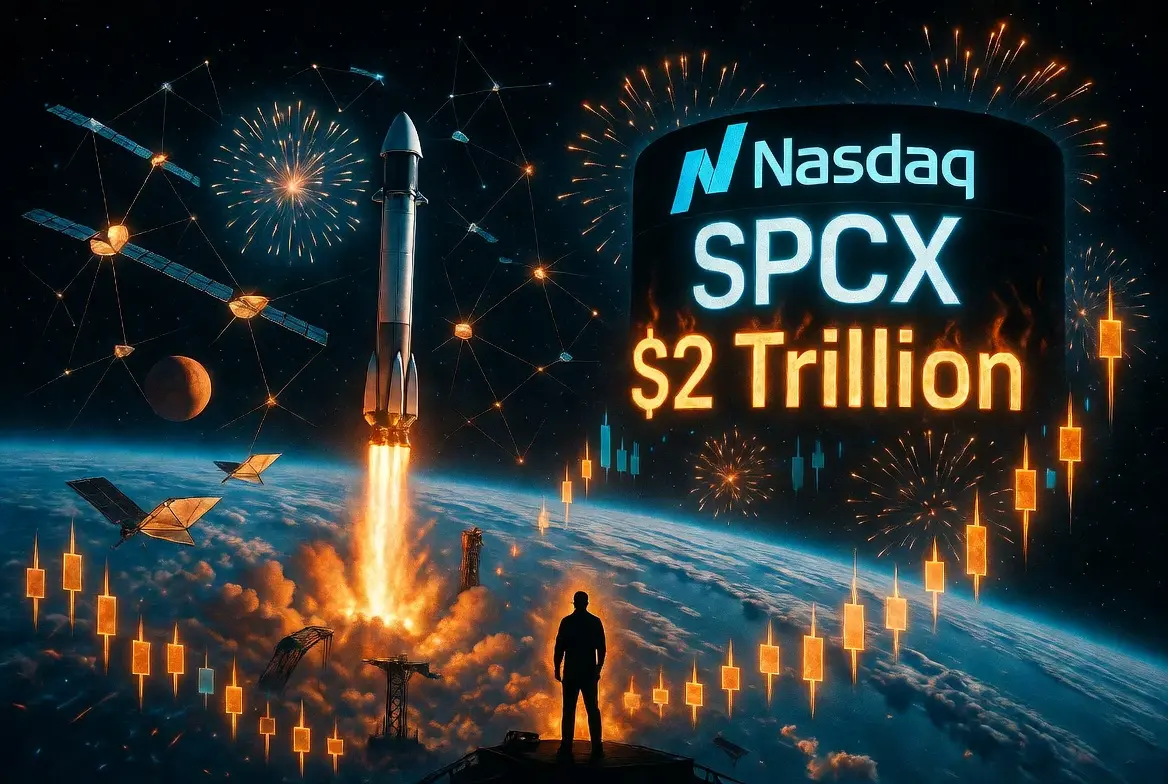
#SpaceXOfficiallyFilesforIPO
Opening Highlights — Why This Event Changes Everything
SpaceX stepping into public markets is not a routine IPO — it is a structural reset of how global capital views technology, infrastructure, and long-term value creation.
A projected valuation of nearly $2 trillion signals that markets are pricing in a multi-planetary, AI-driven future rather than a conventional aerospace business.
The inclusion of 18,712 BTC worth over $1.3 billion adds a powerful layer of digital asset legitimacy at the highest corporate level.
Investors are not just watching earnings anymor
BTC-2.8%
SPCX-4.28%
HighAmbition
#SpaceXOfficiallyFilesforIPO
Opening Highlights — Why This Event Changes Everything
SpaceX stepping into public markets is not a routine IPO — it is a structural reset of how global capital views technology, infrastructure, and long-term value creation.
A projected valuation of nearly $2 trillion signals that markets are pricing in a multi-planetary, AI-driven future rather than a conventional aerospace business.
The inclusion of 18,712 BTC worth over $1.3 billion adds a powerful layer of digital asset legitimacy at the highest corporate level.
Investors are not just watching earnings anymore — they are evaluating future civilizations of infrastructure, data, and orbital expansion.
This is where space engineering, artificial intelligence, and digital finance begin to merge into a single investment narrative.
Market Entry Shift — From Aerospace Firm to Global Infrastructure Core
The official S-1 filing of SpaceX on May 20, 2026, has triggered global attention across institutional and sovereign capital channels. With its planned Nasdaq ticker SPCX, the company is preparing for one of the largest IPOs in modern financial history.
The valuation range of $1.75 trillion to $2 trillion positions SpaceX far beyond a traditional aerospace entity. It is now being interpreted as a hybrid infrastructure platform combining orbital transport systems, AI computing ecosystems, and global communications networks.
The projected capital raise of $75–80 billion reflects extraordinary institutional demand, where investors are treating the IPO as a long-duration strategic allocation rather than a speculative listing.
Bitcoin Treasury Signal — Institutional Validation of Digital Assets
One of the most impactful disclosures within the filing is SpaceX’s holding of 18,712 Bitcoin, valued at approximately $1.3–1.45 billion.
This is not a passive treasury decision — it represents a strong institutional signal that Bitcoin is evolving into a strategic reserve asset. As one of the most influential private technology companies in the world, SpaceX’s allocation carries symbolic weight far beyond its balance sheet.
It reinforces a growing global narrative: Bitcoin is transitioning from a volatile speculative instrument into a long-term macro hedge against monetary instability, inflation cycles, and fiat currency dilution.
Financial Structure — Expansion-Driven Growth Model
SpaceX operates under a high-intensity reinvestment model where revenue expansion is prioritized over short-term profitability.
With $18.67 billion in annual revenue (2025) and significant operating losses, the company reflects a classic “scale-first, profit-later” strategy.
Adjusted EBITDA remains strong, indicating underlying operational efficiency despite aggressive capital deployment across multiple high-growth divisions.
This structure mirrors historical industrial revolutions where infrastructure dominance was achieved before profitability stabilization.
Starlink Network — The Revenue Engine of the Future
Starlink stands as the most mature and scalable business unit within SpaceX, generating over $11.3 billion in revenue and serving more than 10.3 million users globally.
It has evolved into a planetary-scale connectivity system rather than a satellite internet service. With over 9,600 satellites in orbit, Starlink represents the largest communication network ever deployed in space.
Its structural advantage lies in low-latency global coverage, making it increasingly competitive against traditional telecom giants and cloud-based communication infrastructure providers.
Starship & Space Division — Redefining Orbital Economics
The Starship program is central to SpaceX’s long-term disruption strategy, with over $15 billion invested in development.
Its objective is not incremental improvement but a fundamental reduction in cost per kilogram to orbit — potentially by up to 99%.
If successful, this will unlock entirely new economic sectors:
Orbital manufacturing ecosystems
Lunar logistics and exploration networks
Deep-space communication systems
Large-scale satellite deployment platforms
This marks a shift from space being a high-cost frontier to becoming a scalable industrial layer.
AI Infrastructure Expansion — Building the Compute Backbone
SpaceX’s integration with AI systems and xAI-linked infrastructure represents a rapidly expanding capital frontier.
With annual R&D exceeding $5 billion and total capital commitments surpassing $25 billion, the company is positioning itself as a core AI infrastructure provider, not just an application user.
This includes investments in:
High-performance GPU clusters
Distributed training systems
Autonomous robotics frameworks
Orbital AI communication networks
The long-term vision integrates AI across both terrestrial and space-based systems.
Orbital Data Centers — The Next Computing Revolution
A key future pillar is the development of space-based data centers expected around 2028.
These systems would operate using:
Continuous solar energy exposure
Vacuum-based thermal efficiency
Zero terrestrial infrastructure constraints
This could create a parallel global cloud layer operating above Earth, potentially reshaping how computational infrastructure is built and scaled.
$28.5 Trillion Convergence Thesis — Multi-Industry Integration
SpaceX’s long-term valuation narrative is built on the convergence of multiple trillion-dollar industries into a unified ecosystem.
This includes:
Artificial intelligence infrastructure
Global satellite communications
Defense and strategic networks
Orbital logistics systems
Autonomous manufacturing platforms
Rather than competing in one sector, SpaceX is positioning itself as an infrastructure aggregator across multiple global systems.
Governance Model — Concentrated Strategic Control
Elon Musk retains approximately 85% voting power through a dual-class share structure, ensuring long-term strategic control.
This governance model enables execution of highly ambitious, long-duration projects such as Mars colonization and orbital industrial systems.
However, it also introduces centralized decision-making risk, reducing traditional shareholder influence on corporate direction.
Risk Environment — High Complexity, High Execution Pressure
Despite strong institutional optimism, SpaceX operates within a high-risk execution environment:
Extremely capital-intensive development cycles
Regulatory dependencies across multiple jurisdictions
Starship technical uncertainty
AI infrastructure scaling challenges
Global supply chain volatility
At near $2 trillion valuation levels, even small deviations in growth assumptions may significantly impact market perception.
Final Perspective — The Birth of a New Asset Class
SpaceX’s IPO represents more than a corporate milestone — it signals the emergence of a new category of global assets combining:
Orbital infrastructure systems
Artificial intelligence compute networks
Digital financial integration (Bitcoin treasury)
Planetary-scale logistics ecosystems
If execution aligns with long-term projections, SpaceX may redefine how capital markets classify value — shifting from traditional industries to integrated technological civilizations spanning Earth and space.
repost-content-media
  • Reward
  • Comment
  • Repost
  • Share
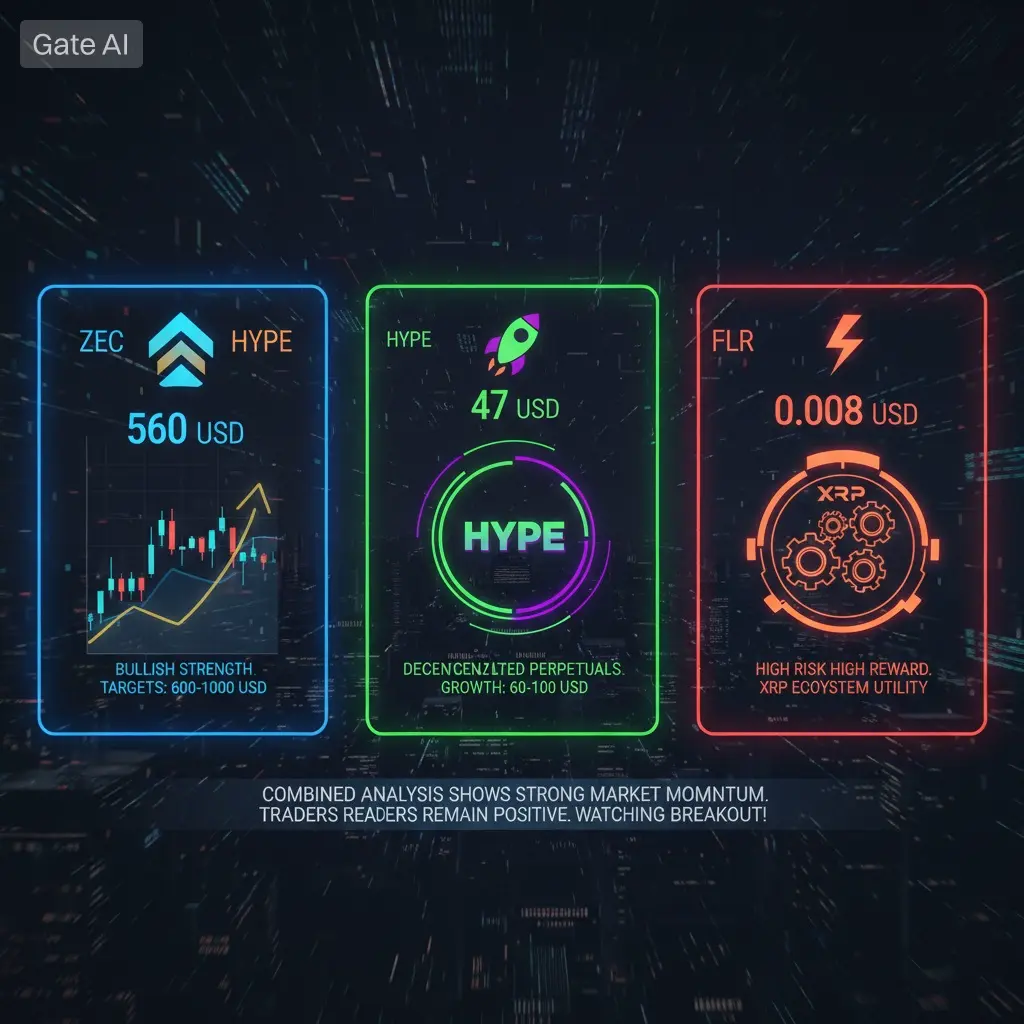
#ZEC.HYPE.FLRStrength
The 2026 crypto market is showing a powerful shift toward real utility driven assets where traders are no longer focusing only on hype cycles but instead prioritizing privacy technology, decentralized trading infrastructure, and cross chain data utility. In this evolving structure ZEC HYPE and FLR are emerging as three of the strongest narrative driven assets because each one represents a different core pillar of blockchain evolution.
ZEC represents privacy and financial anonymity using advanced zero knowledge cryptography. HYPE represents decentralized perpetual futures
HighAmbition
#ZEC.HYPE.FLRStrength
The 2026 crypto market is showing a powerful shift toward real utility driven assets where traders are no longer focusing only on hype cycles but instead prioritizing privacy technology, decentralized trading infrastructure, and cross chain data utility. In this evolving structure ZEC HYPE and FLR are emerging as three of the strongest narrative driven assets because each one represents a different core pillar of blockchain evolution.
ZEC represents privacy and financial anonymity using advanced zero knowledge cryptography. HYPE represents decentralized perpetual futures trading infrastructure with massive volume and strong revenue generation. FLR represents blockchain interoperability and XRPFi ecosystem expansion with focus on real world data integration and smart contract utility.
Together these three assets are being discussed as a diversified strength basket across crypto communities combining privacy liquidity and utility into one powerful market narrative.
ZEC Market Analysis
Zcash is currently trading near 560 dollars after a strong impulsive bullish recovery phase that started from lower accumulation zones and gradually expanded into a high momentum breakout structure. The asset has shown strong buyer dominance after breaking major resistance near 500 dollars which triggered increased volume inflows and institutional accumulation interest.
Recent trading range remains between 520 and 598 dollars with intraday volatility increasing significantly as traders reposition for higher targets. Daily trading volume is consistently above 650 million to 730 million dollars showing strong participation from both retail and larger market participants.
Market capitalization is currently around 8.7 to 9 billion dollars depending on exchange flow conditions while circulating supply pressure remains limited due to increasing shielded pool activity.
Earlier cycle data shows ZEC trading near 200 to 300 dollars and even below 100 dollars during long accumulation phases which means current valuation reflects a multi hundred percent recovery structure exceeding 1000 percent from historical lows.
Key Levels
Support 520 500 480 450
Resistance 600 650 700 850 1000 1200
If ZEC successfully holds above 520 dollars then bullish continuation toward 600 and 700 becomes highly probable. A strong breakout above 600 could trigger aggressive momentum expansion toward 850 and 1000 dollars zones where historical liquidity clusters may react strongly.
Some extended cycle projections discussed among traders suggest potential long term expansion toward 1200 to 1500 dollars if privacy narrative strengthens globally and institutional demand increases significantly.
ZEC Market Psychology
Trader sentiment around ZEC is strongly bullish because privacy coins are gaining renewed attention due to increasing concerns around data surveillance and centralized financial monitoring. Many traders are comparing ZEC to early Bitcoin phase behavior where undervalued narratives eventually lead to exponential growth cycles.
Whale accumulation behavior and reduced circulating supply through shielded transactions are adding additional bullish pressure. However volatility remains extremely high so traders are advised to monitor liquidity zones carefully.
HYPE Market Analysis
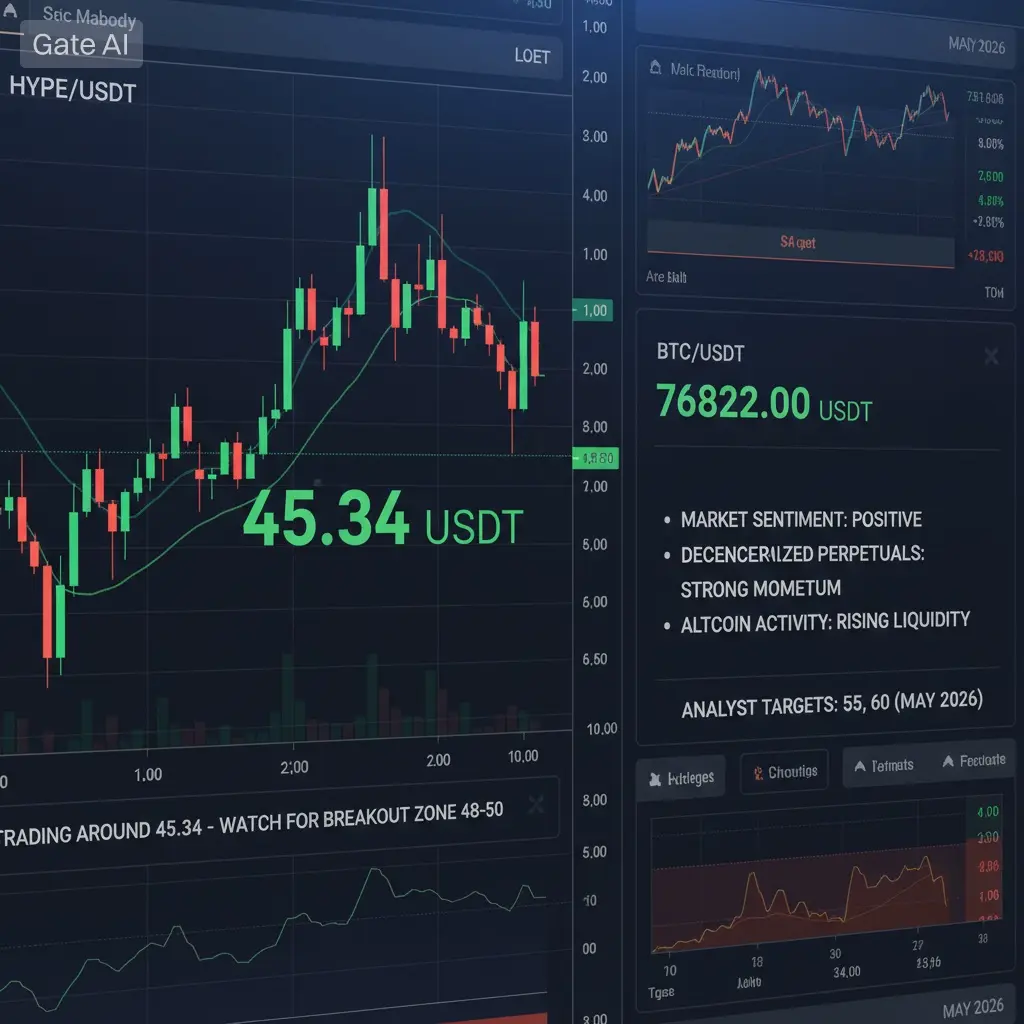
Hyperliquid is currently trading near 47 dollars and remains one of the strongest decentralized perpetual trading infrastructure assets in the entire crypto market. The protocol has established dominance in on chain derivatives trading with massive volume share and strong ecosystem expansion.
Market capitalization is approximately 10.9 to 11 billion dollars with daily trading volume ranging between 700 million and 800 million dollars showing continuous high level activity. The token benefits from a strong revenue driven model where trading fees contribute directly to buyback and burn mechanisms which creates long term deflationary pressure.
HYPE has previously reached price highs near 50 to 59 dollars and continues forming higher lows indicating strong structural demand even during correction phases.
Key Levels
Support 44 42 40 38
Resistance 50 60 75 100 120
If HYPE breaks above 50 dollars with strong volume confirmation then momentum expansion toward 60 and 75 dollars becomes highly likely. Long term breakout scenarios above 60 dollars could potentially unlock 100 to 120 dollars zones driven by ecosystem growth and increasing institutional participation.
HYPE Growth Drivers
One of the strongest growth drivers behind HYPE is its dominance in decentralized perpetual futures markets where it captures a significant share of trading volume compared to competing platforms. The integration of HyperEVM ecosystem expansion also increases developer activity and strengthens long term utility.
Institutional treasury interest and increasing adoption of decentralized derivatives platforms are further strengthening bullish expectations. Many traders now consider HYPE as one of the most important infrastructure plays in the crypto sector
FLR Market Analysis
Flare is currently trading near 0.0084 dollars and represents a low market cap high potential utility asset focused on blockchain interoperability and XRPFi ecosystem expansion. Despite short term weakness the long term structure remains constructive as accumulation patterns continue forming across multiple timeframes.
Market capitalization is around 900 million to 950 million dollars which is relatively small compared to other infrastructure assets making FLR a high risk high reward opportunity in the current market cycle
Historical performance shows strong percentage rallies during previous breakout phases where FLR delivered rapid gains exceeding 50 to 70 percent within short periods when momentum returned.
Key Levels
Support 0.0080 0.0075 0.0065 0.0060
Resistance 0.010 0.012 0.015 0.022 0.038 0.056 0.090
Breakout above 0.010 could trigger strong momentum expansion toward 0.015 and 0.022 levels while long term adoption of XRPFi infrastructure could push FLR into higher valuation zones over time.
FLR Utility Expansion
Flare’s core strength lies in its ability to connect external data sources to blockchain applications through decentralized oracle systems and state connector technology. This enables smart contracts to interact with real world data making it a key infrastructure layer for DeFi and XRP ecosystem integration.
As XRPFi continues expanding, FLR may benefit from increased usage demand, staking activity, and ecosystem participation which could gradually strengthen price structure over time.
Trader Sentiment Across All Three Assets
Overall market sentiment remains cautiously bullish across ZEC HYPE and FLR. Traders are rotating capital between privacy narratives infrastructure plays and utility driven assets depending on volatility conditions.
ZEC is viewed as high volatility privacy momentum asset
HYPE is viewed as strong revenue driven infrastructure leader
FLR is viewed as low cap high upside utility expansion token
Many portfolios are combining all three assets to diversify exposure across multiple crypto narratives simultaneously.
However traders remain aware that volatility is extremely high and sudden corrections can occur due to leverage driven market movements across the broader crypto ecosystem.
Trading Strategy Breakdown
ZEC strategy focuses on accumulation near 520 to 500 dollars with breakout confirmation above 600 targeting 700 to 1000 dollars and extended cycle potential toward 1200 plus zones.
HYPE strategy focuses on momentum trading above 50 dollars with targets toward 60 and 75 dollars while long term holding for infrastructure expansion toward 100 plus zones.
FLR strategy focuses on long term accumulation near 0.008 with breakout above 0.010 targeting 0.015 and 0.022 while holding for ecosystem driven expansion.
Risk Management Perspective
Despite bullish structure across all three assets traders must remain highly disciplined because crypto markets remain extremely volatile. Proper position sizing, stop loss usage, and gradual accumulation strategies are essential for survival in fast moving conditions.
Leverage exposure should be controlled because sudden volatility spikes can liquidate overexposed positions even during strong bullish trends.
Conclusion
ZEC HYPE and FLR collectively represent three powerful narratives shaping the 2026 crypto cycle privacy infrastructure and utility. ZEC leads privacy revolution with strong bullish momentum HYPE dominates decentralized trading infrastructure with strong revenue model and FLR supports cross chain data and XRPFi expansion.
Market structure remains bullish overall but highly volatile and traders must focus on discipline patience and strategic positioning while monitoring key breakout levels across all three assets.
If momentum continues strengthening these assets could potentially deliver strong multi phase expansion cycles throughout 2026 driven by narrative rotation institutional participation and ecosystem growth.
repost-content-media
  • Reward
  • Comment
  • Repost
  • Share
#TradfiTradingChallenge
XAG Silver is currently trading near 78.5 after experiencing a strong momentum recovery phase where buyers regained control following previous consolidation ranges and liquidity accumulation zones. The market structure surrounding Silver has become extremely active because traders are closely monitoring whether XAG can maintain bullish momentum above 78.0 and continue expanding toward the next major resistance regions near 80.0, 82.5, 85.0, 88.0, and potentially even the psychological 90.0 expansion zone if macro momentum remains supportive during upcoming sessions.
Th
HighAmbition
#TradfiTradingChallenge
XAG Silver is currently trading near 78.5 after experiencing a strong momentum recovery phase where buyers regained control following previous consolidation ranges and liquidity accumulation zones. The market structure surrounding Silver has become extremely active because traders are closely monitoring whether XAG can maintain bullish momentum above 78.0 and continue expanding toward the next major resistance regions near 80.0, 82.5, 85.0, 88.0, and potentially even the psychological 90.0 expansion zone if macro momentum remains supportive during upcoming sessions.
The current Silver market environment reflects growing volatility across global financial markets where institutional positioning, inflation expectations, interest rate discussions, currency weakness, geopolitical uncertainty, and broader commodity demand continue influencing price movement aggressively. As a result, traders throughout the TradFi sector are treating XAG as one of the most important high-volatility assets for short-term and medium-term momentum opportunities.
Many traders currently believe Silver entered a major expansion phase after successfully defending previous support zones near 70.0, 71.5, 73.0, and 75.0 because these regions acted as strong accumulation areas where buying pressure repeatedly absorbed downside volatility before the latest upward movement pushed price aggressively toward the current 78.5 region.
The latest recovery wave accelerated significantly after XAG broke above the critical 76.0 resistance barrier because that zone previously acted as a major rejection area throughout earlier sessions. Once buyers reclaimed control above 76.0 and later strengthened above 77.0, momentum traders rapidly entered fresh positions expecting continuation toward higher resistance levels including 80.0 and beyond.
Current market psychology surrounding Silver remains extremely bullish because many traders believe the broader macroeconomic environment still supports commodity strength, particularly during periods of uncertainty across global equities, currencies, and risk-sensitive assets. As inflation fears continue influencing institutional positioning, Silver remains one of the strongest discussion topics throughout TradFi trading communities.
Several market participants are now discussing whether XAG could eventually challenge the 85.0–90.0 macro expansion zone if broader commodity demand strengthens further during upcoming months. This expectation has increased speculative momentum significantly because traders believe Silver volatility may continue outperforming many traditional financial instruments during high uncertainty conditions.
From a technical perspective, the current XAG structure remains highly constructive above 78.0 because buyers continue defending short-term support aggressively while upward momentum remains active across multiple trading timeframes.
Immediate support regions currently remain near 77.8, 77.0, and 76.5 while stronger defensive support zones exist near 75.0, 73.5, and 72.0. As long as Silver remains above these critical structures, bullish continuation scenarios continue dominating trader expectations.
On the upside, immediate resistance currently appears near 79.5 and 80.0 because these zones may temporarily slow momentum expansion due to profit-taking activity from short-term traders. However if XAG successfully breaks above 80.0 with strong volume confirmation, the market could rapidly accelerate toward 82.5, 85.0, and potentially 88.0 during broader bullish continuation phases.
Several momentum traders currently believe a breakout above 80.0 could create a powerful liquidity expansion because many stop-loss clusters from bearish traders are positioned above that zone. Once those positions become invalidated, additional buying pressure could intensify upward momentum aggressively.
Traders across the TradFi community are also closely monitoring the relationship between Silver, the US Dollar, bond yields, and broader commodity sentiment because macroeconomic conditions continue influencing volatility throughout precious metals markets.
Whenever the US Dollar weakens significantly or inflation expectations strengthen, Silver often experiences aggressive upward movement due to increased institutional demand and defensive capital rotation into hard assets.
At the same time, any sudden strengthening in the Dollar Index or aggressive risk-off volatility across global markets could temporarily pressure Silver toward lower support zones before the next major movement develops.
Several short-term traders currently expect XAG to remain highly volatile between 77.0 and 82.0 throughout upcoming sessions because large speculative flows continue entering and exiting the market aggressively.
Scalpers are primarily focusing on short-term movements between 78.0 and 79.5 while swing traders continue targeting larger expansion zones between 82.5 and 88.0 depending on broader market conditions.
Longer-term commodity-focused traders remain significantly more bullish because many believe Silver still has room for a larger macro breakout if inflation conditions continue intensifying globally throughout 2026.
Trading discussions throughout the TradFi community have become increasingly active because many participants believe Silver currently offers one of the strongest risk-to-reward opportunities among high-volatility TradFi assets.
Some traders are positioning aggressively for continuation toward 85.0 while others remain cautious regarding potential short-term corrections toward 76.0 and 75.0 before the next expansion phase develops.
The psychological importance of the 80.0 barrier cannot be ignored because this zone may determine whether Silver enters another explosive momentum phase or temporarily pauses inside consolidation before continuation.
Many traders are currently discussing three major bullish scenarios for XAG.
The first scenario involves Silver maintaining stability above 78.0 while gradually reclaiming 79.5 and 80.0 before expanding toward 82.5 and 85.0 through controlled bullish continuation.
The second scenario involves aggressive breakout momentum above 80.0 where buying pressure rapidly intensifies and pushes XAG toward 85.0–88.0 faster than expected due to short covering and liquidity expansion.
The third and most aggressive bullish scenario involves broader macroeconomic instability increasing institutional commodity demand strongly enough for Silver to eventually challenge the huge 90.0 psychological expansion zone during future sessions.
However traders are also discussing bearish risks because failure to maintain support above 77.0 could temporarily expose Silver toward lower retracement zones near 76.0, 75.0, and potentially 73.5 before stronger accumulation returns.
Despite these risks, overall market sentiment currently remains tilted toward bullish continuation because momentum structure, speculative positioning, and broader commodity discussions continue supporting higher price expectations.
XAG Trading Plan
Bullish Trading Scenario
Entry Zone: 77.8 – 78.5
Short-Term Targets: 79.5 – 80.0
Mid-Term Targets: 82.5 – 85.0
Macro Expansion Targets: 88.0 – 90.0
Strong Bullish Breakout Zone: Above 80.0
Support Protection Zone: 76.0 – 77.0
If buyers maintain strong momentum above 78.0 while volume expansion increases near 79.5 and 80.0, bullish continuation toward 82.5 and 85.0 may accelerate rapidly.
Bearish Risk Scenario
If XAG loses stability below 77.0 then temporary downside movement toward 76.0, 75.0, and potentially 73.5 could develop before broader market stabilization returns.
However deeper downside continuation currently appears weaker unless broader commodity sentiment deteriorates significantly.
What Traders Are Thinking Right Now
TradFi traders throughout the community are currently divided into two major groups.
The first group strongly believes Silver is preparing for another explosive upward expansion phase because inflation pressure, macro uncertainty, and commodity demand continue strengthening bullish momentum.
The second group remains cautious because they believe aggressive volatility near the 80.0 resistance zone could trigger temporary corrections before the next major breakout attempt develops.
Despite different opinions, one major reality remains clear across trading discussions — Silver volatility has returned aggressively and market participation surrounding XAG continues increasing rapidly as traders search for larger opportunities throughout the TradFi ecosystem.
Momentum traders are focusing heavily on breakout confirmation above 80.0 while swing traders continue monitoring support stability near 77.0 and 76.0 for potential accumulation opportunities.
Many traders are also sharing increasingly bullish long-term expectations because Silver historically performs strongly during periods of macroeconomic instability, inflation pressure, and currency uncertainty.
Market Outlook
The broader XAG structure currently remains constructive as long as price continues holding above major support regions near 76.0 and 77.0 while buyers attempt to establish stronger momentum above the critical 80.0 psychological barrier.
If bullish momentum continues strengthening throughout upcoming sessions then Silver could potentially become one of the strongest-performing TradFi assets during this volatility cycle with possible expansion toward 82.5, 85.0, 88.0, and eventually the huge 90.0 macro target zone.
However traders must remain disciplined because Silver volatility can expand aggressively in both directions whenever liquidity conditions shift rapidly.
Risk management, controlled leverage, and disciplined position sizing remain extremely important because sudden volatility spikes can create rapid price movement throughout high-momentum commodity environments.
The Gate Plaza TradFi Trading Sharing Challenge has now transformed into far more than a standard trading event because it continues bringing together traders, analysts, momentum investors, and macro-focused participants who are actively discussing some of the most important financial assets shaping global market sentiment throughout 2026.
With XAG currently trading near 78.5 and momentum discussions intensifying rapidly across the TradFi community, traders remain focused on one critical question — can Silver successfully reclaim 80.0 and begin another explosive expansion toward 85.0, 88.0, and potentially 90.0, or will volatility create another deep correction before the next major breakout phase begins.
repost-content-media
  • Reward
  • Comment
  • Repost
  • Share
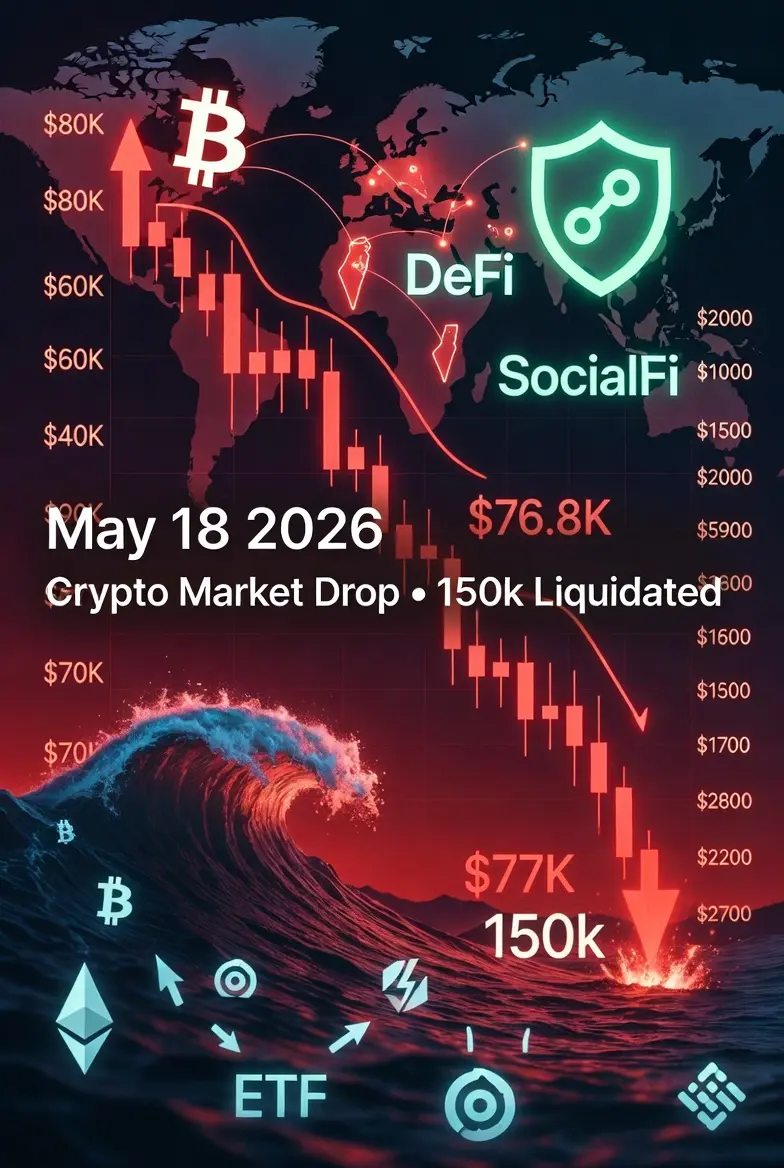
#CryptoMarketDrops150KLiquidated
Global Crypto Market Faces Brutal Liquidation Storm
The cryptocurrency market has entered one of the most aggressive volatility phases of 2026 as nearly 150,000 traders were erased from leveraged positions within only 24 hours while the broader digital asset market witnessed an enormous destruction wave approaching $700 million dollars in liquidations, creating deep fear, emotional panic, collapsing momentum, and violent downside pressure across Bitcoin, Ethereum, Solana, XRP, Dogecoin, Cardano, Avalanche, Chainlink, and multiple high-risk altcoin ecosystems.
HighAmbition
#CryptoMarketDrops150KLiquidated
Global Crypto Market Faces Brutal Liquidation Storm
The cryptocurrency market has entered one of the most aggressive volatility phases of 2026 as nearly 150,000 traders were erased from leveraged positions within only 24 hours while the broader digital asset market witnessed an enormous destruction wave approaching $700 million dollars in liquidations, creating deep fear, emotional panic, collapsing momentum, and violent downside pressure across Bitcoin, Ethereum, Solana, XRP, Dogecoin, Cardano, Avalanche, Chainlink, and multiple high-risk altcoin ecosystems.
The liquidation event transformed the market into a battlefield between panic sellers and aggressive dip buyers as billions in crypto market capitalization disappeared rapidly while traders struggled to protect positions from continuous liquidation pressure spreading across the entire digital asset sector.
What initially looked like a normal correction quickly evolved into one of the largest leverage wipeouts of recent months because the market had become dangerously overcrowded with bullish long positions expecting continuation toward significantly higher price targets across almost every major cryptocurrency.
Bitcoin Struggles Below The $80,000 Resistance Barrier
Bitcoin is currently trading near $76,995 after losing major bullish momentum above the huge $80,000 psychological resistance region where traders had aggressively opened large leverage positions expecting continuation toward $82,000, $85,000, $88,000, $90,000, $95,000, and eventually the massive $100,000–$115,000 macro expansion zone later during 2026.
However once BTC failed to maintain strength above $79,800 and started slipping below $78,500, the market structure weakened aggressively and massive liquidation pressure exploded throughout the crypto sector.
Bitcoin rapidly collapsed from the $80,500 region toward $79,200, then toward $78,000, before aggressively testing the dangerous $76,500–$77,000 support zone where enormous clusters of leveraged long positions were completely destroyed within minutes.
The market remains highly unstable because Bitcoin continues fluctuating between major support near $75,500–$76,000 and resistance around $78,500–$80,000 while both bulls and bears continue fighting for dominance across short-term and macro trading structures.
If Bitcoin successfully stabilizes above $76,000 and eventually reclaims $78,500 and $80,000 with strong buying volume, future expansion toward $82,000, $85,000, $90,000, and potentially $100,000 could still remain possible during later stages of 2026.
However additional weakness below $75,000 could expose BTC toward deeper retracement zones near $72,000, $69,500, and potentially even $65,000 if broader market fear intensifies further.
Several market participants also believe Bitcoin volatility may remain elevated for weeks because leverage concentration across the market still remains relatively high despite the massive liquidation event.
Ethereum Enters High-Risk Volatility Zone
Ethereum is currently trading near $2,133 after suffering strong rejection pressure from higher resistance regions where bullish traders expected ETH to reclaim $2,250, $2,400, $2,650, $2,800, and eventually the major $3,000 psychological barrier.
Instead Ethereum collapsed sharply toward the $2,100 support region while panic selling accelerated aggressively throughout both spot and leveraged trading environments.
ETH volatility expanded dramatically once Bitcoin weakness intensified because large leveraged positions opened above $2,200 and $2,300 faced immediate liquidation pressure as the market structure deteriorated rapidly.
If Ethereum loses stability below $2,050 then deeper downside regions near $1,980, $1,920, $1,850, and potentially even $1,700 may enter focus during broader market weakness.
However successful recovery above $2,250 could potentially strengthen bullish continuation toward $2,500, $2,800, and eventually retest the critical $3,000 zone if overall crypto sentiment improves significantly.
Ethereum traders are also closely monitoring institutional accumulation activity because ETH remains one of the most important assets influencing broader altcoin momentum throughout the market cycle.
Solana Faces Explosive Downside Pressure
Solana is currently trading near $84 after becoming one of the most heavily damaged large-cap altcoins during the liquidation storm because traders had aggressively positioned for bullish continuation toward $95, $110, $125, $140, and even higher expansion zones following previous market recoveries.
However once Bitcoin weakness intensified and broader altcoin sentiment collapsed, Solana entered a brutal volatility phase where price rapidly fell from higher momentum regions and aggressively tested lower support zones near $84, $80, and potentially $72 if additional selling pressure expands across the market.
Solana remains highly sensitive to overall market direction because speculative trading activity surrounding the ecosystem remains extremely aggressive compared to traditional large-cap cryptocurrencies.
If broader market stability improves and Bitcoin regains bullish structure then Solana recovery toward $95, $110, and $125 could become possible again during future expansion phases.
However continued weakness below $80 could expose SOL toward deeper correction zones near $72 and potentially even $65 during another major market flush.
XRP, Dogecoin & Altcoins Experience Heavy Damage
The liquidation wave spread aggressively throughout the broader crypto market as XRP slipped toward major support zones after losing bullish momentum near higher resistance levels while Dogecoin experienced severe speculative outflows due to panic-driven selling activity.
Cardano, Avalanche, Chainlink, Polygon, Near Protocol, Arbitrum, Optimism, and several meme-focused ecosystems also faced sharp downside volatility because leveraged traders rushed to exit positions rapidly once Bitcoin weakness intensified.
Many lower-cap altcoins experienced double-digit percentage declines within hours as liquidity disappeared rapidly and emotional selling pressure accelerated throughout the market.
Several traders who expected meme coins and high-risk altcoins to continue explosive upward momentum suddenly faced devastating portfolio destruction as leverage amplified losses aggressively.
Why The Liquidation Cascade Became Extremely Dangerous
This event became one of the most destructive leverage wipeouts of 2026 because traders across the market had become excessively bullish after previous Bitcoin recovery attempts pushed BTC near $80K while Ethereum approached higher resistance regions and Solana regained momentum above previous support levels.
Thousands of market participants entered highly leveraged positions using 10x, 20x, 50x, and sometimes even more aggressive leverage ratios while believing the market was preparing for a direct continuation toward fresh all-time highs.
The dangerous reality of leverage is that even relatively small market corrections can completely destroy trading accounts within minutes.
For example, a trader entering a 20x Bitcoin long near $80,000 could face total liquidation after only a limited downside movement because the margin protecting the trade disappears rapidly once price moves against the position.
These forced closures then create additional selling pressure which pushes prices even lower and triggers neighboring liquidations automatically.
This chain reaction transformed ordinary market weakness into a violent liquidation cascade where every forced sell order created additional downside momentum and every downside movement activated fresh waves of panic across Bitcoin, Ethereum, Solana, XRP, Dogecoin, and the broader altcoin market simultaneously.
Market Data Reveals The Scale Of Destruction
Several liquidation windows throughout recent sessions showed destruction ranging between approximately $580 million and $623 million dollars within only 24 hours while another sharp correction erased almost $158 million mainly across BTC, ETH, and SOL positions.
Another sudden volatility movement liquidated nearly $112 million within only a few hours after a temporary upward move trapped traders before rapidly reversing downward again.
These numbers reveal how unstable crypto markets become whenever leverage concentration reaches dangerous levels because open interest expands aggressively during bullish momentum phases but collapses violently once major support levels fail under pressure.
Prior to the crash Bitcoin had been consolidating between approximately $79,500 and $81,000 while traders expected breakout continuation toward $85K and beyond, creating dangerously overcrowded long positioning throughout the market.
Fear, Volatility & Market Psychology
Broader market sentiment weakened significantly because investors became increasingly nervous regarding liquidity conditions, macroeconomic uncertainty, institutional positioning, and overall risk appetite across financial markets.
Weekend trading conditions amplified volatility even more because thinner liquidity allowed larger market participants to move prices aggressively through heavily concentrated liquidation zones where enormous leverage positions had accumulated.
Once these support areas collapsed the market experienced automatic cascading sell pressure at exceptional speed.
Crypto communities became flooded with discussions regarding stop losses, leverage control, emotional trading mistakes, portfolio destruction, and survival strategies because thousands of traders once again realized how dangerous uncontrolled leverage becomes during unstable market conditions.
Professional market participants repeatedly warned that survival inside crypto trading depends far more on risk management than emotional prediction because even powerful bullish trends can experience brutal short-term corrections capable of erasing overexposed accounts within minutes.
Future Outlook & Recovery Possibilities
Despite the destruction some analysts continue viewing the current correction as a potential long-term market reset because removing excessive speculative leverage may eventually allow stronger spot accumulation and healthier future price action across Bitcoin, Ethereum, Solana, and the broader digital asset sector.
If Bitcoin successfully reclaims $80,000 while Ethereum recovers above $2,250 and Solana stabilizes above $84 before reclaiming $95, broader market confidence could improve significantly during upcoming weeks.
Future bullish continuation toward BTC $85K–$90K, ETH $2,800–$3,000, and SOL $110–$140 may still remain possible if liquidity conditions strengthen and broader sentiment recovers.
However continued weakness below BTC $75,000, ETH $2,000, and SOL $80 may increase downside risks toward deeper retracement zones and potentially trigger another massive wave of liquidation pressure across overleveraged market participants.
The nearly $700 million wipeout across 150,000 traders will remain one of the defining liquidation events of 2026 while reinforcing powerful lessons regarding discipline, patience, risk control, capital preservation, and intelligent positioning during extremely volatile market conditions where Bitcoin near $76,995, Ethereum near $2,133, and Solana near $84 continue acting as critical battleground zones between fear, opportunity, collapse, and potential recovery.
repost-content-media
  • Reward
  • Comment
  • Repost
  • Share
#CryptoMarketDrops150KLiquidated :
Gate Plaza Discussion — May 18, 2026 Crypto Market Drop (#150k Liquidated)
The May 18, 2026 crypto market event has triggered a sharp volatility expansion across the entire digital asset ecosystem, with Bitcoin briefly breaking below the $77,000 level and stabilizing around $76,6K–$76,9K, while Ethereum dropped more than 2.71% and lost the $2,200 support zone decisively during intraday pressure. The market-wide liquidation wave of nearly 150,000 traders highlights a highly leveraged environment that was vulnerable to cascading downside moves once key support
HighAmbition
#CryptoMarketDrops150KLiquidated :
Gate Plaza Discussion — May 18, 2026 Crypto Market Drop (#150k Liquidated)
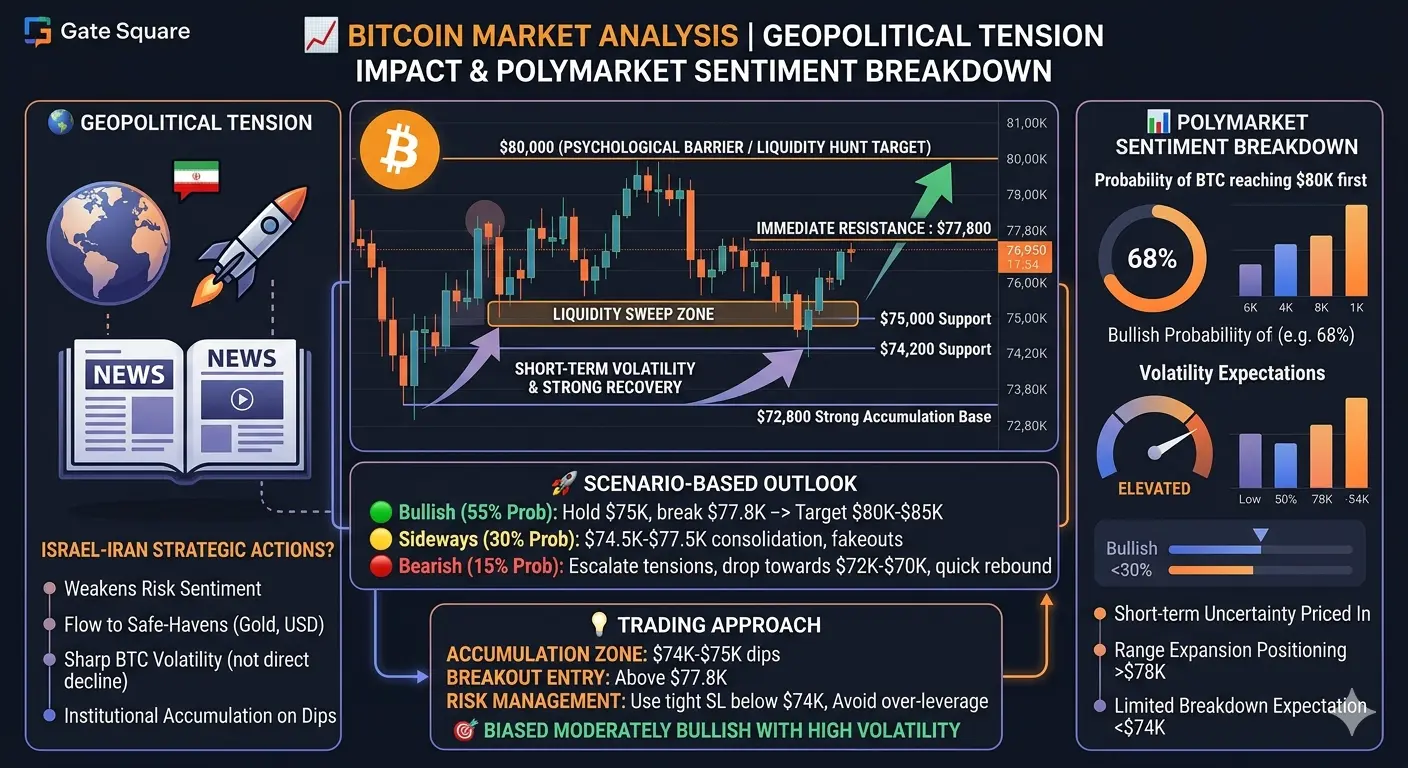
The May 18, 2026 crypto market event has triggered a sharp volatility expansion across the entire digital asset ecosystem, with Bitcoin briefly breaking below the $77,000 level and stabilizing around $76,6K–$76,9K, while Ethereum dropped more than 2.71% and lost the $2,200 support zone decisively during intraday pressure. The market-wide liquidation wave of nearly 150,000 traders highlights a highly leveraged environment that was vulnerable to cascading downside moves once key support levels were breached. This was not an isolated price correction but a synchronized event driven by leverage imbalance, macro uncertainty, liquidity thinning, and sentiment shock across derivatives and spot markets simultaneously. Despite this turbulence, DeFi and SocialFi sectors showed relative resilience, indicating that capital within crypto did not fully exit the ecosystem but rotated selectively into narrative-driven segments, which is an important structural signal for medium-term market health.
Q1: US–Israel–Iran Geopolitical Risk — Will It Impact Crypto Again?
Geopolitical instability involving the United States, Israel, and Iran remains one of the most influential external risk factors for global financial markets, and crypto is increasingly sensitive to such developments due to its growing integration with macro liquidity flows. If military actions or escalations resume, the immediate impact on crypto markets is expected to be a risk-off reaction, where investors reduce exposure to volatile and speculative assets in favor of liquidity preservation.
In such scenarios, the short-term market behavior typically includes rapid volatility spikes, accelerated liquidation cascades, and temporary breakdowns of support levels, particularly in highly leveraged environments. Bitcoin and Ethereum often experience sharp intraday movements as liquidity thins and stop-loss clusters are triggered across exchanges.
However, the long-term interpretation of geopolitical shocks in crypto markets is more nuanced. Bitcoin is no longer viewed solely as a speculative asset; it is increasingly positioned as a macro hedge against geopolitical fragmentation, sovereign risk, and fiat currency instability. This creates a dual-phase reaction pattern where initial fear-driven selling is often followed by strategic accumulation from long-term capital.
Historically, geopolitical uncertainty tends to create temporary dislocations rather than permanent downtrends, unless it escalates into sustained global financial disruption affecting liquidity, banking systems, or cross-border capital flows. Therefore, while such events can significantly increase short-term volatility, they are more likely to act as transient shock catalysts rather than structural trend reversals.
Q2: Panic Sell-Off or Strategic Market Reset?
The current market movement requires a deeper structural interpretation rather than a surface-level price analysis. The primary driver behind the decline is not organic selling pressure but a liquidity imbalance combined with excessive leverage buildup in derivatives markets.
Key contributing factors behind this move include:
Overcrowded leveraged long positions across major exchanges
Cascading liquidation of approximately 150,000 traders
Forced selling triggered after BTC broke intraday support zones
Macro pressure from rising bond yields and tightening liquidity conditions
Reduced institutional inflows due to ETF outflows and risk reallocation
Thin liquidity conditions during high-volatility trading windows
When these conditions align, markets often experience what is known as a liquidity cascade event, where price movements become disproportionately large relative to actual spot demand. This is exactly what has been observed in the current correction phase.
From a bearish structural perspective, the market remains fragile in the short term because Bitcoin has not yet reclaimed higher resistance zones and volatility remains elevated. The $75,000 region has now become a critical structural pivot, and failure to maintain this level could expose further downside liquidity zones.
From a bullish structural interpretation, however, this event has already completed a key function: leverage reset and forced deleveraging cycle completion. Excess speculative positioning has been removed, which historically creates healthier conditions for medium-term trend formation once stability returns.
Additional Structural Insight — Market Behavior Beneath Price Action
Beyond immediate price movement, several important structural signals are emerging beneath the surface. The relative strength seen in DeFi and SocialFi sectors suggests that capital rotation is still active within crypto, rather than complete exit behavior. This is typically a sign of selective risk-taking rather than systemic panic.
Another important observation is that Bitcoin dominance remains relatively stable, indicating that altcoins are not independently driving the market. Instead, they are still highly dependent on Bitcoin’s directional structure, which reinforces BTC as the primary liquidity anchor of the entire ecosystem.
Additionally, ETF outflows represent temporary institutional caution rather than structural exit, as institutional participants often rebalance exposure during volatility spikes rather than abandoning positions entirely. This distinction is important because it suggests that liquidity may return once stability improves.
Sentiment-wise, the market has entered a compression phase, where fear is elevated but not extreme enough to indicate a full macro bearish cycle. Historically, such phases often precede either consolidation ranges or recovery attempts, depending on macro catalysts and liquidity return.
My View — Is This a Buy-the-Dip Opportunity?
In my view, this situation is not a fully confirmed buy-the-dip environment, but rather a high-probability accumulation zone with elevated uncertainty and risk dispersion. The market structure has improved due to leverage cleanup, but macro and geopolitical risks continue to limit directional clarity.
A disciplined strategy is more appropriate in this environment:
Prefer gradual DCA-based accumulation instead of aggressive lump-sum entries
Focus primarily on Bitcoin and strong large-cap assets with liquidity depth
Avoid high leverage due to unpredictable volatility spikes and liquidation risk
Treat $75K–$72K as a strategic accumulation range, not a guaranteed bottom
Wait for structural confirmation above $78K–$80K for trend continuation confidence
This phase rewards patience, capital preservation, and structured positioning more than aggressive directional speculation.
Scenario-Based Outlook (Probability Framework)
Bullish scenario (60%): BTC stabilizes above $75K and gradually recovers toward $80K–$83K as liquidity returns and sentiment stabilizes
Range-bound scenario (25%): Consolidation between $74K–$78K as the market absorbs liquidation shock and rebuilds structure
Bearish scenario (15%): Breakdown below $75K opens deeper liquidity test toward $72K–$70K zone
Altcoins are expected to remain relatively weak until Bitcoin confirms directional strength and market-wide liquidity improves.
Final Outlook — Market Emotion vs Structural Reality
The current crypto environment represents a transition phase between forced liquidation shock and early-stage accumulation behavior. The removal of approximately 150,000 leveraged positions has significantly reset market leverage conditions, but macro uncertainty, geopolitical risk, and institutional hesitation continue to cap strong momentum development.
One of the most important characteristics of this phase is the disconnect between emotion and structure. Sentiment remains fragile and reactive, while underlying structure is gradually reorganizing through liquidity redistribution and positioning resets.
In essence, this is a probability-driven market environment rather than a certainty-driven trend, where success depends on disciplined execution, risk control, and patience rather than aggressive forecasting.
repost-content-media
  • Reward
  • Comment
  • Repost
  • Share
#MubadalaBitcoinETFHoldingsHit660M
Bitcoin is currently trading around $76,940, and the latest institutional development surrounding Mubadala Investment Company has become one of the most closely watched signals in the crypto market. According to Q1 2026 SEC 13F filings, Mubadala’s exposure to Bitcoin through BlackRock’s iShares Bitcoin Trust (IBIT) has reached approximately $660 million. This represents a notable increase from the previous quarter and reflects continued accumulation of regulated Bitcoin exposure by one of Abu Dhabi’s most influential sovereign wealth funds.
This move is sign
BTC-2.8%
IBIT-2.38%
HighAmbition
#MubadalaBitcoinETFHoldingsHit660M
Bitcoin is currently trading around $76,940, and the latest institutional development surrounding Mubadala Investment Company has become one of the most closely watched signals in the crypto market. According to Q1 2026 SEC 13F filings, Mubadala’s exposure to Bitcoin through BlackRock’s iShares Bitcoin Trust (IBIT) has reached approximately $660 million. This represents a notable increase from the previous quarter and reflects continued accumulation of regulated Bitcoin exposure by one of Abu Dhabi’s most influential sovereign wealth funds.
This move is significant not just because of the size of the investment, but because of what it represents in the broader institutional landscape. Mubadala manages over $300 billion in assets, and its decision to expand Bitcoin ETF holdings indicates a growing comfort with Bitcoin as a regulated macro asset rather than a speculative instrument. The ETF structure, particularly IBIT, allows institutions to gain exposure without directly holding Bitcoin, reducing custody risks while maintaining price correlation with the underlying asset.
The increase in holdings is also being interpreted as a signal of long-term strategic positioning. Sovereign wealth funds typically operate with multi-decade investment horizons, meaning their allocation changes are not driven by short-term volatility but by macro conviction.
The additional inflows of roughly $90 million into Bitcoin ETFs suggest that digital assets are gradually being integrated into traditional portfolio frameworks, alongside equities, commodities, and fixed income instruments.
From a market perspective, this kind of institutional accumulation has multiple effects on Bitcoin’s price structure. First, it reduces circulating supply pressure because ETF providers must acquire and hold actual Bitcoin to back shares. As more capital flows into ETFs like IBIT, liquidity is gradually absorbed from the open market. This creates a structural demand base that is less sensitive to short-term sentiment swings compared to retail-driven cycles.
Second, it enhances Bitcoin’s perception as a legitimate store of value. When sovereign wealth funds and global asset managers participate at scale, it strengthens the narrative that Bitcoin is transitioning into a macro hedge asset. This can influence other institutional players who are still cautious, potentially triggering a second wave of allocations over time.
However, the market impact is not purely one-directional or immediately bullish. Institutional flows are often uneven, as seen in the broader Q1 2026 filings. While Mubadala and some other entities increased exposure, certain Western institutions reduced positions or rebalanced away from Bitcoin ETFs. This divergence creates a mixed liquidity environment where inflows and outflows can offset each other in the short term, resulting in range-bound price behavior rather than immediate breakout momentum.
The Abu Dhabi Investment Authority maintaining its position unchanged also highlights an important point: even within the same region, institutional strategy is not uniform. Some funds are actively accumulating while others are maintaining exposure, indicating a phase of cautious expansion rather than aggressive all-in positioning.
For Bitcoin’s price outlook, with BTC near $76,940, the market is currently sitting at a structurally important zone where institutional demand and macro uncertainty intersect. In a bullish scenario, continued ETF inflows combined with improving macro liquidity conditions could push Bitcoin toward the $85,000 to $92,000 range. If momentum strengthens and inflows accelerate, extended targets in the $100,000 region become technically plausible, especially if ETF demand remains consistent over multiple quarters.
In a base-case scenario, Bitcoin is likely to remain within a consolidation range between $72,000 and $85,000. This would reflect balanced flows between institutional accumulation and profit-taking from earlier cycles. Such a phase would not indicate weakness, but rather a distribution of supply into stronger hands, particularly ETFs and long-term holders.
In a bearish scenario, if macro conditions tighten or ETF inflows slow significantly, Bitcoin could revisit lower support zones around $68,000 to $70,000. However, given the current level of sovereign and institutional participation, deep breakdowns are generally expected to be absorbed relatively quickly unless there is a broader risk-off shock across global markets.
From a trading strategy perspective, the current environment favors a disciplined and structured approach rather than aggressive directional bets. Accumulation strategies are generally being considered by long-term participants during dips toward support zones, especially when ETF inflows remain positive. Traders focusing on swing positions are watching the $75,000 to $78,000 range as a key equilibrium zone where price compression often leads to volatility expansion.
Breakout traders are monitoring resistance areas above $80,000, as a clean break with volume confirmation could trigger momentum-driven moves toward higher liquidity zones. However, false breakouts remain a risk in the current environment due to mixed institutional flows, so confirmation is critical rather than early entry.
Risk management remains central in this phase of the market cycle. Position sizing is being adjusted by many traders to account for sudden liquidity shifts caused by large ETF-related flows. Stops are generally placed below key structural supports rather than tight intraday levels, as volatility can spike quickly during institutional rebalancing periods.
Overall sentiment among professional traders is cautiously optimistic. The presence of sovereign wealth funds like Mubadala in the Bitcoin ETF ecosystem is being viewed as a medium to long-term bullish structural factor, even if short-term price action remains range-bound. The key argument is that Bitcoin is increasingly being absorbed into global capital allocation frameworks, reducing its dependence on purely retail-driven cycles.
In conclusion, Mubadala’s $660 million position in Bitcoin ETFs is more than just a headline figure. It reflects a deeper transformation in how Bitcoin is being treated by global capital. At a price of $76,940, the market is in a transitional phase where institutional adoption is steadily increasing but not yet fully dominant. The coming months are likely to be defined by this tension between accumulation and consolidation, with Bitcoin’s next major move depending heavily on whether ETF inflows continue to accelerate or stabilize.
repost-content-media
  • Reward
  • Comment
  • Repost
  • Share
#HYPE
Writing
HYPE Market Analysis May 2026
Current Market Position
HYPE is currently trading around 45.34 and remains one of the strongest momentum driven assets in the crypto market during the ongoing altcoin expansion phase. While Bitcoin consolidates near 76822 and Ethereum struggles around 2116 traders are increasingly shifting attention toward high volatility ecosystem plays connected to perpetual futures decentralized trading and liquidity infrastructure narratives where HYPE continues gaining massive traction.
The recent movement above 40 completely changed trader sentiment across
HYPE-3.31%
BTC-2.8%
ETH-3.23%
SOL-2.84%
HighAmbition
#HYPE
Writing
HYPE Market Analysis May 2026
Current Market Position
HYPE is currently trading around 45.34 and remains one of the strongest momentum driven assets in the crypto market during the ongoing altcoin expansion phase. While Bitcoin consolidates near 76822 and Ethereum struggles around 2116 traders are increasingly shifting attention toward high volatility ecosystem plays connected to perpetual futures decentralized trading and liquidity infrastructure narratives where HYPE continues gaining massive traction.
The recent movement above 40 completely changed trader sentiment across the market because buyers aggressively defended every pullback while volume continued increasing during volatility spikes. Many traders now believe HYPE is entering a larger expansion phase capable of pushing prices toward 48 52 58 and potentially even 65 if bullish market conditions remain active through May and June 2026.
🚀 Why Traders Are Watching HYPE
The biggest reason behind HYPE strength is the explosive growth of decentralized perpetual trading ecosystems during 2026. Traders across crypto markets are increasingly preferring fast onchain execution deep liquidity and leverage exposure instead of relying only on centralized exchanges. Because Hyperliquid sits directly inside this rapidly expanding sector many traders view HYPE as more than just another speculative altcoin.
Unlike meme coins that depend entirely on viral hype HYPE is connected to active trading demand ecosystem growth derivatives volume and trader participation. This gives the project stronger long term narrative support compared to short lived speculative pumps that collapse quickly after social media attention fades.
📈 Current Trader Sentiment
Market sentiment around HYPE remains strongly bullish despite short term volatility. Crypto communities across trading discussions are increasingly talking about continuation toward 50 plus because the current structure still appears healthy instead of overheated. Traders believe the project still has room for another expansion leg before reaching euphoric conditions.
Several aggressive traders are already targeting 55 and 60 if HYPE successfully breaks above the major resistance zone between 48 and 50. Some long term bullish projections are even discussing 75 to 100 during late 2026 especially if decentralized derivatives trading continues growing across the crypto industry.
At the same time cautious traders remain aware that leverage driven assets can experience violent corrections very quickly. Because of this many experienced participants are avoiding emotional entries and instead accumulating gradually during pullbacks toward strong support levels.
💰 Bitcoin Ethereum And Solana Impact
Bitcoin remains the most important market driver. BTC currently holding above 76500 continues supporting broader bullish sentiment across altcoins. If Bitcoin successfully breaks above 80000 analysts expect aggressive liquidity rotation into high beta assets including HYPE.
Ethereum meanwhile remains relatively weak around 2116 because traders are prioritizing faster speculative opportunities instead of slower large cap movements. This weakness in ETH is helping ecosystem tokens and derivatives projects attract more attention.
Solana near 84 34 continues dominating meme coin activity with nonstop viral token launches and pump.fun speculation. However many traders are now rotating profits away from meme coins into stronger ecosystem infrastructure assets like HYPE because they believe these projects offer more sustainable momentum.
📊 Key Price Levels Traders Are Watching
The most important support region currently sits between 43 and 44 where buyers previously defended price aggressively during volatility events. If HYPE holds this zone traders believe bullish momentum can continue building steadily.
Immediate resistance now sits around 46 80 and 48 50 while the psychological 50 level remains the main breakout target controlling market momentum. A strong breakout above 50 could trigger rapid acceleration toward 55 and 60 because historical resistance above those levels remains relatively thin.
If broader crypto weakness appears and HYPE loses 42 support some traders expect temporary retracements toward 40 or even 38 before buyers attempt another recovery structure.
⚡ Trading Strategies Traders Are Using
Conservative traders are currently waiting for stronger confirmation above 48 and especially above 50 before entering larger swing positions because they want confirmation that the market structure can sustain higher prices without immediate rejection.
Aggressive momentum traders meanwhile continue buying dips between 43 and 45 targeting continuation toward 52 plus. Scalpers are heavily focusing on volatility ranges between 44 and 47 because rapid liquidity movements continue creating fast trading opportunities during intraday sessions.
Some experienced traders are using partial profit strategies where they secure profits gradually at 48 52 and 60 while leaving smaller positions open for possible long term continuation toward higher targets later in 2026
.
🧠 What Traders Are Thinking Right Now
Current trader psychology shows growing confidence but not full euphoria yet. Many participants believe the market is still in the expansion phase rather than final cycle mania conditions. Fear and Greed conditions remain relatively balanced which historically allows strong trends to continue building gradually.
A large number of traders believe HYPE could become one of the defining infrastructure tokens of the 2026 cycle because decentralized trading ecosystems are becoming increasingly important within crypto markets. Discussions around perpetual trading decentralized order books and onchain liquidity are growing rapidly which continues supporting the broader HYPE narrative.
At the same time traders remain extremely cautious about leverage risk because sudden liquidations can create aggressive volatility spikes in both directions. This is why disciplined entries stop management and emotional control remain critical in current market conditions.
🌍 Broader Crypto Environment
The overall crypto market remains heavily liquidity driven. Meme coins including PEPE WIF TURBO BRETT NEIRO and TRUMP continue attracting speculative retail attention while infrastructure projects connected to real trading activity are slowly gaining stronger institutional and professional trader interest.
The CLARITY Act discussions in the United States Senate continue providing regulatory optimism which is helping broader market confidence improve. ETF inflows into Bitcoin are also maintaining strong support for overall market sentiment which indirectly benefits altcoins and ecosystem projects like HYPE.
📌 Final Outlook
HYPE around 45.34 currently represents one of the strongest momentum narratives inside the 2026 crypto market where decentralized derivatives infrastructure speculative liquidity and altcoin season dynamics are all combining simultaneously.
As long as Bitcoin remains stable above 76000 and altcoin sentiment continues improving traders expect HYPE to remain one of the most actively watched high volatility assets in the market. The next major targets remain 48 50 55 and potentially 60 while support between 43 and 40 remains critically important for maintaining bullish structure.
The market currently rewards disciplined execution fast decision making and strong risk management rather than emotional chasing. HYPE continues offering massive opportunity potential but traders understand that volatility remains extremely high which makes strategy and patience more important than hype alone.
repost-content-media
  • Reward
  • Comment
  • Repost
  • Share
#PolymarketHundredUWarGodChallenge
Current BTC Price: $76,950
The global crypto market is once again entering a highly sensitive phase where macro geopolitics and speculative prediction markets are both shaping short-term volatility. Bitcoin is currently trading around $76.9K, after a strong recovery from lower liquidity zones near $74K–$75K, and traders are closely watching whether this momentum can extend toward the psychological barrier of $80,000.
At the center of the latest uncertainty is rising geopolitical tension, as reports suggest that Israel may be considering renewed strategic mi
BTC-2.8%
XAUUSD-0.74%
HighAmbition
#PolymarketHundredUWarGodChallenge
Current BTC Price: $76,950
The global crypto market is once again entering a highly sensitive phase where macro geopolitics and speculative prediction markets are both shaping short-term volatility. Bitcoin is currently trading around $76.9K, after a strong recovery from lower liquidity zones near $74K–$75K, and traders are closely watching whether this momentum can extend toward the psychological barrier of $80,000.
At the center of the latest uncertainty is rising geopolitical tension, as reports suggest that Israel may be considering renewed strategic military actions involving Iran. Such developments often trigger risk-off behavior across global markets, including crypto, equities, and commodities. However, Bitcoin has historically shown a mixed reaction: short-term volatility followed by strong recovery phases as liquidity re-enters the market.
🌍 Geopolitical Tension & Crypto Market Reaction
Geopolitical uncertainty is one of the strongest external catalysts for Bitcoin price movement.
When tensions escalate in the Middle East:
Global risk sentiment weakens initially
Liquidity flows into safe-haven assets like gold and USD
Bitcoin experiences sharp volatility rather than direct decline
Institutional traders often use dips for accumulation
In the current scenario, the market saw a quick dip toward $74K–$75K, but buyers aggressively stepped in, pushing BTC back above $76K. This behavior suggests that market participants are still treating Bitcoin as a long-term hedge rather than purely a risk asset.
Importantly, panic selling has not dominated the structure, indicating strong underlying demand zones.
📈 Bitcoin Price Structure & Key Levels
Current market structure shows a consolidation phase after recent volatility.
🔹 Immediate Support Levels:
$75,000 (short-term defense zone)
$74,200 (liquidity sweep zone)
$72,800 (strong accumulation base)
🔹 Resistance Levels:
$77,800 (first breakout barrier)
$79,200 (pre-$80K liquidity zone)
$80,000 (psychological resistance level)
If BTC maintains above $76K, momentum favors a gradual push toward $78K–$80K range.
📊 Polymarket Sentiment & Prediction Flow
Prediction markets like Polymarket are increasingly influencing trader psychology. According to current sentiment trends:
Majority of traders still assign higher probability to BTC reaching $80K before a major breakdown
Short-term uncertainty is priced in due to geopolitical risk
Volatility expectations remain elevated across weekly contracts
This aligns with a broader market narrative: uncertainty in global politics often leads to temporary fear, but not structural reversal in Bitcoin’s macro trend.
Polymarket data suggests that traders are positioning for:
Range expansion above $78K
Higher probability of liquidity hunt toward $80K
Limited expectation of sustained breakdown below $74K unless escalation intensifies significant.
⚖️ Buy or Wait? Market Psychology Breakdown
At the current level around $76,950, the market is in a decision zone.
📌 Bullish Case:
Strong rebound from $74K zone
Buyers defending dips aggressively
Momentum targeting $78K–$80K
Institutional accumulation behavior visible on dips
📌 Bearish Case:
Geopolitical escalation could trigger sudden liquidity exit
Failure to break $77.8K may lead to sideways correction
Short-term volatility spikes still expected
📊 Key Insight:
This is not a clear breakout or breakdown phase. It is a liquidity compression zone, where smart money typically accumulates before expansion.
🚀 Scenario-Based BTC Outlook
🟢 Bullish Scenario (55% Probability)
If BTC holds above $75K and breaks $77.8K resistance:
Move toward $79K–$80K likely
Momentum acceleration possible above $80K
Extension targets: $82K–$85K range
🟡 Sideways Scenario (30% Probability)
If price remains between $74.5K–$77.5K:
Consolidation continues
Fake breakouts possible both directions
Market awaits geopolitical clarity
🔴 Bearish Scenario (15% Probability)
If tensions escalate sharply and panic selling increases:
Drop toward $72K support zone
Possible wick toward $70K liquidity area
Quick rebound likely if demand holds
💡 Strategic Trading Approach
📌 Accumulation Strategy:
Best accumulation zone: $74K–$75K dips
Gradual buying preferred over lump sum entry
Focus on long-term positioning rather than short-term noise
📌 Breakout Strategy:
Entry confirmation above $77.8K
Target: $80K initially, then $82K+
Volume confirmation is critical for sustainability
📌 Risk Management:
Avoid over-leverage in geopolitical uncertainty
Use tight stop-loss below $74K for short-term trades
Preserve capital during unpredictable spikes
🌐 Macro Insight: Why Bitcoin Holds Strength
Despite global tension, Bitcoin continues to show resilience due to:
Increasing institutional adoption
ETF-driven liquidity support
Limited supply narrative strengthening
Global uncertainty pushing diversification demand
In many cases, Bitcoin behaves less like a speculative asset and more like a macro liquidity barometer.
🎯 Final Outlook
At $76,950, Bitcoin is positioned at a critical inflection point.
If stability continues, $80K becomes highly probable in the short term
If geopolitical pressure intensifies, volatility will increase but long-term structure remains intact
Market sentiment still favors upside continuation over breakdown
📊 Overall bias remains moderately bullish with high volatility conditions
The next 24–72 hours will likely define whether Bitcoin enters a breakout phase or remains trapped in consolidation.
repost-content-media
  • Reward
  • Comment
  • Repost
  • Share
#TradfiTradingChallenge
Asset: MRNA (Moderna Inc.)
Current Price: 49.00
MRNA MARKET STRUCTURE
MRNA is currently trading around 49.00, and the market is in a very important structural phase where long-term valuation, future growth expectations, and sector positioning are being continuously re-evaluated by market participants. The current behavior is not random price movement; it reflects a deeper transition phase where the stock is gradually shifting from a past high-growth narrative into a more mature biotechnology valuation cycle.
The overall structure shows that MRNA has already complete
HighAmbition
#TradfiTradingChallenge
Asset: MRNA (Moderna Inc.)
Current Price: 49.00
MRNA MARKET STRUCTURE
MRNA is currently trading around 49.00, and the market is in a very important structural phase where long-term valuation, future growth expectations, and sector positioning are being continuously re-evaluated by market participants. The current behavior is not random price movement; it reflects a deeper transition phase where the stock is gradually shifting from a past high-growth narrative into a more mature biotechnology valuation cycle.
The overall structure shows that MRNA has already completed a major expansion and correction cycle, and now it is attempting to build a stable foundation. This phase is often referred to as a structural base-building environment, where price does not trend aggressively in one direction but instead moves in controlled ranges while liquidity is redistributed between buyers and sellers.
At this stage, market participants are focusing more on future potential rather than historical performance. The attention is shifting toward the company’s biotechnology pipeline, long-term research direction, and innovation capacity in the mRNA medical space. Because of this shift, price action becomes more sensitive to expectation changes rather than short-term news alone.
PRICE ACTION DYNAMICS — RANGE DEVELOPMENT & LIQUIDITY FLOW
The current price region around 49.00 is part of a broader consolidation band where the market is actively balancing supply and demand. Instead of forming a clear directional trend, the asset is moving in a controlled range structure where both upward and downward movements are being absorbed.
This type of behavior usually indicates that large participants are not fully exiting or entering aggressively but are instead building positions gradually over time. Price movements in this environment are typically characterized by:
Controlled volatility expansion and contraction
Frequent retests of support and resistance zones
Short-term breakout attempts followed by retracements
Liquidity accumulation at both ends of the range
Market indecision before a larger directional move
This is why MRNA currently appears active but not trending strongly. The market is effectively creating energy for a future expansion phase while maintaining equilibrium in the present.
EXTENDED PRICE STRUCTURE — FULL VALUATION FRAMEWORK
UPPER STRUCTURE ZONES (EXPANSION LEVELS)
The upside structure for MRNA is layered across multiple resistance levels that define potential growth phases:
52.00 → Short-term breakout trigger zone
55.00 → Structural momentum confirmation level
60.00 → Early trend expansion region
68.00 → Medium-term growth continuation zone
75.00 → Strong momentum acceleration area
85.00 → Long-cycle recovery confirmation level
100.00 → Major psychological revaluation milestone
120.00+ → Extended innovation cycle expansion zone
Each of these levels represents a different phase of potential market re-rating, where sentiment and capital flow could gradually shift if momentum continues to build.
LOWER STRUCTURE ZONES (VALUE & SUPPORT REGIONS)
On the downside, the structure is equally important as it defines where long-term interest tends to appear:
47.50 → Immediate stabilization level
45.00 → Strong structural value zone
42.00 → Institutional interest accumulation region
38.00 → Historical demand absorption zone
32.00 → Extreme long-term valuation floor scenario
These zones are not just technical levels but also represent areas where long-term participants may evaluate positioning based on perceived value.
MARKET STRUCTURE INTERPRETATION — SHIFT IN ASSET IDENTITY
MRNA has undergone a significant transformation in how it is perceived by the market. During its earlier cycle, the asset was primarily driven by high-demand expectations and rapid growth projections. However, the current environment reflects a more mature phase where valuation is being aligned with long-term innovation potential rather than short-term demand spikes.
This shift means that MRNA is now behaving more like a long-duration biotechnology development asset, where market value is tied to pipeline execution, research outcomes, and future medical breakthroughs rather than immediate revenue expansion.
Because of this transition, the stock is no longer trending in explosive cycles but instead forming structured waves of accumulation and distribution that reflect gradual capital reallocation.
TRADER BEHAVIOR & MARKET PARTICIPATION FLOW
Market participants in MRNA are currently operating with mixed but structured strategies. Short-term traders are focusing on range-bound opportunities, capturing volatility between support and resistance zones, while longer-term participants are slowly evaluating accumulation opportunities in lower valuation areas.
Institutional behavior appears measured and gradual, with positioning being adjusted in small phases rather than large directional commitments. This indicates that the market is still in a positioning discovery stage, where participants are building exposure based on long-term expectations rather than short-term momentum.
Algorithmic systems also play a strong role in current price action, creating sharp but temporary moves that often return back into the main range structure. This contributes to the overall environment of controlled volatility.
RICE FORECAST STRUCTURE — FULL SCENARIO MAPPING

EXPANSION SCENARIO (STRUCTURAL BREAKOUT)
If MRNA builds sustained strength above the 52.00–55.00 zone, the market may enter a progressive expansion phase where momentum gradually increases over time. In this case, price structure could extend toward 60.00, followed by 68.00, and potentially reach 75.00–85.00 in a stronger continuation cycle.
If broader sentiment shifts positively across the biotechnology sector, a long-term revaluation phase could eventually target the 100.00+ region, marking a significant structural milestone in market perception.
RANGE CONTINUATION SCENARIO (CURRENT STRUCTURE)
If the market continues its current behavior, MRNA is likely to remain within the 45.00–55.00 range, where price oscillates between accumulation and distribution phases. In this environment, the market remains balanced, and directional conviction remains limited.
This scenario supports a gradual and steady formation process rather than rapid directional expansion.
STRUCTURAL WEAKNESS SCENARIO
If the lower boundary around 45.00 fails to hold, the structure may shift into a deeper valuation phase where price could revisit 42.00, 38.00, and in extended stress conditions, 32.00. However, such moves typically require broader market risk-off conditions or significant changes in sector sentiment.
INSTITUTIONAL FLOW PERSPECTIVE — GRADUAL POSITIONING ENVIRONMENT
Institutional activity in MRNA is currently characterized by selective and phased positioning. Rather than aggressive accumulation or distribution, large participants appear to be adjusting exposure gradually based on long-term biotechnology expectations.
This type of flow typically indicates that the asset is in a rebuilding valuation phase, where long-term positioning is being slowly re-established as the market transitions into a new structural cycle.
TRADING STRATEGY FRAMEWORK — STRUCTURED APPROACH
ACCUMULATION STRATEGY
Focus range: 45.00 – 48.00
Gradual entry approach recommended
Long-term positioning orientation
Scaling strategy preferred over full entry
BREAKOUT STRATEGY
Activation above 55.00 with confirmation
Potential continuation toward higher structural zones
Momentum participation after validation
Avoid early entry without confirmation signals
STRUCTURED RISK MANAGEMENT
Maintain controlled position sizing
Focus on disciplined entry zones
Avoid emotional trading during volatility spikes
Respect structural support and resistance levels
FINAL MARKET OUTLOOK
MRNA at 49.00 is currently in a structured development phase, where the market is gradually forming a foundation for its next major directional cycle. Price action reflects a balanced environment where accumulation, distribution, and liquidity formation are all occurring simultaneously.
This type of phase is often where future major trends begin forming quietly before broader market recognition occurs.
repost-content-media
  • Reward
  • Comment
  • Repost
  • Share
#BitcoinVShapedReversalBack
Bitcoin V-Shaped Reversal Analysis
What is a V-Shaped Reversal?
A V-shaped reversal is one of the most powerful technical chart structures in financial markets. It occurs when an asset experiences a sharp and fast decline, followed by an equally sharp and aggressive recovery, forming a clear “V” shape on the price chart.
This pattern typically indicates:
Strong demand absorption at lower price levels
Aggressive buying from institutional and smart money participants
Short squeeze and forced liquidation of bearish positions
Rapid sentiment shift from fear to opportu
BTC-2.8%
HighAmbition
#BitcoinVShapedReversalBack
Bitcoin V-Shaped Reversal Analysis
What is a V-Shaped Reversal?
A V-shaped reversal is one of the most powerful technical chart structures in financial markets. It occurs when an asset experiences a sharp and fast decline, followed by an equally sharp and aggressive recovery, forming a clear “V” shape on the price chart.
This pattern typically indicates:
Strong demand absorption at lower price levels
Aggressive buying from institutional and smart money participants
Short squeeze and forced liquidation of bearish positions
Rapid sentiment shift from fear to opportunistic accumulation
Unlike other reversal patterns, a V-shape shows very little consolidation at the bottom, meaning buyers step in immediately without allowing extended sideways movement.
In Bitcoin’s case, this structure is currently being closely monitored as market volatility increases.
Current Bitcoin Market Context (May 2026)
Bitcoin is currently trading near $78,034, reflecting a consolidation phase after recent volatility.
Price Action Overview:
Current Price: $78,034.62
24h Change: -1.32%
24h High: $79,188.7
24h Low: $77,656.7
Market Cap: $1.54 Trillion
The market is currently stabilizing after sharp swings between $77,000 and $79,000, indicating active liquidity battles between buyers and sellers.
Technical Indicators (7-Day Multi-Timeframe View)
Daily (1D) Timeframe:
Moving Averages: Bullish alignment
RSI: Neutral zone (balanced momentum)
ADX: 34.12 (moderate trend strength)
Interpretation: Long-term structure remains supportive despite short-term volatility.
4-Hour Timeframe:
MA Alignment: Bearish pressure present
CCI: -105.6 (oversold conditions)
Williams %R: -88.8 (deep oversold zone)
Interpretation: Short-term market is technically oversold, suggesting potential relief bounce conditions.
Hourly Timeframe:
MA Alignment: Neutral
ADX: 50.3 (strong directional movement)
CCI: -144.6 (extreme oversold reading)
Interpretation: Market is in a high-volatility compression phase, often seen before strong directional moves.
Key Discussion Points on Bitcoin’s V-Shaped Recovery
1. Critical Resistance Levels
Bitcoin’s recovery structure is currently being tested against major resistance zones.
Key Levels:
$70,000 → Psychological confirmation zone
$74,000 → Major resistance / previous support flip
$77,500 – $79,200 → Current consolidation band
$81,000 – $85,000 → Next macro resistance cluster
Interpretation:
$70K acts as structural confirmation level
$74K is the main breakout barrier for V-shape validation
Above $79K, momentum expansion becomes significantly stronger
Failure to hold below $70,000 would weaken the V-shaped recovery structure.
2. Macro Factors Influencing the Pattern
Several macroeconomic conditions are shaping Bitcoin’s current structure:
Global inflation concerns linked to energy prices
Middle East geopolitical tensions increasing safe-haven demand
Federal Reserve policy uncertainty ahead of key meetings
Exchange reserves declining to multi-year lows
Institutional accumulation continuing during dips
Interpretation: Macro conditions are creating a mixed environment of risk pressure and long-term accumulation support.
3. Community Sentiment and Trader Psychology
Market participants are actively debating whether Bitcoin is forming a true V-shaped recovery or a temporary bounce.
Current sentiment themes:
Dip buyers accumulating between $70,000 – $75,000
Aggressive traders expecting continuation toward $81,000+
Bearish traders waiting for rejection at $74,000 resistance
Common trader view:
“Buy the dip until invalidation”
“Breakout above $74K confirms trend continuation”
“Failure below $70K signals deeper correction risk”
Interpretation: Sentiment is split but leaning cautiously bullish.
4. Risk Factors and Market Uncertainty
Despite bullish V-shape expectations, risks remain active:
Federal Reserve maintaining restrictive policy stance
Inflation spikes reducing liquidity appetite
Resistance rejection near $74,000–$75,000 zone
Liquidity traps creating fake breakout structures
Higher timeframe bearish divergence signals
Key Risk Scenario: If Bitcoin fails to reclaim $74,000, the move may turn into a liquidity grab instead of a full reversal.
5. Trading Strategy Outlook (Next Market Plan)
Bullish Scenario Strategy:
If Bitcoin holds above $70,000 and breaks $74,000:
Momentum target: $77,000 → $81,000 → $85,000
Strong breakout above $81K may open expansion toward new cycle highs
Traders may consider trend-following entries after confirmation
Bearish Scenario Strategy:
If Bitcoin fails to hold $70,000:
First downside target: $68,000
Extended correction zone: $65,000 – $66,000
Deep invalidation level: below $65,000
Interpretation: This would invalidate the clean V-shaped structure.
Accumulation Strategy (Smart Money Approach):
Gradual buying between $70K – $74K zone
Avoid heavy leverage during volatility spikes
Scale positions instead of full exposure
Wait for breakout confirmation above resistance zones
6. Volume and Confirmation Logic
A true V-shaped reversal requires:
Declining volume during the drop
Rising volume during recovery
Strong breakout above resistance
No prolonged consolidation at the bottom
Interpretation: Volume behavior is the final confirmation factor for validating the pattern.
Summary
Bitcoin is currently showing early-stage characteristics of a V-shaped recovery structure, with price stabilizing around $78,000 after sharp volatility between $77,000–$79,000.
The structure is still not fully confirmed, but key conditions are developing:
Strong support near $70,000
Major resistance at $74,000
Expansion potential above $81,000 – $85,000
Final Market Logic:
Above $74K → bullish continuation likely
Below $70K → recovery structure weakens
Between range → consolidation and volatility
Bitcoin is currently in a decision zone, where the next breakout will determine whether this becomes a full V-shaped reversal or a prolonged consolidation phase.
repost-content-media
  • Reward
  • Comment
  • Repost
  • Share
#CMEToLaunchNasdaqCryptoIndexFutures
CME Group to Launch Nasdaq Crypto Index Futures
1. Executive Overview
CME Group has officially announced the upcoming launch of Nasdaq CME Crypto Index Futures, scheduled for June 8, 2026, subject to regulatory approval. This development represents a major structural evolution in the digital asset derivatives market, introducing CME’s first-ever market-cap weighted crypto index futures contract.
This product is designed to provide a single, regulated gateway to the broader cryptocurrency market, combining major digital assets into one standardized futures
HighAmbition
#CMEToLaunchNasdaqCryptoIndexFutures
CME Group to Launch Nasdaq Crypto Index Futures
1. Executive Overview
CME Group has officially announced the upcoming launch of Nasdaq CME Crypto Index Futures, scheduled for June 8, 2026, subject to regulatory approval. This development represents a major structural evolution in the digital asset derivatives market, introducing CME’s first-ever market-cap weighted crypto index futures contract.
This product is designed to provide a single, regulated gateway to the broader cryptocurrency market, combining major digital assets into one standardized futures instrument. It marks a clear transition from single-asset exposure (like Bitcoin or Ethereum futures) toward diversified crypto index-based trading—similar to how traditional equity markets evolved from single stocks to index products like the S&P 500 futures.
2. Launch Structure and Contract Design
The Nasdaq CME Crypto Index Futures will be introduced in two distinct contract sizes to accommodate different market participants:
Micro Contracts
Designed for retail traders and smaller institutional accounts
Lower margin requirements
Flexible position sizing for risk-controlled exposure
Ideal for hedging small portfolios or testing index exposure strategies
Standard (Large) Contracts
Built for institutional investors, hedge funds, and asset managers
Higher notional exposure per contract
Suitable for large-scale portfolio allocation and macro trading strategies
Efficient tool for systematic crypto market exposure
Both contract types are cash-settled, meaning there is no physical delivery of cryptocurrencies at expiration. Instead, settlement is based on the Nasdaq CME Crypto Settlement Price Index, ensuring operational simplicity and reduced custody risk.
3. Index Composition and Market Coverage
The underlying benchmark, the Nasdaq CME Crypto Index, includes seven major cryptocurrencies based on market capitalization and liquidity as of May 14, 2026:
Bitcoin (BTC)
Ethereum (ETH)
Solana (SOL)
XRP (XRP)
Cardano (ADA)
Chainlink (LINK)
Stellar Lumens (XLM)
This basket represents more than 75% of total global crypto market capitalization, making it one of the most comprehensive institutional-grade crypto benchmarks currently designed.
Structural Importance of the Basket
Bitcoin and Ethereum dominate weighting as core liquidity drivers
Altcoins provide diversification across smart contracts, payments, and oracle ecosystems
The index reduces single-asset volatility risk while maintaining full-sector exposure
This structure effectively mirrors how traditional financial markets use diversified indices to smooth volatility while preserving growth exposure.
4. Strategic Market Benefits
The introduction of Nasdaq CME Crypto Index Futures provides multiple advantages for different market participants:
4.1 Regulated Market Access
The product operates under CFTC-supervised frameworks, offering institutional investors a compliant pathway to crypto exposure without direct asset custody risks.
4.2 Capital Efficiency
Instead of opening multiple positions in different cryptocurrencies, traders can now access a single contract representing the entire crypto market, significantly reducing margin and operational complexity.
4.3 Hedging Capability
Portfolio managers can hedge:
Broad crypto market risk
Multi-asset digital portfolios
ETF-linked crypto exposure
Institutional token allocations
4.4 Cost Optimization
The index structure reduces:
Trading fees across multiple assets
Slippage from fragmented liquidity
Custody and transfer overhead
5. Market Context and CME Growth Expansion
The launch comes during a period of explosive growth in CME’s crypto derivatives ecosystem.
Key Performance Metrics
Average daily volume (2025): 270,900 contracts ($12B notional)
Year-over-year growth: 132% increase
Early 2026 average daily volume: ~407,200 contracts
Year-to-date growth: 43% increase
Record single-day volume (Nov 2025): ~795,000 contracts
These figures highlight accelerating institutional adoption of regulated crypto derivatives, driven primarily by hedge funds, asset managers, and ETF-related hedging activity.
6. Industry Statements and Strategic Vision
According to CME leadership, the new product is designed to meet increasing institutional demand for structured crypto exposure.
CME’s Global Head of Cryptocurrency Products emphasized that the index futures will enable both hedging and broad exposure to the crypto market in a regulated and cost-efficient framework.
From Nasdaq’s perspective, the index was built to mirror traditional benchmarks in equities, ensuring:
Transparent methodology
Governance standards aligned with institutional expectations
Reliable benchmark construction for long-term adoption
This alignment between CME and Nasdaq signals a deeper integration between traditional financial infrastructure and digital asset markets.
7. CME Crypto Product Evolution Timeline
CME has progressively expanded its digital asset offerings over time:
2017: Bitcoin Futures introduced
2021: Ethereum Futures launched
2024: XRP and Solana futures added
May 29, 2026: 24/7 crypto trading framework introduced
June 8, 2026: Nasdaq CME Crypto Index Futures (planned launch)
This progression demonstrates a clear shift from isolated crypto exposure toward a fully integrated digital asset derivatives ecosystem.
8. Institutional and Market Implications
8.1 Institutional Adoption Acceleration
The introduction of a crypto index futures product signals that digital assets are now transitioning into a fully institutionalized asset class, similar to equities, commodities, and fixed income.
8.2 Market Maturity Signal
Index-based futures are typically introduced only when:
Market liquidity is deep
Asset correlation structures are stable enough
Regulatory frameworks are mature
This suggests crypto markets are entering a more stabilized structural phase.
8.3 Competitive Landscape Shift
CME strengthens its position as the dominant regulated crypto derivatives exchange, competing indirectly with offshore derivatives platforms by offering:
Greater trust
Regulatory oversight
Institutional-grade infrastructure
8.4 Portfolio Construction Evolution
Asset managers may begin treating crypto as:
A macro asset class
A single index exposure rather than fragmented holdings
A hedgeable beta exposure similar to equity indices
9. Trading and Investment Impact
The launch of this index futures product will likely reshape trading strategies across multiple layers:
9.1 Short-Term Impact
Increased volatility around launch expectations
Higher derivatives volume concentration
Arbitrage opportunities between spot and futures markets
9.2 Medium-Term Impact
Reduced dominance of single-asset trading strategies
Growth in index-based positioning models
More institutional hedging activity
9.3 Long-Term Impact
Crypto markets may begin tracking index flows rather than individual token narratives
ETF-style crypto products may expand further
Institutional allocation models will likely standardize around index exposure
10. Risk and Market Considerations
Despite its advantages, the new index futures structure introduces several considerations:
Correlation risk across assets may increase systemic exposure
Index weighting may overrepresent dominant assets like BTC and ETH
Altcoin volatility can still impact index performance significantly
Regulatory adjustments may affect contract specifications over time
Traders and institutions will need to adapt risk frameworks accordingly, especially when managing leveraged index exposure.
11. Future Outlook
The Nasdaq CME Crypto Index Futures launch is likely just the beginning of a broader transformation. Future developments may include:
Expanded crypto indices with DeFi-focused baskets
Sector-specific crypto futures (Layer-1, AI tokens, payment tokens)
Options on crypto indices
ETF-linked derivatives integration
Global cross-exchange index standardization
This evolution suggests the crypto market is moving toward a structure that increasingly resembles traditional global capital markets.
12. Final Outlook
The upcoming Nasdaq CME Crypto Index Futures represent a major milestone in the financialization of digital assets. By combining regulated infrastructure, diversified exposure, and institutional-grade settlement mechanisms, CME Group is effectively bridging the gap between traditional finance and the crypto economy.
This product is not just a new trading instrument—it is a structural shift toward index-driven crypto market architecture, where institutional participation, risk management, and capital allocation become more efficient, standardized, and globally scalable.
The long-term implication is clear: crypto markets are no longer evolving in isolation—they are integrating directly into the core framework of global derivatives finance.
repost-content-media
  • Reward
  • Comment
  • Repost
  • Share
#TrumpVisitsChina
The official visit of U.S. President to China from May 13–15, 2026, became one of the most important financial and geopolitical events of the year as global investors, crypto traders, institutions, hedge funds, and commodity markets closely monitored the meetings between Trump and Chinese President in Beijing. Financial markets entered the summit with very high expectations because traders believed the discussions could improve trade relations, stabilize global markets, increase energy cooperation, and reduce tensions between the world’s two biggest economies.
The summit h
BTC-2.81%
HighAmbition
#TrumpVisitsChina
The official visit of U.S. President to China from May 13–15, 2026, became one of the most important financial and geopolitical events of the year as global investors, crypto traders, institutions, hedge funds, and commodity markets closely monitored the meetings between Trump and Chinese President in Beijing. Financial markets entered the summit with very high expectations because traders believed the discussions could improve trade relations, stabilize global markets, increase energy cooperation, and reduce tensions between the world’s two biggest economies.
The summit happened during a difficult economic environment where inflation remained high, interest rates stayed elevated, oil markets faced supply risks because of Middle East tensions, and global investors were already worried about volatility linked to the Strait of Hormuz and slowing economic growth across major economies.
Before the summit started, investors aggressively entered Bitcoin, technology stocks, oil futures, and commodity markets because expectations were rising that Trump and Xi could announce stronger trade agreements, technology cooperation, and expanded economic partnerships. However, after the meetings ended without major breakthrough agreements, markets quickly shifted toward profit-taking and defensive positioning, creating strong volatility across cryptocurrencies, commodities, and global equities.
Bitcoin (BTC) Market Reaction and Crypto Volatility
Bitcoin became one of the most closely watched assets during the Trump–China summit because traders expected that better diplomatic relations between the United States and China could indirectly support institutional crypto adoption and improve global market confidence.
Before the summit, Bitcoin traded between approximately $80,500 and $82,300 while bullish traders targeted higher resistance zones near $84,000, $85,500, and $88,000 if positive announcements emerged from Beijing. Optimism increased after reports confirmed that several major technology executives joined Trump’s delegation, which investors viewed as a positive sign for future technology cooperation and AI-related infrastructure growth.
During the summit, Bitcoin initially remained stable around $81,000, but volatility expanded quickly as traders waited for official announcements related to trade policy and technology agreements. After the summit concluded without meaningful crypto-related developments, sentiment weakened and Bitcoin declined toward the $77,200–$79,300 range before stabilizing near $78,900.
The correction triggered heavy liquidations across leveraged futures markets, with approximately $550 million–$620 million worth of long positions removed within a short period. Traders described the movement as a classic “buy the rumor, sell the news” reaction where expectations became too optimistic before the event and were later reset after the final outcomes disappointed markets.
Despite short-term weakness, analysts believe Bitcoin’s broader long-term structure remains stable because ETF inflows, institutional accumulation, and long-term adoption trends continue supporting the market. Many traders now expect Bitcoin to fluctuate between $75,000 and $85,000 in the near term, while a breakout above $88,000 could reopen momentum toward $90,000 and higher levels if global tensions ease.
Oil Market Reaction and Energy Developments
The oil market experienced major volatility throughout the Trump–China meetings because investors remained concerned about Middle East tensions and supply risks connected to the Strait of Hormuz, which handles a significant portion of global oil transportation.
Before the summit, Brent crude traded between $106 and $108.50 per barrel, while WTI crude fluctuated near $104.80–$107.20 per barrel because geopolitical uncertainty and supply concerns continued supporting elevated prices.
During the summit, oil prices briefly moved lower toward $106 per barrel because traders expected diplomatic progress that could calm global tensions. However, sentiment changed after Trump announced that China plans to increase purchases of U.S. crude oil from Texas, Louisiana, and Alaska.
The announcement created a bullish reaction in energy markets, pushing Brent crude toward $109–$110 per barrel while WTI approached $108.50 per barrel during intraday trading. Investors interpreted the development as a possible revival of U.S.–China energy cooperation after years of trade restrictions and tariff disputes.
Even after prices stabilized, oil remained highly volatile between $101 and $110 per barrel, while analysts warned that any escalation involving Iran or disruptions around the Strait of Hormuz could quickly push Brent crude toward $115 or higher levels.
Gold Market Performance and Safe-Haven Demand
Gold remained one of the strongest safe-haven assets during the summit because investors continued searching for protection against inflation uncertainty, geopolitical risks, and market volatility.
Before the meetings, gold traded between $4,680 and $4,720 per ounce as Middle East tensions and inflation concerns supported strong demand. During the summit, gold prices remained relatively stable near $4,690–$4,715 per ounce, while futures contracts traded close to $4,725 per ounce.
Inflation data showed U.S. CPI remaining near 3.8%–4.0%, while producer prices continued rising, creating uncertainty for financial markets and limiting stronger upside momentum in gold.
Federal Reserve policy expectations also influenced gold prices because persistent inflation reduced the possibility of rapid interest rate cuts, keeping pressure on non-yielding assets. However, analysts still believe gold could remain structurally strong above $4,600, while a move above $4,750–$4,800 could open the path toward the psychological $5,000 level if geopolitical tensions intensify further.
Global Stock Market Reaction
Global stock markets reacted negatively after the Trump–China summit because investors expected larger breakthroughs in trade agreements and technology cooperation. Once those expectations failed to materialize, institutional investors reduced exposure to high-risk sectors.
The Dow Jones declined approximately 0.80%–0.95%, the S&P 500 fell around 0.90%–1.10%, and the Nasdaq dropped nearly 1.20%–1.60% as technology and semiconductor companies faced renewed uncertainty regarding exports and future China-related business growth.
Total market capitalization losses exceeded approximately $1.1 trillion during the post-summit selloff, showing how strongly investors repositioned after the event outcomes disappointed financial markets.
Final Market Outlook
Following the Trump–China summit, global financial markets entered a new phase of volatility where investors remain highly sensitive to geopolitical developments, inflation data, energy security risks, and central bank policy decisions. Bitcoin continues trading inside a macro-driven environment, oil remains reactive to Middle East developments, gold continues acting as a safe-haven asset, and global equities remain vulnerable to disappointment surrounding trade and technology negotiations.
The summit demonstrated that financial markets are increasingly influenced by expectations, liquidity conditions, and geopolitical narratives, meaning future diplomatic meetings between the United States and China will likely continue creating major volatility across cryptocurrencies, commodities, and stock markets.
repost-content-media
  • Reward
  • Comment
  • Repost
  • Share
#JaneStreetReducesBitcoinETFHoldings
Jane Street’s Bitcoin ETF Holdings Reduction:
Global financial markets and cryptocurrency traders closely analyzed the latest SEC 13F filings from after the company significantly reduced its exposure to several major Bitcoin-related investment products during Q1 2026. The filings revealed large reductions in positions connected to spot Bitcoin ETFs and crypto-linked equities, creating immediate discussion across institutional trading desks, hedge funds, crypto exchanges, and social media platforms.
The biggest reductions included exposure to Bitcoin ETF
HighAmbition
#JaneStreetReducesBitcoinETFHoldings
Jane Street’s Bitcoin ETF Holdings Reduction:
Global financial markets and cryptocurrency traders closely analyzed the latest SEC 13F filings from after the company significantly reduced its exposure to several major Bitcoin-related investment products during Q1 2026. The filings revealed large reductions in positions connected to spot Bitcoin ETFs and crypto-linked equities, creating immediate discussion across institutional trading desks, hedge funds, crypto exchanges, and social media platforms.
The biggest reductions included exposure to Bitcoin ETF products, Fidelity Bitcoin funds, and Strategy stock holdings. At the same time, Jane Street increased exposure toward Ethereum ETFs and crypto-related equity investments, which quickly triggered speculation regarding institutional sentiment toward Bitcoin and the broader digital asset market.
Despite the strong headlines, many analysts explained that the situation is more complex than a simple bearish signal because Jane Street primarily operates as a market-making and liquidity-providing firm rather than a traditional long-term investment institution. Understanding the difference between directional investing and market-making activity became extremely important after the filings were released.
Breakdown of Jane Street’s Bitcoin ETF Reductions
According to the latest regulatory filings, Jane Street significantly reduced exposure across several major Bitcoin-linked products during Q1 2026.
The company reduced its holdings in iShares Bitcoin Trust (IBIT) by approximately 71%, lowering the position from nearly 20 million shares to approximately 5.9 million shares. Even after the reduction, the remaining position was still valued near $225 million based on market prices during the reporting period.
Jane Street also reduced exposure to Fidelity’s FBTC Bitcoin ETF by roughly 60%, decreasing holdings toward approximately 2 million shares with a remaining market value near $115 million.
Another major reduction involved stock holdings, where Jane Street reportedly lowered exposure by approximately 78%, reducing the stake from nearly 968,000 shares to around 210,000 shares during the quarter.
These portfolio adjustments immediately created bearish discussion across crypto markets because many traders interpreted the filings as a sign that large institutions were reducing confidence in Bitcoin near the $80,000–$82,000 price region.
However, deeper analysis showed that the situation was far more strategic and technical than social media reactions initially suggested.
Ethereum Rotation and Portfolio Reallocation
While reducing Bitcoin-linked exposure, Jane Street simultaneously increased investments across Ethereum ETFs and crypto-related equities, suggesting a tactical portfolio rotation rather than a complete exit from digital assets.
The company reportedly added approximately $82 million into Ethereum ETF products while significantly increasing exposure to iShares Ethereum Trust (ETHA) and Fidelity Ethereum Fund (FETH).
At the same time, Jane Street aggressively increased holdings in , boosting exposure from approximately 17,000 shares to nearly 1.5 million shares. The market value of that position expanded from roughly $380,000 to nearly $28 million during the reporting period.
This rotation created an important narrative across financial markets because it suggested that institutional capital was not abandoning crypto exposure entirely but was instead reallocating toward different segments of the digital asset ecosystem.
Many analysts believe Ethereum benefited from rising institutional interest connected to staking infrastructure, tokenization growth, decentralized finance development, and expanding blockchain utility across financial markets.
Why 13F Filings Can Be Misleading
One of the most important aspects of this story involves understanding how 13F filings work and why they often fail to show the complete institutional picture.
Jane Street operates primarily as a market maker and liquidity provider. Unlike traditional long-term investors, market makers continuously rebalance positions, hedge exposure, and exploit price inefficiencies across multiple markets simultaneously.
SEC 13F filings only display long equity positions held at the end of a quarter. The filings do not reveal:
• Short positions
• Futures hedges
• Options exposure
• Delta-neutral trades
• Arbitrage strategies
• Temporary liquidity positions
Because of this limitation, the reported reduction in Bitcoin ETF exposure may not represent a true bearish position on Bitcoin itself.
For example, market makers often buy spot ETFs while simultaneously shorting Bitcoin futures contracts to capture spreads between markets. The 13F filing only shows the ETF holdings side of the strategy while hiding the hedging structure operating behind the scenes.
This means Jane Street’s actual net exposure to Bitcoin could remain partially neutral even after the reported reductions.
Several institutional analysts explained that the filings likely reflected:
• Portfolio rebalancing
• Risk management adjustments
• Capital efficiency optimization
• Tactical exposure rotation
• Hedging modifications during volatile conditions
rather than a direct prediction that Bitcoin prices would collapse.
Bitcoin Price Reaction and Market Sentiment
Despite the dramatic headlines, Bitcoin showed relatively strong resilience after the filings became public.
During the reporting period, Bitcoin continued trading above the major psychological support range between $78,000 and $80,000 while maintaining broader macro bullish structure conditions. Spot Bitcoin prices fluctuated between approximately $79,500 and $82,500 during several sessions following the news release.
Short-term volatility increased because social media traders interpreted the filings as institutional bearishness, leading to temporary selling pressure and increased liquidation activity across leveraged futures positions.
However, broader ETF market data continued showing strong institutional participation.
Analysts highlighted that spot Bitcoin ETFs still recorded approximately $2.4 billion–$2.5 billion in net inflows during April 2026, demonstrating that institutional demand across the broader market remained strong despite Jane Street’s internal adjustments.
This divergence became extremely important because it showed that one firm’s portfolio rebalancing should not automatically be viewed as a complete institutional market trend.
Some traders even argued that reducing concentrated ETF exposure could create healthier long-term price action by lowering excessive leverage and reducing dependency on a small number of dominant institutional positions.
Institutional Market Structure and Crypto Maturity
The situation surrounding Jane Street also highlighted how cryptocurrency markets continue evolving toward more mature institutional structures.
In traditional financial markets, large market-making firms constantly rebalance positions across equities, derivatives, commodities, and foreign exchange products. These adjustments rarely create panic because institutional investors understand that liquidity providers continuously optimize exposure according to volatility, spreads, and market conditions.
However, crypto markets still remain highly sensitive to institutional headlines because digital assets operate within a more emotionally reactive trading environment.
The outsized reaction to Jane Street’s filings demonstrated how quickly crypto sentiment can shift based on regulatory documents and institutional activity, even when the underlying market impact remains relatively limited.
At the same time, growing participation from firms such as , Fidelity, and other institutional asset managers continues strengthening the legitimacy and structural depth of the cryptocurrency ecosystem.
Bitcoin Trading Strategy and Market Outlook
From a trading perspective, Bitcoin continues operating inside a broad macro consolidation structure where institutional flows, ETF demand, and macroeconomic conditions remain the primary drivers of momentum.
Traders currently view the $75,000–$77,000 region as a major support zone where institutional buyers could aggressively defend price structure if volatility increases further. Holding above this range may allow Bitcoin to stabilize and attempt another movement toward the $84,000–$86,000 resistance area.
If Bitcoin successfully breaks above $88,000 with strong volume and ETF inflows, momentum could expand toward the psychological $90,000 and $95,000 resistance levels during the coming months.
However, if macroeconomic conditions weaken significantly or institutional selling pressure accelerates across broader markets, Bitcoin could revisit deeper support levels near $72,000–$74,000 before rebuilding momentum again.
Trading Strategy Plans
• Conservative traders may wait for confirmation above $84,000 before entering larger swing positions.
• Short-term traders may focus on volatility ranges between $78,000 and $82,000 while maintaining disciplined stop-loss management.
• Long-term investors continue monitoring ETF inflows, Federal Reserve policy direction, and institutional accumulation trends rather than reacting emotionally to individual 13F filings.
• Risk management remains extremely important because crypto markets continue experiencing rapid sentiment-driven movements during institutional news cycles.
Final Market Outlook
Jane Street’s Bitcoin ETF reductions created major headlines across crypto markets, but deeper analysis suggests the situation reflects sophisticated institutional portfolio management rather than a complete loss of confidence in Bitcoin itself.
The simultaneous increase in Ethereum ETF exposure and crypto-equity investments indicates that institutional capital continues flowing into the broader digital asset ecosystem, even while portfolio allocations shift between sectors.
Bitcoin remains structurally supported by institutional adoption, ETF demand, long-term accumulation trends, and growing integration with traditional financial markets. While short-term volatility surrounding institutional filings will likely continue influencing sentiment, broader market conditions still suggest that cryptocurrencies remain an increasingly important part of the global financial system.
The overall market reaction demonstrated once again that modern crypto markets are heavily driven by expectations, narratives, institutional positioning, and liquidity conditions, meaning future regulatory filings and institutional portfolio adjustments will likely continue generating strong volatility across Bitcoin and the broader digital asset sector.
repost-content-media
  • Reward
  • Comment
  • Repost
  • Share
#PolymarketHundredUWarGodChallenge
Polymarket Prediction Strategy
“Will Bitcoin Remain Above $90,000 Before the End of Q2 2026?”
Introduction
Bitcoin continues trading inside one of the most important macroeconomic and liquidity-driven environments in modern cryptocurrency market history. The current Polymarket discussion surrounding whether Bitcoin can remain above the $90,000 level before the end of Q2 2026 has become a major focus for traders, institutional participants, hedge funds, and volatility-driven market analysts.
At the time of this analysis, Bitcoin is trading near $79,350 afte
BTC-2.8%
HighAmbition
#PolymarketHundredUWarGodChallenge
Polymarket Prediction Strategy
“Will Bitcoin Remain Above $90,000 Before the End of Q2 2026?”
Introduction
Bitcoin continues trading inside one of the most important macroeconomic and liquidity-driven environments in modern cryptocurrency market history. The current Polymarket discussion surrounding whether Bitcoin can remain above the $90,000 level before the end of Q2 2026 has become a major focus for traders, institutional participants, hedge funds, and volatility-driven market analysts.
At the time of this analysis, Bitcoin is trading near $79,350 after experiencing strong volatility and temporary rejection from higher resistance zones. Despite recent corrections, Bitcoin still maintains a structurally important long-term position supported by institutional adoption, ETF demand, post-halving supply dynamics, and broader global interest in digital assets as alternative macro hedge instruments.
Current Bitcoin Market Structure
Bitcoin’s current structure reflects a market balancing between long-term bullish expansion and short-term macroeconomic uncertainty. Buyers continue defending major support regions, while sellers remain active near psychological resistance zones.
The broader crypto market also remains highly sensitive to:
Federal Reserve policy expectations
Global liquidity conditions
ETF inflows and outflows
Inflation data releases
Institutional capital rotation
This creates a highly dynamic environment where market sentiment can change rapidly following major economic developments.
Institutional & Macro Support Factors
Several long-term structural drivers continue supporting Bitcoin’s broader market outlook.
Institutional Adoption
Spot Bitcoin ETFs continue transforming market participation by increasing accessibility for traditional financial institutions. Large-scale capital inflows from institutional entities reduce circulating supply pressure while strengthening long-term accumulation behavior.
Post-Halving Supply Dynamics
Bitcoin’s post-halving environment remains historically important. Reduced miner issuance creates long-term scarcity conditions that can support bullish momentum during liquidity expansion cycles.
Global Liquidity Expectations
Any improvement in monetary policy conditions or easing financial pressure could significantly strengthen risk assets, including Bitcoin and the broader cryptocurrency sector.
Digital Hedge Narrative
Bitcoin increasingly functions as a macro hedge asset during periods of uncertainty, currency weakness, and global financial instability.
Major Risk Factors
Despite long-term bullish structural support, several bearish risks remain active.
Interest Rate Pressure
Higher-for-longer interest rate expectations continue creating pressure across speculative and risk-sensitive markets.
Regulatory Uncertainty
Unexpected regulatory developments, taxation concerns, or exchange-related restrictions can rapidly affect sentiment.
Profit-Taking Volatility
Large holders frequently realize profits during strong market expansions, which can trigger aggressive correction phases.
Correlation With Traditional Markets
Bitcoin still maintains partial correlation with Nasdaq and broader technology equities, meaning weakness in global financial markets can negatively influence crypto momentum.
Probability Analysis
From a probability perspective, reclaiming and sustaining levels above $90,000 before the end of Q2 2026 remains challenging but still possible.
The shorter timeframe increases volatility sensitivity because Bitcoin requires substantial upward expansion within limited time conditions.
Estimated Probability Structure
YES Scenario (Bitcoin above $90,000): 25%–40%
NO Scenario (Bitcoin below $90,000): 60%–75%
Current sentiment reflects cautious positioning as traders balance long-term bullish cycle expectations against immediate short-term macro resistance pressure.
Market Sentiment & Volatility Expectations
Bitcoin remains one of the most reactive assets in global financial markets. Sudden volatility expansions remain possible following:
ETF flow changes
Inflation reports
Federal Reserve announcements
Global liquidity shifts
Institutional positioning adjustments
Because of this, Polymarket probabilities can reprice aggressively within very short periods.
Fear-driven corrections can rapidly transform into momentum expansions if positive liquidity catalysts appear unexpectedly.
Strategic Outlook
The market currently shows a slight short-term probability advantage toward the NO side due to:
Tight Q2 timeframe
Current price distance from $90,000
Ongoing macroeconomic uncertainty
Resistance pressure near higher levels
However, broader long-term cycle conditions remain constructive, meaning bullish momentum cannot be dismissed entirely.
Bitcoin historically demonstrates aggressive repricing behavior during favorable liquidity environments, especially when institutional demand accelerates simultaneously with improving market sentiment.
Final Conclusion
Bitcoin continues trading inside a highly sensitive macroeconomic and institutional environment where both bullish and bearish scenarios remain active.
While the broader long-term structure still supports future upside potential, the immediate challenge of reclaiming and sustaining levels above $90,000 before the end of Q2 2026 creates a difficult short-term probability environment.
Current analysis suggests:
Slight short-term bias toward the NO scenario
Strong volatility potential remains active
Institutional flows and liquidity conditions will remain the key market drivers
The coming weeks will likely determine whether Bitcoin can generate enough momentum expansion to challenge the $90,000 threshold before Q2 concludes.
Polymarket continues rewarding traders who focus on disciplined probability analysis, emotional control, macroeconomic understanding, and adaptability rather than emotional speculation alone.
#PolymarketHundredUWarGodChallenge
repost-content-media
  • Reward
  • 1
  • Repost
  • Share
HighAmbition:
To The Moon 🌕
#GateSquareMayTradingShare
# Ethereum (ETH) Analysis
Current ETH Price: $2,191
Ethereum is currently trading inside one of its most important macro consolidation phases of the current crypto cycle. After multiple expansion attempts above the $2,300–$2,500 region, ETH has entered a period of controlled weakness where institutional accumulation, ETF inflows, staking growth, and Layer-2 ecosystem expansion are conflicting with bearish technical pressure, rising Bitcoin dominance, and cautious market sentiment.
The current ETH structure reflects a market caught between strong long-term fundament
HighAmbition
#GateSquareMayTradingShare
# Ethereum (ETH) Analysis
Current ETH Price: $2,191
Ethereum is currently trading inside one of its most important macro consolidation phases of the current crypto cycle. After multiple expansion attempts above the $2,300–$2,500 region, ETH has entered a period of controlled weakness where institutional accumulation, ETF inflows, staking growth, and Layer-2 ecosystem expansion are conflicting with bearish technical pressure, rising Bitcoin dominance, and cautious market sentiment.
The current ETH structure reflects a market caught between strong long-term fundamentals and weak short-term momentum. Traders, institutions, and long-term investors are closely watching Ethereum because the coming weeks may determine whether ETH transitions into another bullish expansion phase or enters a deeper corrective structure before recovery begins.
📌 Current Ethereum Market Structure
Ethereum is currently trading near $2,191 after declining almost 7% over the previous week. Price action remains volatile as sellers continue defending major resistance zones while buyers attempt to protect important support regions.
Recent Weekly ETH Price Movement:
May 11 → $2,340
May 12 → $2,275
May 13 → $2,259
May 14 → $2,283
May 15 → $2,225
May 16 → $2,181
Current Price → $2,191
The market recently lost the important $2,200–$2,275 support region, which previously acted as a major defensive floor during earlier consolidation attempts.
This breakdown created additional bearish pressure across the broader altcoin market because Ethereum remains the second-largest crypto asset and the leading smart contract ecosystem.
📉 Why ETH Price Is Not Increasing Aggressively
Despite strong institutional attention and ETF inflows, Ethereum still struggles to produce sustained bullish expansion. Several important reasons are limiting ETH momentum at the current stage.
⚠️ Rising Bitcoin Dominance
Bitcoin dominance has climbed above 60%, while Ethereum dominance remains near 10%.
This means capital is flowing more aggressively into Bitcoin compared to altcoins. During uncertain macroeconomic conditions, institutional traders often prefer BTC because it carries lower relative volatility compared to the broader altcoin market.
Historically, Ethereum underperforms Bitcoin during defensive market phases where investors prioritize liquidity safety over higher-risk expansion opportunities.
⚠️ Weak Retail Participation
Institutional ETF demand remains strong, but retail market participation still appears relatively weak.
Large entities such as BlackRock and Fidelity continue attracting ETH ETF inflows, yet smaller traders remain cautious because macroeconomic uncertainty and volatility continue affecting confidence.
This creates a temporary imbalance where institutional accumulation alone is not strong enough to generate explosive breakout momentum.
⚠️ Post-Pectra Upgrade Profit Taking
The Pectra upgrade became one of Ethereum’s largest technical upgrades since The Merge. While the upgrade improved staking flexibility, Layer-2 scalability, validator efficiency, and user experience, the market experienced a classic “buy the expectation, sell after launch” reaction.
Many short-term traders accumulated ETH before the upgrade announcement and later realized profits after implementation.
This profit-taking pressure slowed immediate bullish continuation despite strong long-term improvements to the Ethereum ecosystem.
⚠️ Macroeconomic Pressure
Global liquidity uncertainty continues creating pressure across crypto markets.
Several important macro factors remain active:
Federal Reserve policy uncertainty
Inflation concerns
Middle East geopolitical tensions
Strong US dollar conditions
Risk-off institutional positioning
These conditions reduce aggressive speculative behavior and increase caution among large market participants.
📊 Key ETH Support Levels
Immediate Support Zones:
$2,180 → critical short-term support
$2,130 → important liquidity support
$2,100 → psychological defensive region
$1,950 → major accumulation level
$1,750 → long-term structural support
If ETH loses the $2,180 region with strong selling pressure, the probability of deeper correction toward $2,100 or lower increases significantly.
📈 Key ETH Resistance Levels
Major Resistance Zones:
$2,275 → immediate resistance
$2,320 → short-term breakout pressure
$2,500 → major psychological breakout level
$2,700 → bullish continuation target
$3,000 → macro bullish expansion zone
$3,500 → long-term momentum target
Ethereum must reclaim and sustain above $2,500 before strong bullish continuation momentum can fully return.
📌 Institutional ETF Flows & Market Impact
One of the strongest bullish developments for Ethereum remains institutional ETF participation.
Important Institutional Activity:
ETH ETFs recently recorded 10 consecutive days of inflows
Weekly inflows exceeded $850 million
BlackRock ETHA attracted major institutional interest
Fidelity FETH also continued strong accumulation
Jane Street significantly increased Ethereum exposure while reducing Bitcoin ETF holdings, showing that some institutions expect stronger long-term ETH performance relative to current prices.
However, ETF inflows alone are not immediately increasing price aggressively because broader liquidity conditions remain cautious.
📌 Ethereum Staking Analysis
Ethereum staking remains one of the strongest long-term bullish fundamentals for the network.
Why Staking Matters:
More ETH locked in staking reduces circulating supply
Validator participation continues increasing
Staking rewards attract long-term holders
Network security improves with higher validator participation
The validator queue recently exceeded millions of ETH, showing continued confidence in Ethereum’s long-term ecosystem despite temporary price weakness.
Staking currently appears fundamentally healthy because institutional and long-term participants continue locking ETH rather than exiting positions aggressively.
📌 Is Trading Better Than Staking Right Now?
This depends entirely on market goals and risk tolerance.
Short-Term Traders
Active traders currently prefer volatility-based strategies because ETH remains inside a reactive consolidation structure.
Current trading conditions favor:
Range trading
Short-term breakout trading
Liquidity rotation strategies
Dip accumulation during corrections
Long-Term Holders
Long-term investors continue favoring staking because:
Passive yield generation remains attractive
Ethereum ecosystem growth continues expanding
Supply reduction mechanisms support long-term scarcity
Institutional participation continues increasing
Many long-term holders currently combine staking with gradual accumulation strategies during weakness.
📊 Layer-2 Ecosystem Growth
Ethereum’s Layer-2 ecosystem continues becoming one of its strongest long-term growth drivers.
Networks such as:
Arbitrum
Optimism
Base
continue processing massive transaction activity while reducing congestion and fees on Ethereum mainnet.
Layer-2 scaling significantly improves Ethereum usability and strengthens its dominance within the smart contract ecosystem.
This growth remains one of the most important long-term bullish factors supporting Ethereum fundamentals.
📌 Trading Plan & Trader Sentiment
Most traders currently remain cautious but highly focused on key support zones.
What Traders Are Watching:
Can ETH hold above $2,180?
Will ETF inflows continue increasing?
Can ETH reclaim $2,500 resistance?
Will Bitcoin dominance weaken?
Can altcoin liquidity improve again?
Current Trader Positioning:
Short-term traders remain defensive below $2,275
Swing traders are accumulating gradually near support
Institutions continue monitoring ETF flows carefully
Long-term investors remain structurally bullish
Many traders expect volatility expansion soon because ETH is currently trading inside a compressed liquidity structure.
📊 ETH Market Scenarios
🟢 Bullish Scenario
If ETH successfully reclaims $2,320 and breaks above $2,500: 👉 Potential expansion toward $2,700 → $3,000 → $3,500
🟡 Consolidation Scenario
If liquidity remains uncertain: 👉 ETH may continue rotating between $2,100 – $2,350 for an extended period.
🔴 Bearish Scenario
If ETH loses $2,100 support: 👉 Risk increases toward $1,950 → $1,750 accumulation regions.
📌 Final Market Outlook
Ethereum currently remains inside a critical macro consolidation structure where strong long-term fundamentals are conflicting with weak short-term momentum and rising Bitcoin dominance.
Despite current weakness, several important bullish factors remain active:
Institutional ETF accumulation
Strong staking participation
Layer-2 ecosystem expansion
Improved scalability after Pectra upgrade
Long-term institutional adoption growth
However, short-term volatility and macroeconomic uncertainty continue preventing immediate aggressive price expansion.
The coming weeks will likely determine whether Ethereum transitions into another bullish continuation phase or enters deeper consolidation before recovery begins.
At current levels, ETH remains one of the most closely watched assets in the crypto market because its next major move could strongly influence the direction of the broader altcoin ecosystem.
#GateSquare #CreatorCarnival #ContentMining
repost-content-media
  • Reward
  • Comment
  • Repost
  • Share
#PolymarketHundredUWarGodChallenge .
Polymarket Beginner Guide
How to Start Trading on Polymarket – Step-by-Step Complete Educational Guide
Polymarket is one of the most advanced prediction market platforms integrated within the broader crypto trading ecosystem accessible through platforms like Gate.com. It allows users to trade on real-world event outcomes using probability-based pricing rather than traditional speculative instruments.
Instead of betting against a centralized system, Polymarket operates as a peer-to-peer prediction marketplace, where traders express views on future outcomes
BTC-2.8%
ETH-3.23%
USDC0.02%
WCT3.13%
HighAmbition
#PolymarketHundredUWarGodChallenge .
Polymarket Beginner Guide
How to Start Trading on Polymarket – Step-by-Step Complete Educational Guide
Polymarket is one of the most advanced prediction market platforms integrated within the broader crypto trading ecosystem accessible through platforms like Gate.com. It allows users to trade on real-world event outcomes using probability-based pricing rather than traditional speculative instruments.
Instead of betting against a centralized system, Polymarket operates as a peer-to-peer prediction marketplace, where traders express views on future outcomes through YES/NO contracts.
This guide is designed to help beginners understand Polymarket from zero level to advanced usage in a structured, safe, and educational format.
1. What is Polymarket?
Polymarket is a decentralized prediction market where users trade contracts based on real-world events.
These events include:
Cryptocurrency price movements (BTC, ETH, etc.)
Global political elections
Sports match outcomes
Economic indicators (inflation, interest rates)
Technology developments
Cultural and entertainment events
Each market represents a binary question such as:
“Will Bitcoin exceed $100,000 in 2026?”
Users then trade based on their belief about the outcome.
2. Core Concept of Prediction Markets
Each market consists of:
YES shares
NO shares
Each share is priced between:
$0.00 – $1.00
Price reflects probability:
$0.10 → 10% probability
$0.50 → 50% probability
$0.90 → 90% probability
This pricing system allows markets to behave as real-time probability engines driven by global sentiment and data flow.
3. Profit & Loss Mechanism
The outcome is straightforward:
If prediction is correct:
Each share settles at $1
If prediction is incorrect:
Each share settles at $0
Example:
You buy 200 YES shares at $0.35
Total cost = $70
If correct → payout = $200
Profit = $130
If wrong → total loss = $70
Additionally, positions can be sold early based on market movement, allowing dynamic profit-taking.
4. Why Polymarket is Gaining Global Attention
Polymarket has become popular due to its unique financial structure:
Key advantages:
Transparent probability-based pricing
No centralized betting house model
Real-time global sentiment reflection
High liquidity in major markets
Ability to exit positions anytime
Integration with blockchain settlement systems
It is widely used by traders, analysts, and information researchers.
5. Account Setup Process (Gate Ecosystem Access Flow)
To access Polymarket through integrated platforms like Gate ecosystem:
Step 1:
Create or log in to your trading account
Step 2:
Access prediction market section
Step 3:
Connect supported wallet (if required)
Step 4:
Enable trading permissions
The system is designed for smooth onboarding with simplified access for new users.
6. Wallet Setup & Security Framework
Polymarket operates on blockchain infrastructure, requiring wallet connectivity.
Supported wallets:
MetaMask
WalletConnect compatible wallets
Integrated smart wallets (platform-based)
Security steps:
Secure your recovery phrase
Enable authentication layers
Avoid sharing wallet credentials
Verify official domains before login
Security is critical in decentralized environments.
7. Deposit Process (USDC-Based System)
Polymarket typically uses stable digital assets such as USDC.
Deposit steps:
Acquire USDC from exchange platforms
Transfer to supported network (Polygon)
Confirm deposit on platform wallet
Start trading instantly
Benefits:
Low transaction fees
Fast confirmation
Stable value settlement
8. How to Navigate Markets
Inside the platform, users will find:
Dashboard:
Trending prediction markets
High volume events
Active trading opportunities
Categories:
Crypto
Politics
Global economy
Sports
Technology
Market Page:
Each market contains:
Question statement
YES/NO pricing
Trading volume
Historical price movement
Settlement criteria
Understanding market rules is essential before trading.
9. Step-by-Step Trading Execution
Step 1:
Open a market of choice
Step 2:
Select:
YES (if bullish on outcome)
NO (if bearish on outcome)
Step 3:
Choose order type:
Market Order (instant execution)
Limit Order (custom price entry)
Step 4:
Enter investment amount
Step 5:
Confirm transaction
Example:
Market: “Will Ethereum reach $6,000?”
YES price = $0.40
Investment = $100
Shares = 250
If correct:
Payout = $250
Profit = $150
10. Order Types Explained
Market Order:
Instant execution
May include slight price variation
Limit Order:
User-defined price
Executes only when matched
Beginners are advised to start with limit orders in high liquidity markets.
11. Exit Strategy (Early Selling Feature)
One of Polymarket’s key advantages is early exit flexibility.
If market price increases:
You can sell before resolution
Lock profits instantly
Reduce exposure risk
Example:
Buy at $0.30
Price rises to $0.75
Sell early → profit realized
12. Market Resolution System
All markets are resolved based on predefined data sources.
Resolution depends on:
Official announcements
Verified data providers
Structured settlement rules
Outcome:
Correct prediction → $1 payout
Incorrect prediction → $0 payout
Transparency ensures fairness in settlement.
13. Risk Management Framework (Very Important)
Trading involves uncertainty and volatility.
Recommended practices:
Start with small positions
Diversify across multiple markets
Avoid emotional trading decisions
Always read market conditions carefully
Use structured capital allocation
Beginner rule:
Never risk more than a small portion of total capital per trade.
14. Trading Strategies for Beginners
1. Data-Driven Strategy
Analyze:
News events
Economic indicators
Historical patterns
2. Probability Mispricing Strategy
Enter trades where market probability seems inaccurate.
3. Short-Term Momentum Strategy
Capture price movement before resolution.
4. Diversified Portfolio Strategy
Spread risk across unrelated markets.
15. Withdrawal Process
Steps:
Go to wallet section
Select withdraw option
Enter destination wallet address
Confirm transaction
Withdrawals are generally:
Fast
Low-cost (network dependent)
16. Key Success Principles
Focus on learning first, earning later
Understand probability mechanics
Avoid overtrading
Maintain discipline
Track performance consistently
Build long-term strategy
Final Conclusion
Polymarket is an advanced prediction market system that combines:
Financial trading principles
Real-world data interpretation
Global sentiment analysis
When used properly, it becomes a powerful tool for understanding probability, market psychology, and event forecasting.
However, success depends on:
Knowledge
Discipline
Risk control
Continuous learning
Disclaimer
This content is for educational purposes only and should not be considered financial advice. Trading involves risk, and outcomes are not guaranteed. Users should always make informed decisions based on their own research and risk tolerance.
repost-content-media
  • Reward
  • Comment
  • Repost
  • Share
#CLARITYActPassesSenateCommittee
Bitcoin Market Analysis and CLARITY Act Senate Committee Passage
Introduction: Regulatory Breakthrough Meets Market Consolidation
Bitcoin and the broader digital asset market are currently navigating a critical intersection of macroeconomic pressure, technical consolidation, and major regulatory development. The most significant recent catalyst is the advancement of the CLARITY Act (Digital Asset Market Clarity Act) through the U.S. Senate Banking Committee, where it passed with a bipartisan 15–9 vote on May 14, 2026.
At the same time, Bitcoin is trading in a
HighAmbition
#CLARITYActPassesSenateCommittee
Bitcoin Market Analysis and CLARITY Act Senate Committee Passage
Introduction: Regulatory Breakthrough Meets Market Consolidation
Bitcoin and the broader digital asset market are currently navigating a critical intersection of macroeconomic pressure, technical consolidation, and major regulatory development. The most significant recent catalyst is the advancement of the CLARITY Act (Digital Asset Market Clarity Act) through the U.S. Senate Banking Committee, where it passed with a bipartisan 15–9 vote on May 14, 2026.
At the same time, Bitcoin is trading in a tight consolidation range between approximately $79,000 and $81,000, after multiple attempts to break above resistance near $82,000 and repeated defenses of support around $78,000. This combination of regulatory progress and price compression has created a decisive environment for the next major move in the market cycle.
CLARITY Act: What the Senate Committee Passage Means
The CLARITY Act represents one of the most important legislative efforts in U.S. crypto history. Its core objective is to eliminate long-standing regulatory uncertainty by clearly defining how digital assets are classified and supervised.
The Senate Banking Committee’s approval does not make it law yet, but it is a major procedural milestone that signals strong bipartisan willingness to structure the crypto market rather than restrict it outright.
The bill now moves toward full Senate debate, potential amendments, and eventual reconciliation with the House version before reaching the President’s desk.
Core Purpose: Establishing Regulatory Clarity
The primary goal of the CLARITY Act is to resolve the long-standing jurisdictional conflict between two major regulators:
The Securities and Exchange Commission (SEC)
The Commodity Futures Trading Commission (CFTC)
For years, crypto projects have operated under uncertainty regarding whether tokens should be treated as securities or commodities. The CLARITY Act introduces clearer definitions:
Digital commodities (like Bitcoin and sufficiently decentralized assets) fall under CFTC oversight
Investment-contract tokens remain under SEC regulation
This distinction is critical because it removes overlapping enforcement pressure that has historically created legal risk for exchanges, developers, and institutional participants.
Structural Framework of the Bill
The legislation introduces a full market structure for digital assets, covering exchanges, brokers, and token issuers.
Key components include:
Mandatory registration standards for crypto trading platforms
Anti-money laundering (AML) compliance and reporting obligations
Consumer protection rules for retail participants
Defined pathways for token decentralization classification changes
Safe harbor protections for decentralized finance (DeFi) developers who do not control user funds
Stablecoin regulation with restrictions on yield-like rewards tied to passive holding
The stablecoin framework is particularly important because it attempts to balance innovation with financial stability concerns raised by traditional banking institutions.
Market Reaction: Immediate but Controlled Volatility
The immediate market response to the committee vote was cautiously positive but not euphoric. This reflects a key theme: markets are treating this as a long-term structural development rather than an immediate price catalyst.
Following the announcement:
Bitcoin briefly moved toward $82,000
Later retraced back into the $79,000–$81,000 range
Short liquidations exceeding $250 million were reported in leveraged positions
Despite this, Bitcoin did not enter a sustained breakout phase. Instead, price behavior suggests a “buy-the-rumor, moderate-the-news” structure combined with macroeconomic hesitation.
Bitcoin Price Structure: Key Levels and Behavior
Bitcoin remains locked in a defined technical corridor:
Support Zone: $78,000
Resistance Zone: $82,000
Current Trading Range: $79,000–$81,000
Repeated rejection at the upper boundary suggests sellers are active near resistance, while consistent defense of the lower boundary indicates ongoing accumulation interest.
This compression phase is often associated with volatility expansion events, where price eventually breaks sharply in one direction after liquidity builds on both sides.
Broader Market Drivers Beyond Regulation
While the CLARITY Act is a major narrative, Bitcoin’s price action is also shaped by multiple external factors:
ETF inflows and outflows affecting spot demand
Whale accumulation and distribution patterns
Futures market leverage and liquidation cascades
U.S. Federal Reserve interest rate expectations
Inflation data and macroeconomic sentiment
Equity market correlation and risk appetite cycles
These combined forces mean that regulatory optimism alone is not sufficient to trigger a breakout without supportive liquidity conditions
Institutional Impact: Why the Bill Matters Long-Term
One of the most important implications of the CLARITY Act is institutional participation.
If passed into law, it could significantly reduce legal uncertainty for:
Banks
Hedge funds
Pension funds
Asset managers
This would potentially unlock large-scale capital inflows into Bitcoin and other compliant digital assets.
Institutions generally require clear regulatory frameworks before deploying significant capital. The removal of ambiguity around SEC vs CFTC jurisdiction is therefore a major structural shift.
Market Sentiment: Cautious Optimism
Sentiment across the crypto market remains balanced between optimism and caution.
Bullish expectations are driven by:
Regulatory clarity improving legitimacy
Continued ETF demand
Strong on-chain accumulation signals
Long-term supply constraints of Bitcoin
However, caution remains due to:
Macro uncertainty
High leverage in derivatives markets
Possibility of delayed legislative progress
Resistance rejection near $82,000
Market participants are increasingly focused on confirmation rather than speculation.
Bullish Scenario: Potential Expansion Phase
If the CLARITY Act continues advancing through the full Senate with strong bipartisan support, the market could enter a new expansion phase.
In a bullish scenario:
Breakout above $82,000 could trigger momentum continuation
Bitcoin may target $85,000 initially
Extended upside could reach $88,000–$90,000
In strong macro conditions, longer-term projections extend beyond $100,000
This scenario depends heavily on sustained ETF inflows and supportive global liquidity conditions.
Bearish Scenario: Structural Risks Remain
Despite positive legislative progress, downside risks still exist independently of the bill:
Failure to pass full Senate vote due to amendments or political resistance
Macro tightening or delayed interest rate cuts
Equity market corrections triggering risk-off behavior
ETF outflows reducing spot demand
Breakdown of key support near $78,000
In a deeper correction scenario, Bitcoin could revisit:
$75,000 support
Psychological zone near $70,000 in extreme cases
However, many analysts view such pullbacks as cyclical rather than structural breakdowns.
Trading Environment: Strategy Considerations
Current market conditions favor range-based strategies until a confirmed breakout occurs.
Key strategic approaches include:
Accumulation near support zones during dips
Profit-taking near resistance levels
Strict risk management due to leveraged volatility
Avoiding overexposure during consolidation phases
Waiting for volume-confirmed breakout above $82,000
A decisive move outside the current range is likely to define the next major trend phase.
Long-Term Outlook: Structural Market Evolution
The CLARITY Act’s advancement signals a broader transformation of the crypto industry from an uncertain frontier market into a regulated financial asset class.
Over time, this may lead to:
Reduced volatility due to institutional participation
Higher liquidity across exchanges
Stronger integration with traditional financial systems
Increased legitimacy of Bitcoin as a macro asset
This transition mirrors earlier phases in commodities and equity markets where regulatory clarity preceded large-scale adoption.
Conclusion: A Critical Inflection Point
The combination of Bitcoin’s consolidation near $80,000 and the CLARITY Act’s advancement through the Senate Banking Committee represents a significant inflection point for the digital asset market.
In the short term, price action remains range-bound and sensitive to macroeconomic and liquidity conditions. In the long term, regulatory clarity has the potential to reshape the structure of the entire crypto ecosystem by enabling institutional participation at a much larger scale.
The market is now positioned in a compression phase where both regulatory progress and technical structure are building toward a potential expansion. The next decisive move—above resistance or below support—will likely define the next major trend cycle for Bitcoin.
repost-content-media
  • Reward
  • 1
  • Repost
  • Share
MasterChuTheOldDemonMasterChu:
Steadfast HODL💎
#GateSquareMayTradingShare
HYPE Trading Plan
Current Price: $43.84
HYPE coin is currently trading in a strong but volatile mid-range consolidation structure after experiencing multiple sharp expansion and retracement phases. The price is stabilizing around the $42–$45 zone, where market participants are actively rebalancing positions after recent volatility spikes. This phase typically indicates that the asset is transitioning between impulsive moves and a controlled consolidation range before the next directional expansion.
Market Structure
HYPE is currently in a high-volatility consolidati
HYPE-3.38%
BTC-2.8%
  • Reward
  • 2
  • Repost
  • Share
MasterChuTheOldDemonMasterChu:
Steadfast HODL💎
View More
  • Pinned